It’s not every day that you canoe in the boundary waters of Minnesota, let alone do it for days on end while leading a squad of people to fight 30,000+ acres of raging wildfire. However, that’s exactly what I did for three weeks this summer. As Longwood’s Soils and Composting Manager, I also run Longwood’s prescribed fire management program, which supports a thriving Meadow Garden. In addition, I’m a Chester County forest fire warden and a certified wildland firefighter. The skills I develop on the ground here at Longwood support the stewardship and protection of landscapes around the country, and vice versa. Each year, for the past 10 years, I’ve been deployed by the Pennsylvania Department of Conservation and Natural Resources (PA DCNR) to head out west to fight wildfires. This year’s assignment was particularly unique and resulted in a wonderful opportunity for our prescribed fire program here at Longwood Gardens.
Wildfire suppression, as I engaged in during my time in Minnesota, and prescribed fire, as what happens here at Longwood, serve very different purposes. Suppression responds to an unplanned fire to protect people, property, and natural resources, while prescribed fire is intentionally planned and carefully conducted under specific conditions to achieve ecological goals. Although the circumstances differ, both require an understanding of fire behavior, careful preparation, clear communication, and an unwavering commitment to safety.
Through my decade of fighting wildfires through PA DCNR assignments, I’ve had hands-on experience mitigating wildfire damage ranging from densely urban areas like Los Angeles to the UNESCO World Heritage Site of Glacier National Park. This July, I was deployed to support wildfire suppression in the July Lightning Fire Complex in the Boundary Waters of Minnesota. The eight fires were managed together by a Type 1 Incident Management Team, reserved for the nation’s most complex incidents requiring extensive coordination, personnel, and resources.
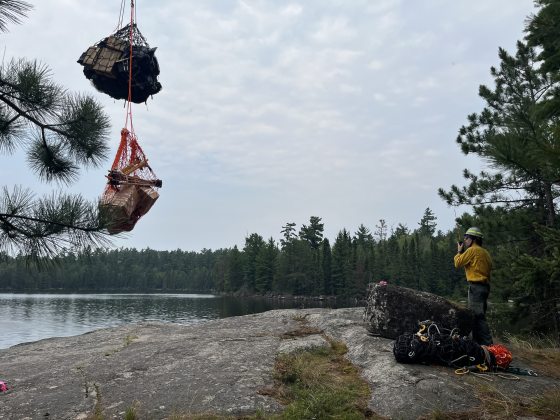
Squad Boss Wyatt Ray speaks to the helicopter pilot over the radio, coordinating and ensuring the safe release of sling loads into the sling site at our campsite on Home Lake. Photo by Erik Stefferud.
The 23-person crew were all representatives of the Commonwealth, with mostly members from the PA DCNR and a few employees from Natural Lands. The group itself was led by a Crew Boss and a Crew Boss Trainee, followed by three Squad Bosses. As one of the Squad Bosses, I was directly responsible for the safety and performance of the firefighters assigned to my squad. I made sure they understood the day's objectives, monitored how the work was progressing, communicated our status and concerns to the Crew Boss, and helped adjust our approach when conditions required it. In a remote environment where weather, terrain, fatigue, and fire behavior can quickly change, clear communication and sound judgment can help avoid or mitigate serious consequences.
An important part of the wildland fire fighting job is to construct firebreaks. This means that we cleared areas of woody debris and other flammable materials, providing a gap that creates a barrier that can slow or stop a fire. During this assignment, our crew constructed roughly seven miles of firebreaks to help keep the fire generally contained. We improved firebreaks along roads, created defensible lines along hiking trails, and leveraged bodies of water as natural barriers. This is hard, manual labor for hours which occurs after& hiking for miles with more than 30 pounds of gear on our backs.
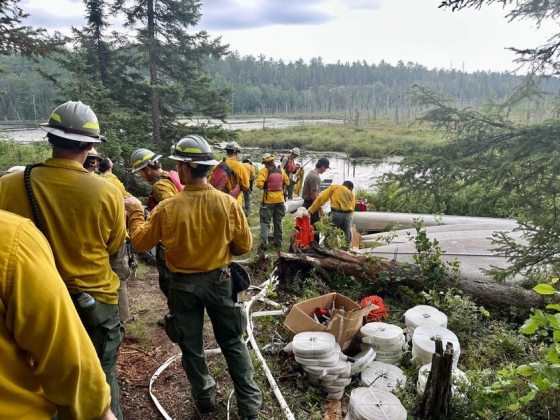
At the end of the 2.5-mile Angleworm Trail, our crew gets ready to paddle across the 2.5-mile Angleworm Lake toward our portage location over to Home Lake and our camp for the next five nights. Photo by Erik Stefferud.
What made this experience truly unique was that for the final five days, we carried canoes and all our gear, paddling and portaging across a series of lakes while constructing firebreaks along the way. One day, this looked like a 2.5-mile hike, a 2.5-mile paddle, a 1,000-foot portage carrying our canoes and gear overland between lakes (essentially over three football fields), and another half-mile paddle … all to reach our campsite. Because of how remote our location was, camping gear, food, fuel for chainsaws, and other supplies were flown in via helicopters and cargo nets, as it was faster and easier to transport it this way than by other modes.
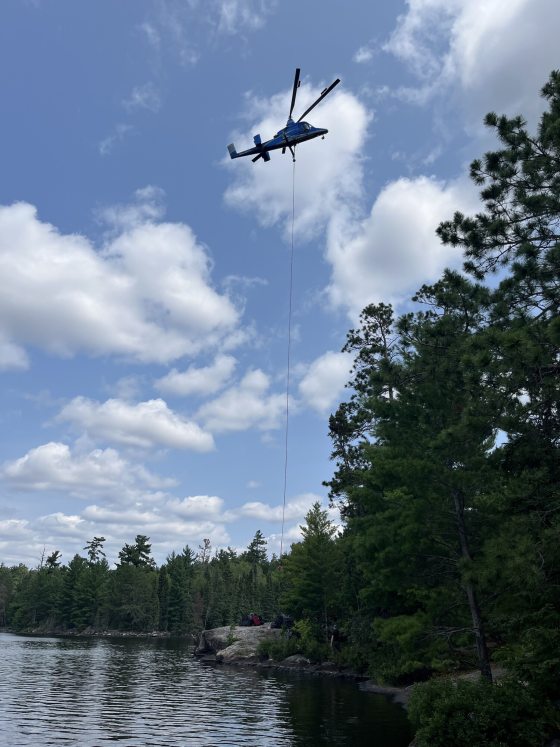
This KMAX helicopter was the specific type of helicopter that was used to fly all our gear back to Ely Minnesota Heli-tack Base at the completion of our fire assignment. The crew spent the morning packing cargo nets, ensuring each load was weighed and daisy chained together accordingly, ensuring a safe flight by the helicopter pilot. We would then meet up with our gear about five hours later once we paddled, portaged, and carried canoes back out to the Angleworm Trail Head . Photo by Erik Stefferud.
By the time our crew was demobilized, the fire covered roughly 33,000 acres. Through the combined efforts of our team and many others, it reached 54 percent containment. This meant that constructed firebreaks and natural barriers were in place around 54 percent of the fire’s perimeter and were expected to prevent further spread. Given that the fire was originally 28,000 acres and zero percent contained, this was a huge accomplishment.
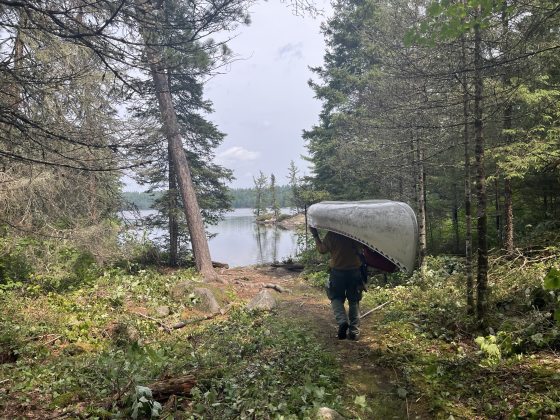
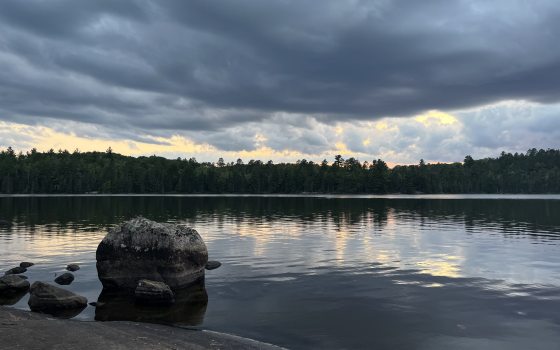
Here, I’m carrying my canoe across the Angleworm Lake/Home Lake Portage. At the far end of Home Lake is where we would camp for the next five nights, continuing to build fire breaks toward Gull Lake. Photo by Erik Stefferud.
Leadership takes on a different weight when the safety of a crew depends on the decisions you make. Over the years of wildland fire fighting, I’ve risen in ranks from a basic firefighter to a faller to a squad boss. An incredibly exciting development occurred at the end of this year’s trip; I was recommended to become a Crew Boss Trainee. This next step would expand my responsibility from leading one squad to helping coordinate the safety and work of the entire crew. The recommendation does not mean that I am already qualified for the role. It means that experienced leaders believe I am ready to begin the supervised training and evaluation required to reach that level. It feels incredible to be able to move up this professional ladder, gaining more responsibility and opportunity to lead in what can be life-or-death situations.
Part of being a leader is understanding what people need in order to continue working safely and effectively. For example, when we were clearing along a trail, we hit a riparian zone, or a zone that was along water, so it was wetter with different types and densities of plants. I realized that we didn’t need to remove as much brush from the area as we created our firebreak, because the fire would likely not behave the same as if it were a drier area. Since we were running chainsaws for more than 12 hours a day, this was a welcome opportunity for our crew to save energy. When the body and mind get tired, accidents happen. I communicated my recommendation to reduce the area of clearing to the Crew Boss and we adjusted what we were doing as a team.
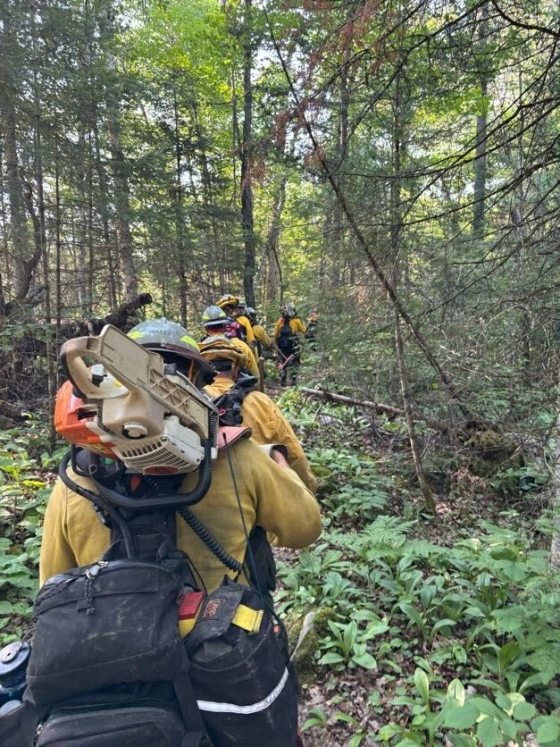
Our crew walks the Angleworm Trail to our assignment for the day. All gear, such as chainsaws and hand tools, had to be carried daily, in addition to at least 1 gallon of water, food, and other amenities that are needed when working a 12-hour shift miles off the road. Photo by Erik Stefferud.
These lessons carry directly from wildfire response to my daily work as Longwood’s Manager of Soils and Composting and my role in Longwood’s prescribed fire program. Wildfire suppression, prescribed fire, and soils and composting management have different purposes and operating conditions, but all are dynamic environments rooted in hard work and situational awareness, and all require safety precautions. Effective leadership in each setting requires adaptability, clear communication, shared effort, and a responsibility for the safety of others.
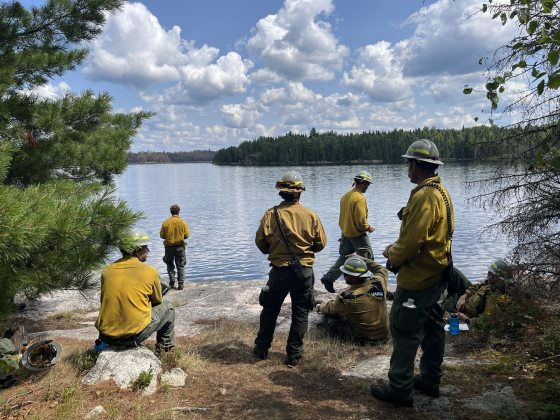
Members of the crew are shown after tying in fireline between Home Lake and Gull Lake. At the far end of the lake you can just make out the brown section of trees where the fire has previously gone through. Strategically, the intent was to keep all fire to the north of Gull Lake (to the left) using Gull Lake as a natural fire break while also using the line we had just created to keep fire to the north of the series of lake and portages we had been traveling and working through over previous days. Photo by Erik Stefferud.
When I think about Soils and Composting, my goal is to create a closed loop: returning green waste to a system so it can support plant growth and life. These materials change form and move through interconnected cycles rather than simply disappearing. Earth functions as a nearly closed system. Matter circulates among the air, water, soil, and living things. Because we share these systems, what happens in one ecosystem can affect people and landscapes far beyond it. This summer made that connection tangible. Smoke from fires burning across northern Minnesota and neighboring northwestern Ontario traveled east, degrading air quality hundreds of miles away, including here in our region.
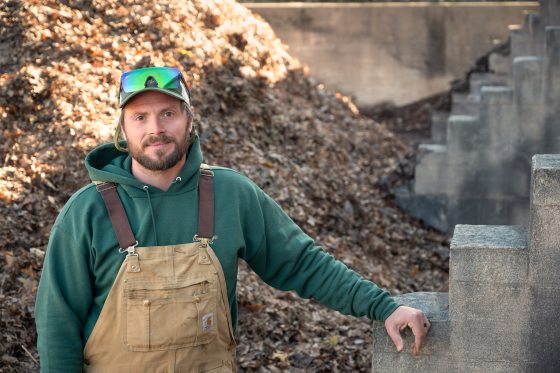
Longwood Soils and Composting Manager Erik Stefferud. Photo by William Hill.
The interconnection between systems is beyond organic material. These trips out west create a tremendous amount of opportunity here in our region. Since our Meadow Garden is managed with fire, our team needs a substantial amount of training before we conduct a burn. Each year, we train Professional Horticulture students on how to use fire effectively to maintain this ecosystem. Given my advancement to Squad Boss in 2022, I am now able to lead this training onsite. Our program and its students benefit from this. Each person we train helps with broadscale land stewardship, as they carry these skills and perspectives forward. As regional leaders, we also now share our expertise and efforts by participating in prescribed burns at other conservation-focused institutions nearby.
These trips provide valuable perspective on what land management looks like in other areas of the country. They also give me the opportunity to see firsthand how fire affects what is happening belowground—from soil conditions and nutrient cycling to erosion and ultimately how a landscape recovers. As a soils professional, I find that this adds another layer to how I think about the relationship between fire, soil health, and long-term landscape resilience at Longwood. Additionally, the more fire I see in a wide range of conditions, the more I can predict fire behavior. Knowledge gained by caring for one landscape can help protect another, and the experience returns home through people, partnerships, and practice.
Wildfire fighting experiences that require leaving loved ones and charging into the unknown are formative. It reminds me of a quote attributed to Nelson Mandela: “There is nothing like returning to a place that remains unchanged to find the ways in which you yourself have altered.”
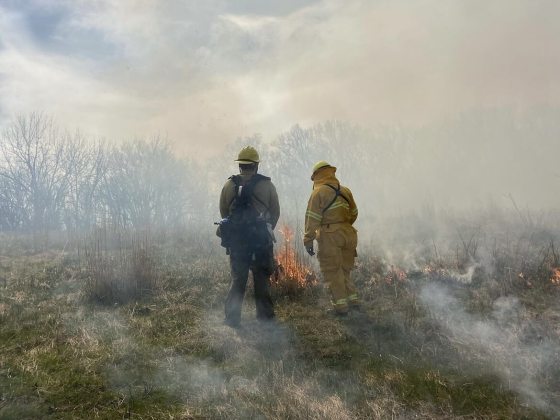
Longwood Soils and Compost Manager Erik Stefferud and Professional Horticulture Student Samantha Paine monitor an area for burn efficacy during 2024 training. Photo by Hattie Moore.
Journeys like this bring me home as a stronger leader, more aware of what it takes to care for the earth and more connected to the vast network of land stewards, past and present. These experiences remind me of the reciprocity inherent in stewardship. Our well-being depends on healthy ecosystems and our choices help determine how resilient these ecosystems can be. My experiences elsewhere help make Longwood’s program stronger, while the knowledge and values I develop at Longwood shape how I approach assignments across the country.
Expertise, relationships, and leadership gained by caring for one landscape or system can help protect another. Though sometimes made elsewhere, these investments, through interconnected cycles, always return home.
Editor’s note: Learn more about our controlled burns with this Science Series recording.