Pennsylvania is home to approximately 2,150 native plant species, of which about 350 are considered rare, threatened, or endangered in the state. Protecting this diversity requires many approaches, including seed banking. With support from a grant through Pennsylvania’s Wild Resource Conservation Program in 2024, Longwood Gardens recognized the unique opportunity to expand its existing seed bank and create the first conservation-focused seed bank in the state. Seed banks are an incredibly useful tool for conserving biodiversity. By safeguarding certain seeds in cool and dry conditions, we can protect both the species, and the genetic diversity encoded within them, for years. As our seed-banking efforts have grown, so too has our understanding. Here, we share some of the key insights and achievements since expanding our seed bank—with much more to come.
The past few years have yielded tremendous advances in both the genetic diversity and representation of our collections, but it has also inspired our research. While we continue to focus on plants critically imperiled in Pennsylvania (ranked S1 through NatureServe), we have expanded our work to include species imperiled or globally vulnerable (ranked G2 or G3 through NatureServe). As of October 2026, we have 241 accessions, or individually documented seed collections, consisting of approximately 82,000 seeds.
As the Director of Conservation Horticulture and Collections, part of my role is to work with our partners and serve as a plant explorer to search for these rare, threatened, and endangered plants. As different populations and individuals often have different genetics, we collect seeds from a range of sources to represent each species as broadly as possible. We study the best ways to store, propagate, and grow these plants, as doing so can help us in the future if we ever need to reintroduce a rare species back into the wild. We follow best practices for seed collection as outlined by the Center for Plant Conservation, in which we are a participating institution.
Working with rare and threatened species is often a puzzle. Not everything is known about them, and if you’ve spent time gardening, you know that not all seeds behave the same. As a scientist, I get to figure out the best ways to store different species’ seeds in a seed bank and how to get them to germinate and move through their life cycles. These collections are an invaluable tool in our efforts to conserve species, research germination and storage methods, and support a verdant future. Presently, our seed bank is supporting the following species: Kate’s mountain clover (Trifolium virginicum), mountain pimpernel (Taenidia montana), serpentine barren aster (Symphyotrichum depauperatum), and Appalachian Jacob’s-ladder (Polemonium vanbruntiae).
Kate’s mountain clover (Trifolium virginicum) is only known from a handful of locations in PA and is associated with specific shale deposits found in southcentral PA. It is a rare plant, and to our knowledge, it had not previously flowered in cultivation. As a member of the pea-family, this species has small, hard seeds that should adapt well to long-term seed bank conditions. However, it is also known to be difficult to grow. With plant conservation, it isn’t enough to get a seed to germinate. It needs to be able to move through its life cycles so it can produce its own seed. Here, we are working to understand what we need to do to propagate it for cultivation.
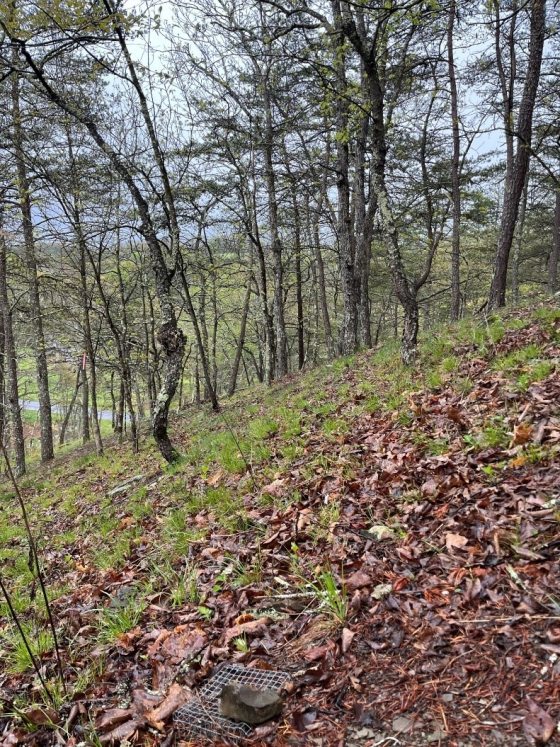
The shale barren habitat of Kate’s mountain clover in southcentral PA. Photo by Peter Zale.
So far, growing it in tall, narrow containers has had great results. Much to our surprise, a plant that has been difficult to bring through its full life cycle in cultivation flowered across nearly all of our trial plants! Given its unique habitat requirements in the wild, our next step will be to transplant them into a gravel surfaced raised bed to continue growing. This long-term trial will also help us determine the potential for using plants we cultivated at Longwood Gardens as a seed source, and explore its potential to be included in the Gardens.
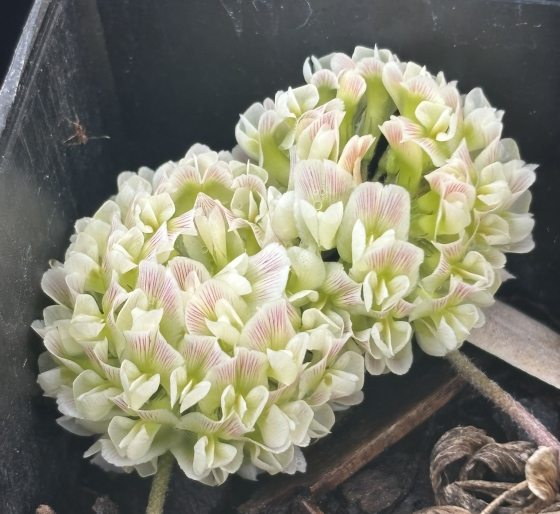
The flowers of Trifolium virginicum in April 2026 at Longwood Gardens. Photo by Peter Zale.
Mountain pimpernel (Taenidia montana) is a rare species only found in a very specific habitat, and it remains relatively unstudied regarding seed collection and seed germination. Compounding this issue, it has been a difficult species to obtain seed from, as attempts to collect it also revealed that it is not an especially prolific seed producer. In some cases, some plants only provided as few as three seeds! Partnerships are essential in this type of conservation work. Working with Cheyenne Moore, former PA Plant Conservation Alliance and now Section Chief with the Pennsylvania Department of Conservation and Natural Resources, we’ve been able to add numerous seeds to our seed bank. Her efforts show that seed production for this plant varies widely year-to-year. Through dedicated plant exploration, we’ve been able to supply enough seeds to initiate small germination trials. This species requires a combination of cold, moist conditions to germinate.
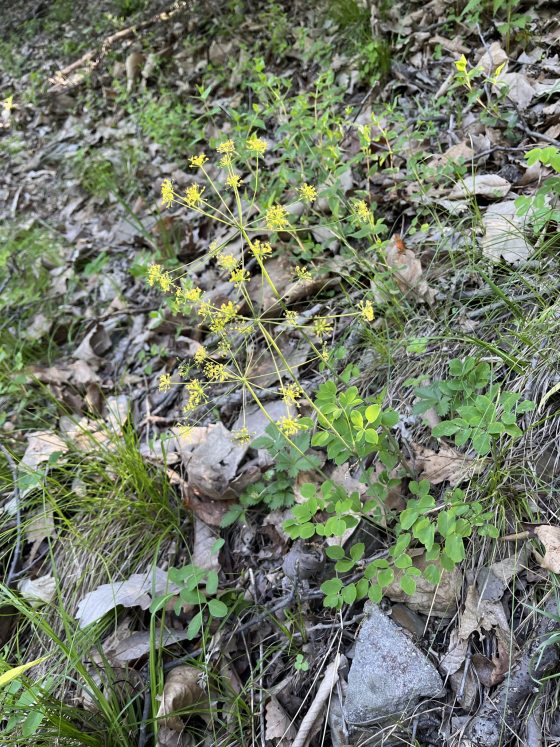
Mountain pimpernel flowers along a southcentral PA roadside in May 2023. Photo by Peter Zale.
In addition to increasing the number of seeds in our collection, we are testing a laboratory method called accelerated aging, which uses elevated temperature and humidity to speed up the aging process. By tracking how germination changes through this process, we hope to estimate the seeds’ storage life. This information helps seed bank managers decide when to retest collections and when to collect fresh seeds, so the banked seeds remain useful for future conservation work.
We are collecting additional species for the seed bank, including one of PA’s rarest species, the serpentine barren aster (Symphyotrichum depauperatum). Occurring primarily in the eastern serpentine barrens of PA and Maryland, with an outlying occurrence in North Carolina, its habitat faces threats. The species is now listed by NatureServe as G2 (globally imperiled) and S2 (imperiled) in PA. This modest species bears multitudes of white flowers in September and October.
Given that some of our local ecosystems used to be managed with fire, including the serpentine barrens, we hypothesized that serpentine barren aster seeds may need an element of fire to support germination. Smoke can sometimes trigger seeds to break dormancy, as it contains karrikins, a compound produced when plant materials burn. After we treated the seed by soaking it in a smoke water solution and counting germination for both the smoke treatment and the control treatment, the results were striking. Within just four days,more than half of the treated seed germinated, while none of the untreated seed germinated. Our team will continue this work, including assessing additional aster species to see if their seeds also interact with smoke. We will also test this treatment on other species endemic to the serpentine barrens to support conservation and population restoration.
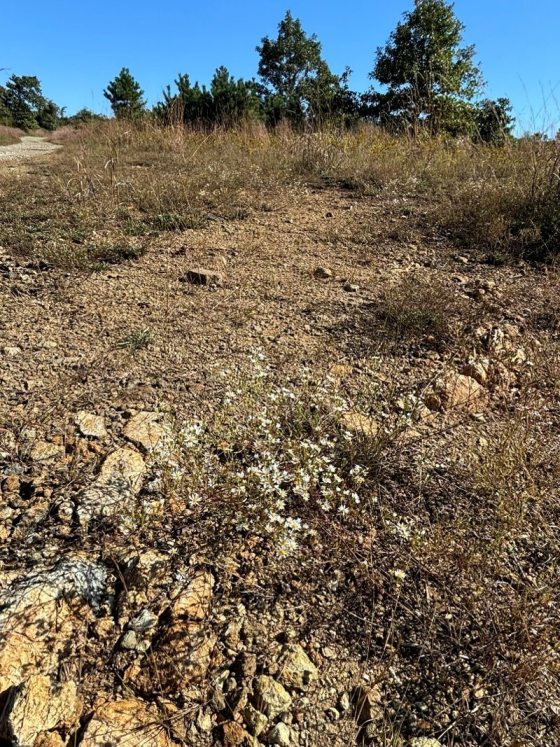
Serpentine barren aster growing in a southern Chester County serpentine barren. Photo by Peter Zale.
We are continuing our work with the endangered (NatureServe S1) and globally vulnerable (NatureServe G3G4) Appalachian Jacob’s-ladder (Polemonium vanbruntiae). There are only five known populations in the entire state. They are geographically isolated, and the populations are small. In one population, there is only a single plant present.
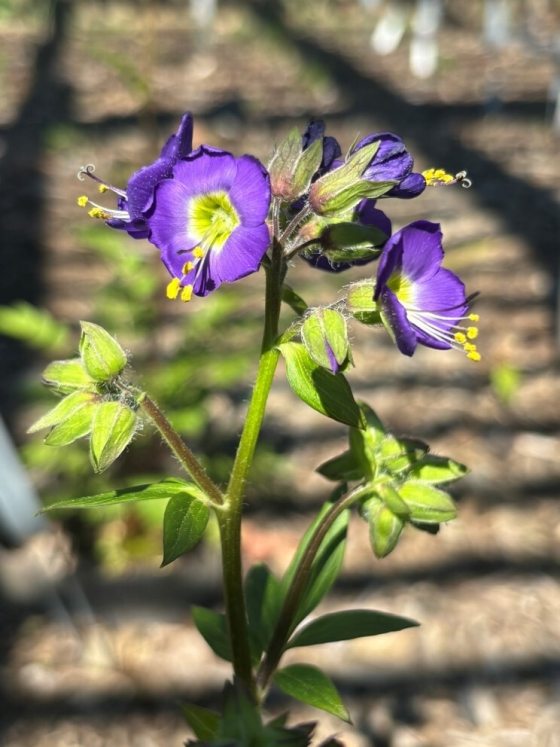
Appalachian Jacob’s-ladder (Polemonium vanbruntiae), growing in the Longwood Gardens research nursery. Photo by Peter Zale.
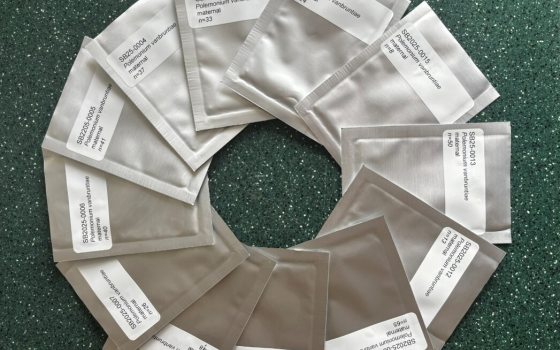
Our past work involved germinating seeds, growing the plant, and participating in planting it back into the wild. Currently, we are studying this plant for its seed banking potential. With effort, we now have seeds of four out of the five known PA populations, and we’ve also collected them over a period of years. This allows us to capture diversity over time. We will be studying how these seeds tolerate long-term storage.
Finally, we are developing protocols to use high-resolution macrophotography in our Seed Science Laboratory to study seeds in remarkable detail. This is especially valuable for tiny orchid seeds, some of which can be as small as 0.1 millimeter long. At 50× magnification, we can document differences in size, shape, and surface texture that may help distinguish species and compare seeds from different collections. Together, the images will form a visual catalog that documents the structure of seeds to support identification of rare and threatened plant species. This will support germination research and future conservation work, while revealing the seeds’ often-overlooked beauty. We look forward to sharing them as we refine our imaging process.
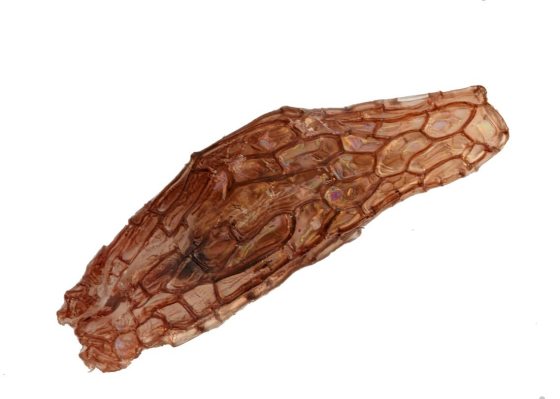
A prototype photo highlighting a 10-year-old seed of the tubercled rein orchid (Platanthera flava var. herbiola) at 50×. Photo by David Ward.
With our Seed Science Laboratory, growing partnerships, and our efforts focused by our Science Strategy, the future of the state’s first conservation seed bank is bright. Together, these projects show that preserving seeds is only the beginning. As we study what makes each species germinate, grow, and survive in storage, we will be advancing what is scientifically known and be able to contribute to global conservation. Some answers will come quickly; others make take years. With each accession of seeds, we strengthen our ability to protect rare plants, and all that depend on them, into the future.