Horticulture—the science and art of growing plants—is the foundation of Longwood Gardens and public gardens worldwide. More than just growing plants, horticulture encompasses a wide range of practices that take place in the field, greenhouse, nurseries, and laboratories, from seed collection, and storage, to propagation and tissue culture, and much more. At its core, horticulture is a multi-faceted discipline that demands skill, dedication, and passion to conserve plant diversity in the present and safeguard it for the future. Conservation horticulture takes this work further by applying these skills to the plants that need them most—those rare in cultivation and, especially, those declining in the wild. Here, ahead of Reverse the Red Day—a global movement and International Union for the Conservation of Nature initiative that encourages biodiversity conservation on a global scale—we share the latest in conservation horticulture at Longwood and what’s ahead.
Longwood Gardens has developed a conservation horticulture program over the last decade to help save plant diversity in our own backyard and around the globe. As one of Longwood’s key scientific focuses, conservation horticulture drives our efforts to protect global plant diversity through exploration, research, propagation, and knowledge‑sharing. Working with partners around the world, we preserve threatened plants, teach others our methods, and, when possible, showcase these species in our displays to inspire guests and share their stories.
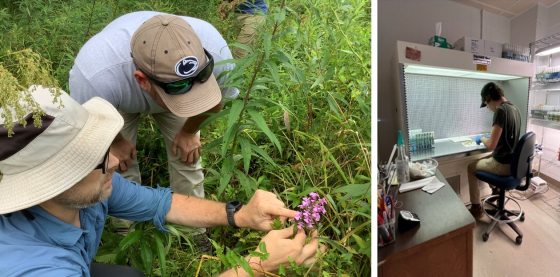
Left to right: Field assessment of rare plants in the wild is a critical part of successfully bringing them into cultivation. Our tissue culture laboratory is a sterile working space that makes our work with orchids possible. Photos provided by Peter Zale.
A significant aspect of conservation horticulture at Longwood is our ongoing commitment to orchid conservation. Few plants embody the urgency of conservation as clearly as orchids. Of the nearly 30,000 orchid species worldwide, it is estimated that nearly half of them are rare and declining in the wild. Organizations like the International Union for the Conservation of Nature (IUCN) track rare species and document them through red listing, a practice that helps direct conservation efforts through ranking and highlighting species that need help and directly impacts how resources and attention are channeled to the plants that need it most.
Orchids are a major part of Longwood’s identity and the orchids on display in the Orchid House are a guest favorite. Supporting that display, which features approximately 250 flowering plants rotating throughout the year, requires a permanent behind-the-scenes collection of approximately 5,500 plants! Some of these plants have been at Longwood for decades, highlighting the skill and dedication of the orchid growers over the last century.
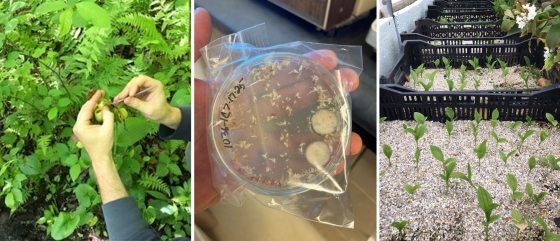
Hand-pollination of Cypripedium flowers ensures that they set seed. On the left, we work to germinate seeds of Cypripedium kentuckiense collected in July 2025 from a population in eastern Kentucky. Center, the tiny seeds of C. kentuckiense sit next to two discs of Russet potato, which provide a stimulatory effect on germination. On the right, seedlings of C. kentuckiense during their first year in the nursery. Photos provided by Peter Zale.
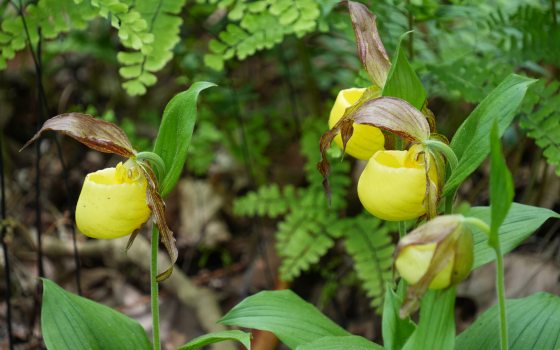
Stemming from our century-long commitment to growing orchids and the conservation needs of so many orchids, including those native to the US, we focus our efforts on native orchids. One of best examples we have is our work with Cypripedium kentuckiense, the Kentucky or southern lady’s slipper orchid.
Although there are an estimated 5,000 Cypripedium kentuckiense plants remaining the wild, 68 percent of them occur in only two of 10 known states. Furthermore, 43 percent of all populations have fewer than 10 individual plants. Seed set is rare or infrequent and it is estimated that fewer than 30 populations are reproductively viable. Despite its rarity and declining health in the wild, it is an exemplary garden plant and relatively easy to propagate, and it comes from a climate that is predicted to be representative of greater Philadelphia within the century.
What started as an effort to bring this species to the gardens to showcase its large flowers, which are among the largest of any orchid native to the US, has now grown into a comprehensive effort to collect seeds and propagate plants from all remaining populations across the species’ disjunct range. Here at Longwood, we are currently growing plants from nine populations in Georgia, Kentucky, Louisiana, Texas, and Virginia. This past year we worked to collect seeds from five populations of this species in Kentucky, which required careful coordination of hand-pollinating flowers and timing of seed collection. This resulted in hundreds, if not thousands, of seedlings now germinating and growing at the Gardens.
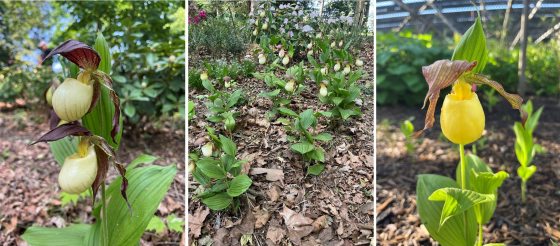
Cypripedium kentuckiense growing in Peirce’s Woods at Longwood Gardens. Last year plants propagated from seeds collected from the only known population in Virginia were planted in Peirce’s Woods and many have a distinctively yellow colored lip. You can see them flowering in late May. Photos by Peter Zale.
Our efforts to propagate and grow this species intersect with opportunities to participate in collaborative research with regional partners that help build towards a holistic understanding of this enigmatic species. In conjunction with the Office of Kentucky State Nature preserves, we recently increased our efforts to understand the role of mycorrhizal fungi—fungi that partner with plant roots, trading nutrients for sugars in a relationship that helps both survive and thrive—in shaping the distribution of this species in the wild and in cultivation.
For this project, we constructed and buried 45 fungus baits near the roots of lady’s slipper plants in six naturally occurring populations in southeastern Kentucky. These traps contain the dust-like seeds of the orchid, meant to attract a particular type or types of mycorrhizal fungi. All orchid seeds require this fungal association for germination and early seedling development but have yet to be characterized for the Kentucky lady’s slipper. These fungi are critical to the long-term survival and reproduction of the orchids and these efforts will help determine germination and seedling development under natural conditions. If the fungus is present in soil where we planted the fungus baits, we can harvest them, take the germinated seeds back to the lab, cultivate the seedlings in test tubes, isolate and identify the fungus using genetics, and use the fungi to attempt to propagate seeds in the lab. We will also maintain the fungus in our orchid fungal bank. All of this provides critical information for conservation efforts with this species and helps inform conservation efforts for other Cypripedium species.
During the fungus baiting activities we also collected seeds of Cypripedium kentuckiense for our conservation seed bank. Established in 2024, the seed bank is focused on the long-term storage of native plants of conservation concern, including US native orchids. We now have five Kentucky populations safely stewarded, but there is a lot to learn. Not all seeds respond to seed bank conditions in the same way. Some seeds can remain viable for centuries, others only weeks or months. One of our goals is to learn more about the shelf life of this species and several other native orchids through a series of germination tests over the coming years.
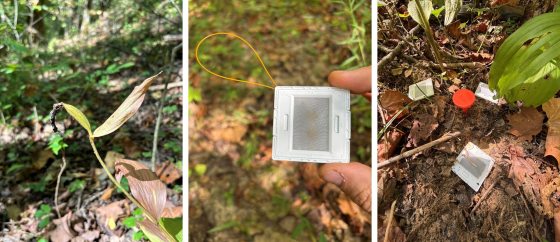
From left to right: The mature seed capsule of Cypripedium kentuckiense. These seeds were harvested and used for the fungus baits. A completed fungus bait. The seeds look like a brown stain on the nylon mesh. Fungus baits buried beneath mature Cypripedium plants. The Cypripedium leaf can be seen in the upper right of the image. Photos by Peter Zale.
As Cypripedium kentuckiense is listed by the IUCN as vulnerable (G3) and declining in the wild, and most populations occur in Arkansas and Kentucky, we will continue to work towards to ex situ conservation of all known populations in Kentucky. We’ll also expand our efforts to Arkansas in the coming years. Our efforts are intended to help reverse the red— to bring awareness, attention, and resources to the plants that need it most.
Our efforts with Cypripedum kentuckiense are among many rare and endangered species we are working with to demonstrate the necessity of horticulture in the conservation continuum … and we look forward to expanding and showcasing this work in the years to come.
Editor’s note: Learn more on how horticultural expertise fuels the preservation of rare and endangered species as Longwood Director of Conservation Horticulture & Collections Peter Zale, Ph.D. leads our February 21 Science Series: Cracking the Code on Endangered Plants, free with Gardens Admission. Learn more and register here.