Among the many captivating elements of Garden Glow is Seeking Light: Bonsai Illuminated, an installation that invites you to experience bonsai as you never have before. Created by Longwood Bonsai Curator Kevin Bielicki, this striking blacklight exhibit unveils the intricate beauty of eight dwarf junipers (Juniperus chinensis ‘Shimpaku’). More than 150 years old, these trees were originally collected from the rugged mountains of eastern Asia before being transformed into the living sculptures they are today. Carved and refined by nature’s forces, and with a contrast between living growth and deadwood that tells a story of survival, their forms take on an extraordinary new dimension under blacklight. What is sometimes subtle becomes dramatic, with each tree transformed into a glowing, otherworldly presence. Here, we share the process and the inspiration behind this mesmerizing display—and how you can experience its allure for yourself.
Prized for their natural character, aged appearance, and resilience, ‘Shimpaku’ junipers thrive at the very edge of survival. These trees were collected from mountain crevices, riverbanks, and rocky outcrops, where they were shaped by the conditions in which they grew, to be trained into bonsai. Central to their identity is the striking interplay between their living growth and their deadwood. In bonsai, deadwood refers to intentionally or naturally created areas of dead branch (jin) or trunk (shari) that highlight a tree’s endurance over time. When it comes to the eight trees on display, the deadwood is original to the tree, with some slight aesthetic alterations made over time.
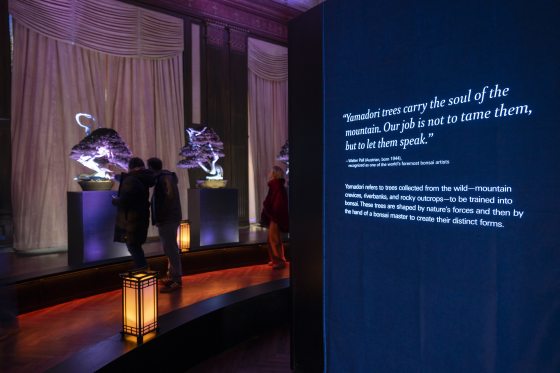
A peek inside Seeking Light: Bonsai Illuminated. Photo by Hank Davis.
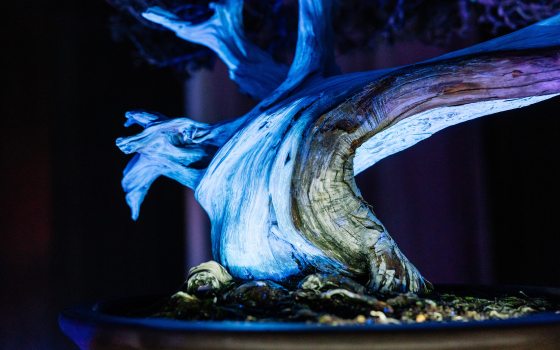
Jin often forms through wind, snow load, drought, or breakage, though it can also be shaped by the bonsai artist. Shari, or dead, barkless sections along the trunk or major limbs, integrates into the tree’s overall structure, exposing the living vein and heightening the contrast between active growth and weathered wood. Both jin and shari add texture, age, and character—and with Seeking Light: Bonsai Illuminated, we’re celebrating their presence. “With this display, we’re telling the story of the tree’s struggle,” shares Bielicki. “They got knocked around by the elements. But then they reoriented and they grew towards the light.”
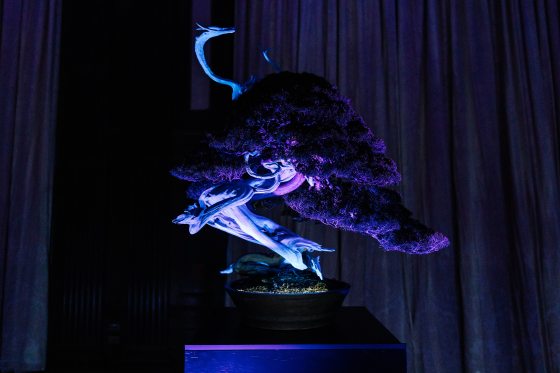
The illuminated deadwood reflects the idea of a spirit still thriving and becoming—still seeking beauty despite what it has endured. “These trees are very healthy and very well maintained,” shares Bielicki. “Yet they’ve come from environments where they have undergone so many different stresses.” Photo by Becca Mathias.
While deadwood is one of the most expressive parts of bonsai, without protection, it is also one of the most fragile. Therefore, we treat deadwood with lime sulfur. This traditional preservative protects the wood from moisture, fungi, and insects, bleaching it to a sun-weathered, silvery white appearance. It also helps define and preserve its fine details, ensuring its dramatic features and natural scars endure. In addition to the lime sulfur, we also treat deadwood with a wood hardener for its long-term protection.
Deadwood is part of a bonsai’s expression, enriching its presence and deepening its sense of time and resilience. Far from flaws, these features tell the story of the tree’s life. With Seeking Light: Bonsai Illuminated, that expression is further deepened through the use of blacklight. Bielicki and his team have meticulously painted each tree’s deadwood with a blacklight paint that’s perfectly safe for the tree and appears transparent without the use of blacklight. Under blacklight, however, it glows a beautiful shade of blue.
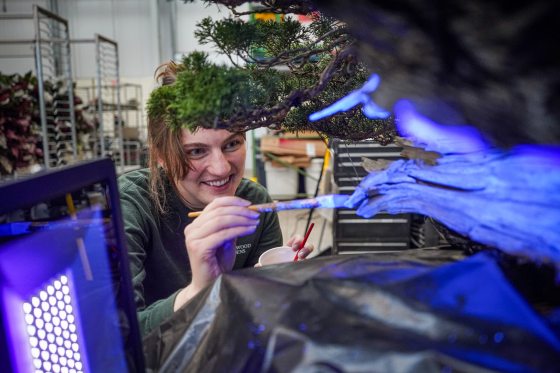
Longwood Professional Horticulture Program Student Ellie Schlehr paints the deadwood of one of the eight trees, using blacklight while doing so. Photo by Carol Gross.
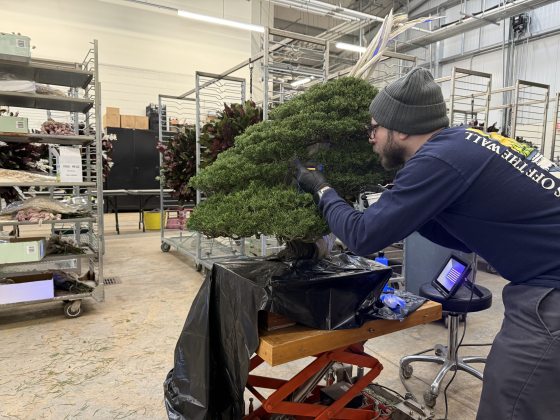
Eugene Balestriere from Deep Cut Bonsai helps with the blacklight painting. Photo by Kevin Bielicki.
Bielicki and his team painted the blacklight paint onto each tree in the same way they do lime sulfur; using a paintbrush and working from the top down. In most cases, they used one coat on the entire surface. “If we wanted to emphasize the gesture of a certain piece of deadwood, or if we wanted to create more of a push and pull from the tree’s foreground to background relationship, we enhanced that with a bit more depth through increased paint application,” shares Bielicki.
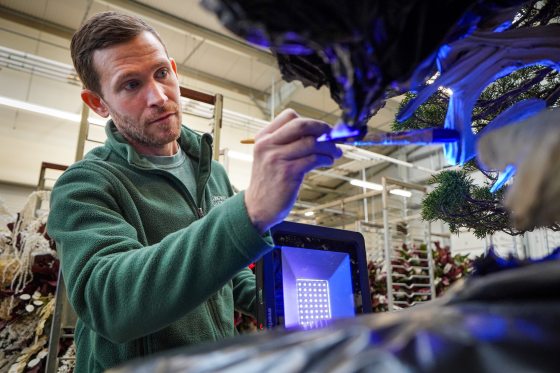
To Longwood Bonsai Curator Kevin Bielicki, “My hope is that guests feel the sacred presence of these trees, sensing how bonsai becomes a living meditation on balance, spirit, and renewal.” Photo by Carol Gross.
The eight junipers on view range in age from 150 to 380 years old, and are all on loan from The Kennett Collection, the finest and largest private collection of bonsai and bonsai-related objects outside of Asia. “These trees embody so much life and time and history,” shares Bielicki. “Each has a part that’s technically dead, but alive in its own way. We want the trees to be able to speak and to show them for the beautiful specimens that they are.”
Each of the eight trees reveals a distinct expression of deadwood. The oldest specimen, which is aged 380 years and has spent 40 years in training, features sharp jins and a tightly twisting shari that creates a sense of force and turbulence—typical of trees battered by wind, ice, and heavy snow. Another, aged 170 years of which 45 has been in training, features deadwood that sweeps outward in a long, gentle arc, creating a soft profile that suggests a long exposure to steady coastal winds. The youngest of the trees, aged 150 years and trained for 40, features a deep vertical fissure that divides the deadwood into two upright planes, giving the tree a bold shape. This form is often the result of a freeze crack or lightning strike later widened by weather.
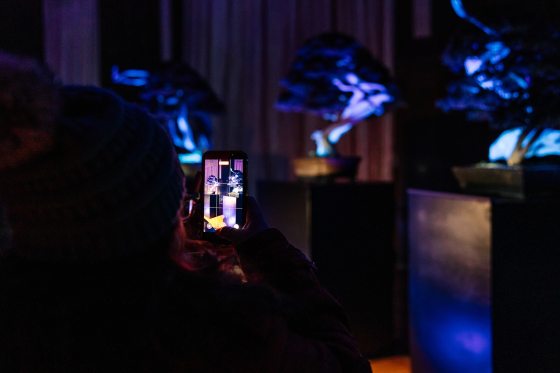
A guest stops to capture the beauty of Seeking Light: Bonsai Illuminated. Photo by Becca Mathias.
In the Music Room, each of the trees has been placed on its own pedestal, equally spaced and at equal heights, all with the intent for the guest to appreciate each as they navigate the space. “Under blacklight, the deadwood literally reaches toward the light,” shares Bielicki. “It becomes the part that shines.”
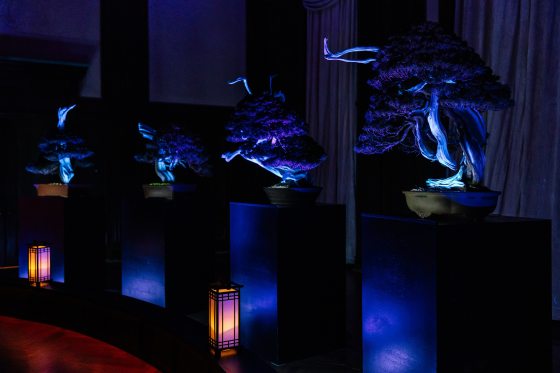
To Bielicki, “These luminous forms invite reflection on resilience, transformation, and the beauty that emerges from hardship.” Photo by Becca Mathias.
Adding to the experience is the use of the musical selection “Seeking Light and Beauty”, performed by the Capital University Conservatory of Music, Chapel Choir. Bielicki chose the selection for its sense of “yearning and uplift”, to create a sensory dialogue between sound and light. “Together, they form a single sensory expression,” shares Bielicki. “The glowing wood feels like what the music sounds like. The music sounds like what the trees are expressing. The result is a quiet, immersive meditation on endurance and transformation. It’s an invitation to notice the light that can emerge from even the most weathered places.”
Editor’s note: Experience Seeking Light: Bonsai Illuminated throughout Garden Glow, on view Friday, Saturday, and Sunday evenings through March 8. Secure your Garden Glow tickets now and be a part of this unfor