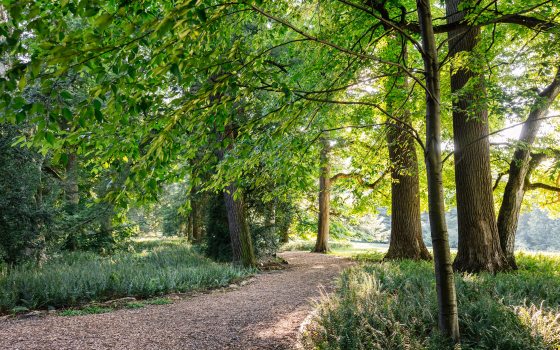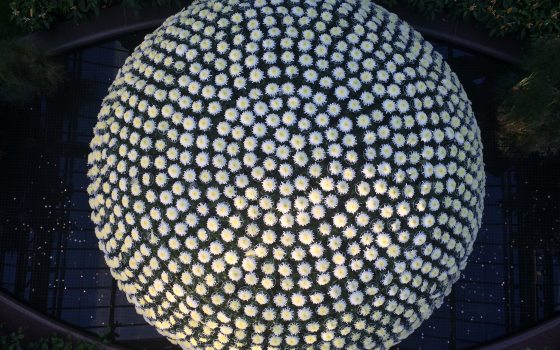
From the hanging baskets that welcome you to our conservatories to the sense of peace found while wandering the Meadow Garden, every natural experience at Longwood is shaped by design and guided by science. Woven into our legacy for more than three quarters of a century, science has informed how this place grows, evolves, and endures. On January 24, we officially launch our new Science Strategy, a framework guiding our science going forward. To understand where this strategy leads, it is essential to first look to where we have been—how science has shaped Longwood’s past, why a strategy matters now, and how we are activating this strategy into action.
From our beginning, we have been a scientific institution. In 1946, the amended certificate of incorporation for the Longwood Foundation gave the clear directive: “to engage in research, laboratory, and development work looking toward the improvement and advancement of the arts of horticulture and floriculture.” From this moment, we set forth on a journey to positively change the world through science.
By the mid-1950s, Longwood established a research division dedicated to the propagation, testing, and evaluation of new plants. In partnership with the US Department of Agriculture, Longwood launched a plant exploration program focused on the introduction of ornamental plants from around the world. Plants collected through this work were grown in Longwood’s experimental greenhouses, constructed between 1957 and 1959, and remain our research greenhouses today. These facilities supported both the introduction and experimental cultivation of new and little-known plants, as well as the improvement of promising selections through breeding and genetic study. Since we began the plant exploration program, we visited 51 countries and 13 states, with many more to come.
Science at Longwood has never been confined to laboratories or greenhouses alone. It is present across our natural areas, gardens, and conservatories, where horticultural and ecological sciences underpin the landscapes and displays that guests experience today. Every thriving collection, restored habitat, and carefully managed display reflects decades of scientific practice in action.
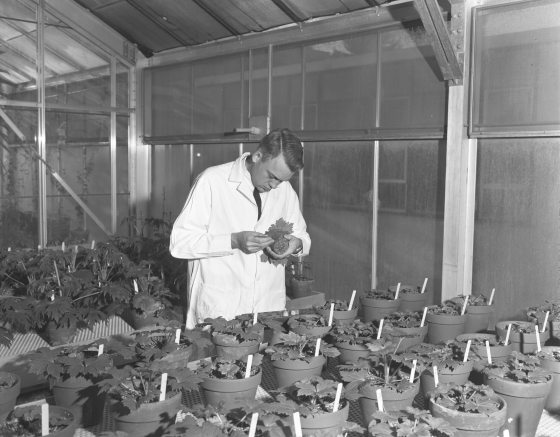
From our formal beginning, we have been actively pushing the boundary of what is possible through science. Here, renowned horticulturist Dr. Richard Lighty is hard at work studying plant specimens in 1963. Photo by Gottlieb Hampfler.
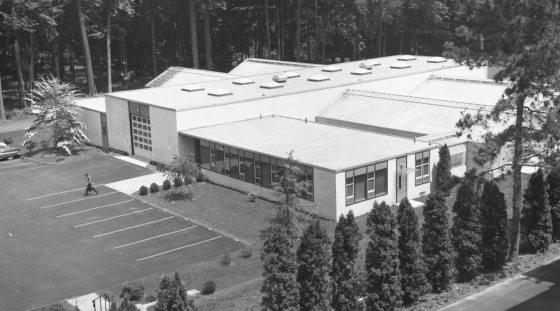
Longwood’s experimental greenhouses were built in the late 1950s, and they are still in use today. Currently they support our Conservation Horticulture and Collections team. Photo by Gottlieb Hampfler.
While Longwood’s commitment to science is deeply rooted in history, the challenges facing plants and landscapes today demand renewed focus and clarity. The present and future are increasingly shaped by uncertainty, from shifting ecosystems and biodiversity loss to emerging pests and diseases and a changing climate. At the same time, public gardens are increasingly looked to as places of trust, learning, and leadership. Longwood’s scale, expertise, and global reach position us to meet this moment with intention.
Longwood’s Science Strategy, aligned with the organization’s strategic plan, articulates how science advances our mission at this critical juncture through four scientific pillars: Conserve, Grow, Sustain, and Inspire. We conserve plants and ecosystems. We grow our plants, knowledge, and collaborations to increase our impact. We sustain our resources. We create beauty that inspires through connection, education, and experience.
These pillars come together through the work of our core Science teams: Conservation Horticulture and Collections, Land Stewardship and Ecology, Floriculture Production, Science Communications, and Soils and Composting.
Conserve
As one example of conservation, beyond what you see on display in our Orchid House, we are growing and protecting rare and threatened orchid species, both from our region and around the world. Through our Conservation Horticulture Program, or learning how to grow plants for the purpose of conserving them, we discover how to propagate these plants, many of which have never been grown by people before. We understand that if the more than 200 native orchid species in North America are going to be carried into the future, we need to coordinate efforts with other orchid-focused institutions across the country.
An example of these efforts includes our active collaboration in the Native Orchid Propagation for Sustainability (NOPS) project, a multi-institutional effort dedicated to securing the future of North America’s native orchids. Propagation protocols for orchids do not always translate across species or regions. Led by the North American Orchid Conservation Center, a program of the Smithsonian Environmental Research Center, NOPS brings together partners from across the continent to prioritize species based on conservation need, coordinate research efforts across institutions, and support the introduction of species into gardens or back into the wild.
Longwood Research Specialist Kevin Allen, who is a major contributor to these efforts, shares of the project: “Recreating the conditions that nature provides—whether in the lab or the greenhouse—can be complex, but it is also deeply rewarding. I especially value the collaborative nature of NOPS, which allows me to work with scientists across the country to compare observations, share expertise, and troubleshoot challenges together. That collective problem-solving approach is central to both the success of the project and to Longwood’s broader conservation mission.”
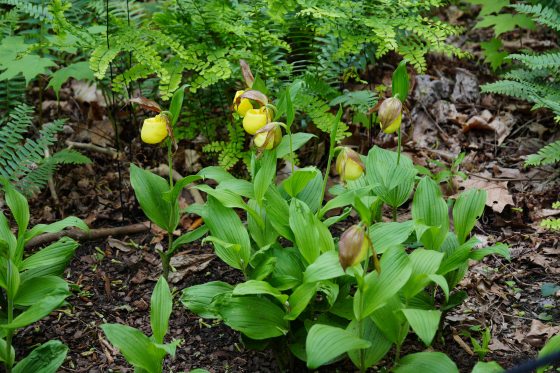
After years of study, we have refined methods to propagate and grow the globally vulnerable Kentucky lady’s slipper, Cypripedium kentuckiense, allowing this rare native orchid to thrive in our Gardens and be reintroduced into the wild to strengthen threatened populations. This work reflects our broader orchid conservation efforts, applying scientific expertise in partnership with institutions worldwide to protect rare orchids at both regional and global scales. Photo by Amy Simon Berg.
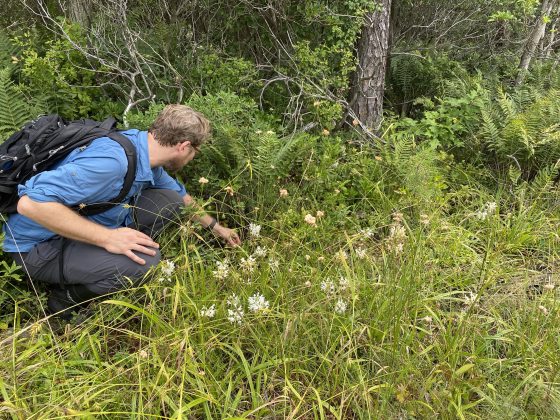
Longwood Director, Conservation Horticulture and Collections Peter Zale, Ph.D., on an orchid expedition in Luzerne County, PA, documents native orchid populations and gathers data and genetics that informs Longwood Gardens’ conservation, research, and habitat protection efforts. As part of the scientific method, we share the results from our work broadly to support orchid conservation. Photo by Matthew Ross.
Grow
We understand that to deliver the incredible displays of flowers and plants our guests see in a responsible way, we need to make sure our behind-the-scenes efforts are coordinated, efficient, and effective.
To improve our work, we’ve incorporated thoughtful data collection that is entered into our new Floriculture Database System. This plays an important role in how plants are grown and how future needs are planned by integrating information on plant production, labor, resource use, and environmental impacts into a single system years ahead of when the plants are showcased on display. By moving beyond anecdote and intuition, this system supports decisions grounded in observation, measurement, and long-term understanding.
Just as importantly, it helps preserve institutional knowledge, strengthen coordination across teams, and support thoughtful investments in plants, infrastructure, and operations. Longwood Procurement Coordinator Kerry Zwack works with teams to ensure materials and plant resources are sourced efficiently and aligned with production needs.
“I’m excited to continue growing and refining our system to better track stock plants, crops, and inventory,” shares Zwack. “Because we grow plants in such unique ways, having strong digital records is essential, especially as we trial and refine methods that aren’t done anywhere else.”
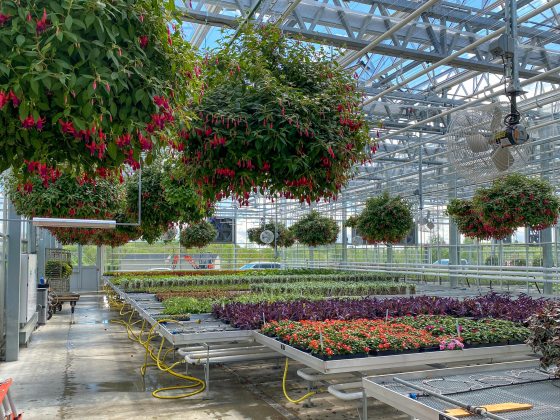
Inside Longwood’s production greenhouse, plants move through every stage of growth under carefully managed conditions. Behind the scenes, this work is coordinated through Longwood’s floriculture database, which brings together information on plant production, labor, resource use, and environmental impacts in one shared system. By pairing hands-on horticulture with clear, connected data, teams can plan more efficiently, track outcomes over time, and make informed decisions that support both beautiful displays and responsible use of resources. Photo by Eileen Tercha.
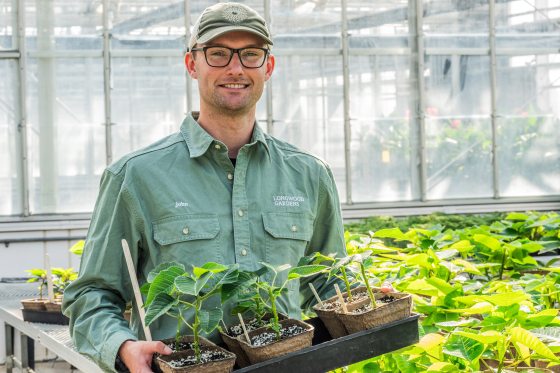
Science team members like Floriculture Production Manager John Leader propagate and care for plants at every stage in our greenhouses, contributing the observations that keep our data meaningful and accurate. The result is a system powered as much by people as by data—where individual actions in the greenhouse contribute to smarter, more coordinated decision-making across the Gardens. Photo by William Hill.
Sustain
Water shapes every landscape at Longwood Gardens, sparkling in fountains and flowing quietly through woodlands and meadows. Guided by a One Water approach, Longwood values every drop, using water thoughtfully and efficiently while seeking opportunities to reuse it in ways that honor legacy and mission. This commitment extends into the landscape through long-term stewardship and restoration efforts.
Through water sampling, GIS analysis, biodiversity studies, and restoration efforts, the Land Stewardship and Ecology team guides decisions that improve ecosystem health across Longwood’s 750+ acres of natural areas and beyond. This is especially important as Longwood sits on a ridge at the headwaters of several streams spanning two major regional watersheds: the Brandywine, which supplies drinking water to the city of Wilmington, and Red Clay Creek, which flows into the federally protected White Clay Creek Wild and Scenic River system.
One of the ways we protect our waterways is by planting trees along rivers, streams, lakes, or wetlands, otherwise known as riparian plantings. As Longwood Research Specialist Kristie Lane Anderson shares: “Planting trees along a stream is more than a beautiful choice. I like to think of our work of as being good neighbors. By doing this, and by monitoring the health of our waterways, we are not only improving our local streams, but we are generating an even greater positive impact on the people, plants, animals, and communities further along in the watershed.”
From 2023 to present day, the team has planted more than 4,000 trees and shrubs, increasing species diversity, both at Bennett’s Run, a tributary to the Brandywine and at Frolic Run in the Meadow Garden. These efforts shade streams—which creates cooler water temperatures for sensitive aquatic species—filter runoff and stormwater, reduce erosion and stabilize slopes, and create essential habitat for wildlife.
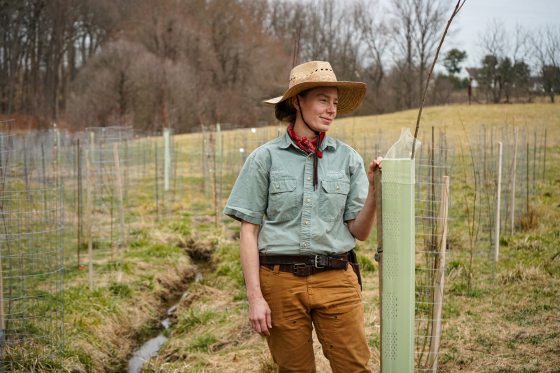
Longwood Senior Land Stewardship Technician Pandora Young inspects a young tree within a riparian restoration planting at Bennett’s Run. Their work supports streamside plantings along waterways like Frolic Run, and contributes to Longwood’s science-based One Water approach, strengthening habitat, improving water quality, and supporting resilient landscapes across the Gardens and the broader watershed. Photo by Carol Gross.
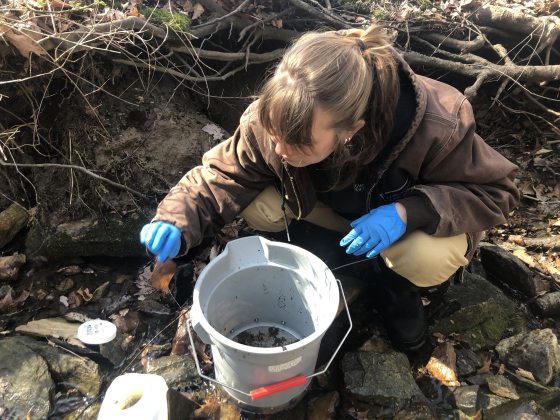
Longwood Land Stewardship and Ecology Technician Ellen Oordt surveys a stream for benthic macroinvertebrates—small aquatic organisms that serve as living indicators of water quality. By sampling what lives beneath the surface, the team gathers critical data that helps reveal stream health and guide Longwood’s ongoing water stewardship and restoration work. Photo by Kristie Lane Anderson.
Inspire
Inspiration at Longwood often begins with beauty, but it deepens through understanding the science behind the beauty. Our monthly, free with admission, Science Series invites our guests to take a deeper dive beyond what they see, offering a closer look at the research, and care that shape the Gardens. Through presentations by scientists, horticulturists, and conservation practitioners, the series opens a window into discoveries unfolding across Longwood and the broader scientific community.
Our Science Series is designed to show the engaging and exciting nature of science, connecting what guests experience in the landscape with the research and stewardship happening behind-the-scenes. Topics range from conserving rare plants to plant exploration stories to deep-dives into how we grow our plants in extraordinary ways, offering multiple entry points for curiosity and learning. In order to make this series more accessible, each presentation is available on our Science at Longwood - YouTube channel.
Our 2026 Science Series brings you presentations from Longwood Gardens staff, offering a closer look at some of the questions and topics we’re asked most often. Mark your calendars and learn directly from the experts shaping our work. For full details, visit our website.
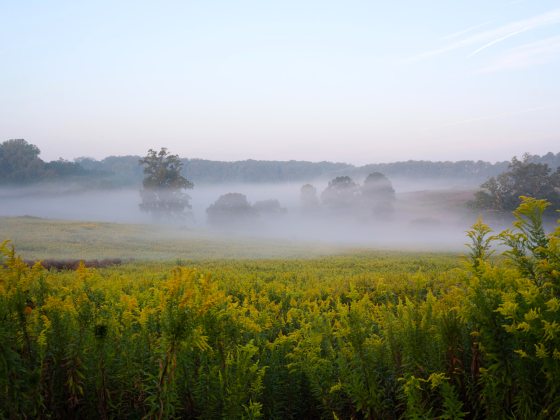
An example of how our work inspires is our 86-acre Meadow Garden, as healthy ecosystems are beautiful ecosystems. We strive to connect people with the inspirational, joyful, and restorative power of nature, as we use science to ensure a beautiful tomorrow. Photo by Daniel Traub.
The Future
Looking ahead, the Science Strategy embraces a simple truth: plants, together with the people who study, care for, and learn from them, are essential to addressing today’s challenges and shaping a more resilient future. Through science, Longwood Gardens is poised to deepen public understanding and actively contribute to meaningful solutions. This moment calls for action grounded in legacy and guided by vision. The Science Strategy charts that course forward, ensuring that Longwood continues to lead, inspire, and steward the beauty of tomorrow through the practice of science today.
Editor’s Note
Join us January 24 for Science in Action Day, a day of discovery as we celebrate the release of our Science Strategy and our passionate community of experts committed to deepening the world’s understanding of plants. Through engaging presentations, interactions with our scientists, and hands-on activities, gain insight into how our applied science is advancing beauty, biodiversity, and sustainability. Don’t miss our Panel Discussion: Longwood Science, Global Connections, Shared Purpose as Longwood Associate Vice President of Science Kate Santos, Ph.D. brings together leading voices from horticulture, conservation, ecology, and agriculture; registration is required for the panel discussion. Experience science in action with five interactive stations throughout our conservatories, designed for all ages; included with Gardens Admission. To support our efforts to sustainably cultivate, conserve, and steward our natural world, donate today.