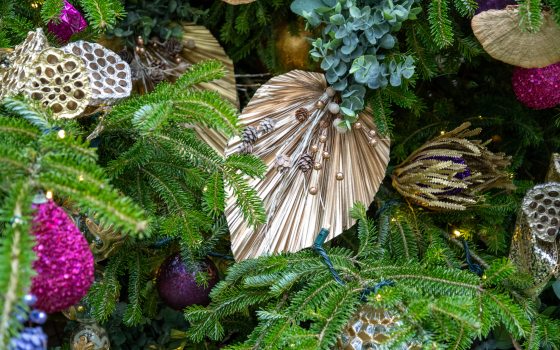
Longwood Gardens has long been a place where beauty and learning flourish side by side. Guests come to experience the sweeping conservatories and seasonal displays, but many also discover something deeper: a commitment to education that has shaped the Gardens for decades. This year, that commitment takes center stage in a new and dazzling way. For the first time, we’re highlighting our Continuing Education programs with a Christmas tree entirely designed and created by Continuing Education floral design students and volunteers. Displayed in the Peirce–du Pont House Conservatory, the tree is more than a festive decoration. It is a radiant expression of what Continuing Education represents: growth, creativity, and the transformative experience of learning.
The vision for this tree began with Longwood Floral Preparation Professional Janet Vibbert, who serves as a floral specialist for Continuing Education and as the creative director for the Christmas tree. Vibbert drew inspiration from Longwood’s newly evolved Floral Design Certificate—one of the Northeast’s most comprehensive and innovative floral design programs, and one that emphasizes the power of color theory and skilled craftsmanship. With those principles in mind, the team chose a dual-complement color palette that mixes deep purples and punchy raspberry hues with luminous metallics of gold, silver, and champagne. The palette aligns beautifully with the A Longwood Christmas display while staying true to the instructional foundations that Continuing Education students study throughout their coursework.
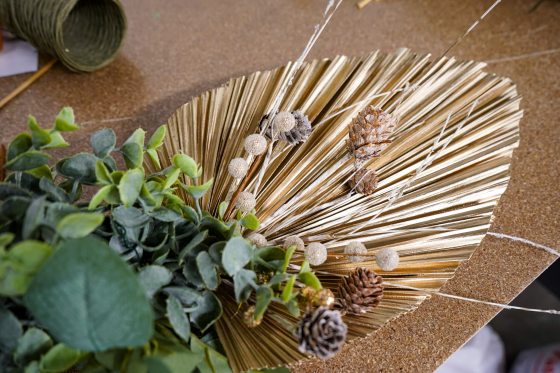
Natural elements like dried palms (Livistona chinensis) and pinecones bring texture and botanical interest to the tree’s design. Photo by Carol Gross.
For Vibbert, the goal was to take familiar botanical materials and elevate them into something unexpected. She saw the tree as a challenge to turn the ordinary into a true “wow” feature. To do that, she selected floral and natural elements commonly used in Continuing Education floral design courses. This ensured that the final display would not only be beautiful, but also a representation of the skills students learn in the classroom.
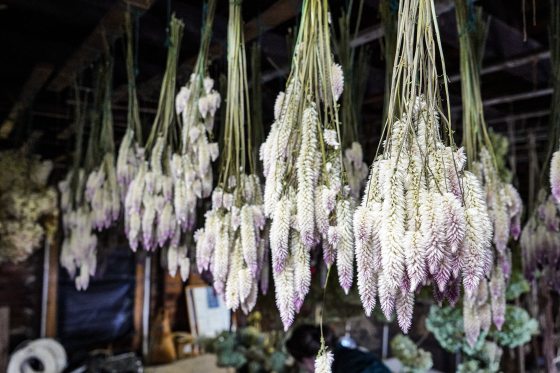
Celosia argentea (Spicata Group) was harvested and dried onsite to be used in miniature bouquet ornaments. Photo by Carol Gross.
The creation of the tree was a true team effort. Throughout the process, Vibbert and Continuing Education Manager Emerson Marine guided the creative and logistical aspects of the project. Volunteers Connie Schmidt, Sharon Mosenkis, and Rhea Doherty—each a Continuing Education floral volunteer and graduate of the Floral Design Certificate program—brought their classroom knowledge to life in the production and installation stages. For Vibbert, the collaboration was one of the most meaningful parts of the experience. “They are a fantastic group of ladies,” she shares. “It has been exciting to be behind the scenes working on the A Longwood Christmas display, even more so being able to design for a 14-foot tree!”
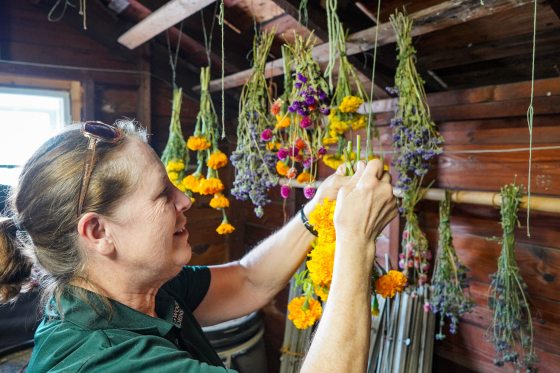
Floral Preparation Professional Janet Vibbert dries flowers harvested from the Idea Garden, used to create handmade ornaments. Photo by Carol Gross.
After first learning in June 2025 that they would be designing the showcase tree for the Peirce–du Pont House Conservatory, the team immediately began assembling ideas, developing concepts, and sketching possible design directions. Once their plan was approved, the months between August and October were dedicated to collecting materials and crafting more than 300 handmade floral and botanical elements.
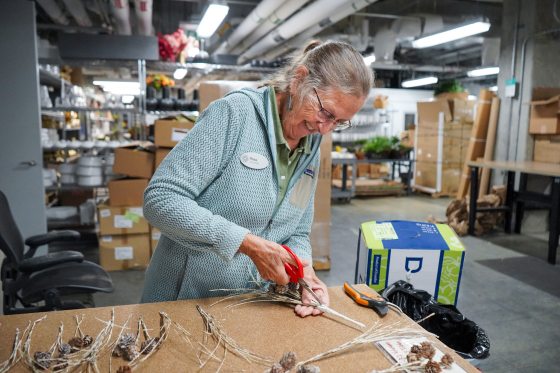
Volunteer Rhea Doherty creates decorative embellishments from natural materials to adorn the eucalyptus garland and lotus (Nelumbo) clusters. Photo by Carol Gross.
One of the most striking aspects of the tree’s design is the intricate botanical “jewelry” that adorns the branches. Mosenkis dedicated months to transforming hundreds of pinecones, seed pods, and other natural findings into shimmering ornaments. She sprayed pinecones in rich jewel tones and crafted delicate tippers and icicles using gold bullion wire, beads, lotus (Nelumbo) pods, sweetgum (Liquidambar styraciflua), and other natural materials. These ornaments are placed at the very tips of the branches, giving the tree a graceful, draped effect reminiscent of fine jewelry.
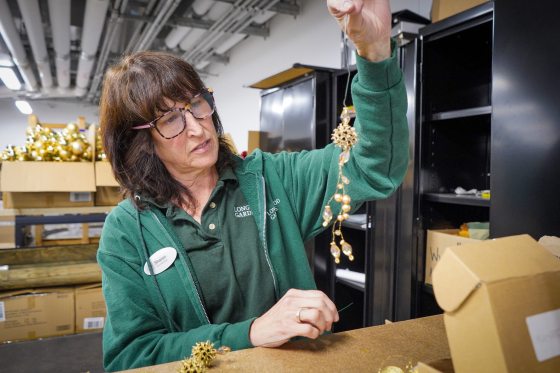
Volunteer Sharon Mosenkis admires her handmade “tipper” ornament assembled from sweetgum pods (Liquidambar styraciflua) and decorative beads. Photo by Carol Gross.
Reflecting on her process, Mosenkis shares, “I love how we’ve taken natural materials used in floral design and transformed them to fit into the gems and jewels theme.” Her work captures the spirit of the project: honoring nature while elevating it through thoughtful design.
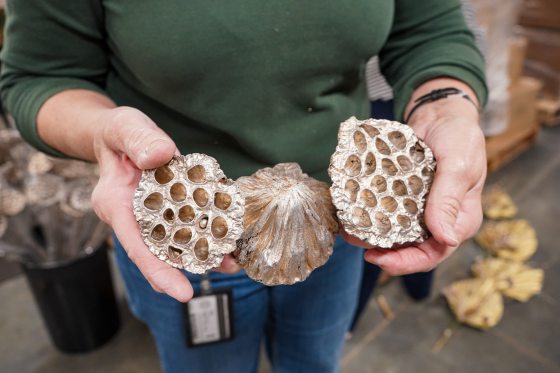
Dried lotus (Nelumbo) pods were painted in shades of gold and champagne and used throughout the tree’s design. Photo by Carol Gross.
While Mosenkis focused on ornamentation, Doherty and the floral team prepared dozens of miniature bouquets to nestle among the branches. Each tiny bouquet includes preserved miniature roses (Rosa), baby’s breath (Gypsophila paniculata), and other small botanicals. These bouquets add softness and detail, creating moments of delicate beauty throughout the display. They mingle with glittering glass ornaments, adding variety and depth to the tree’s texture.
Schmidt contributed one of the design’s most commanding features: sweeping eucalyptus garlands, each embellished with beads, pinecones, and shelf fungus painted in shades of gold and champagne. These garlands introduce movement, subtle shimmer, and a sense of luxury that balances the smaller details throughout the tree.
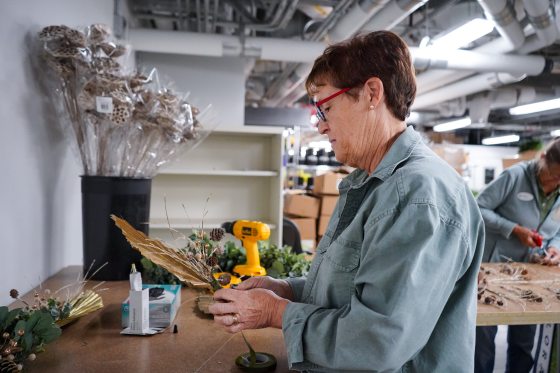
Volunteer Connie Schmidt works on her eucalyptus garland, embellishing it with dried palms (Livistona chinensis), pinecones, and lotus (Nelumbo) pods. Photo by Carol Gross.
The team also incorporated an array of natural ornaments, many of which were harvested from the Gardens and dried onsite. Metallic gold lotus pods, preserved flowers, and other botanicals are woven into the branches. Vibbert’s favorite among these elements are the preserved Protea (Banksia) flowers, which she painted in a vibrant, glittering purple. She notes that “they remind me of a gem that you would find on a ring”, an observation that reflects the blend of botanical beauty and jeweled elegance that defines the entire A Longwood Christmas display.
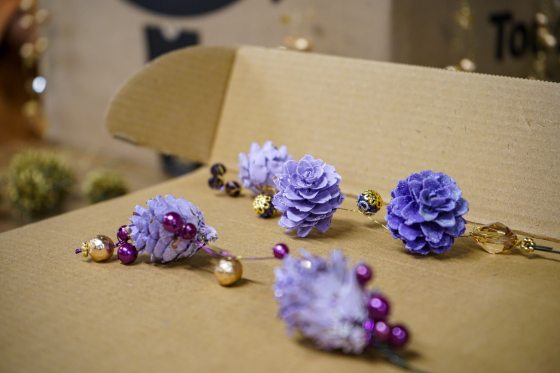
Pinecones were collected from the Gardens and painted in shades of purple to contrast with the deep green of the Fraser fir. Photo by Carol Gross.
The finished tree is a testament not only to creativity but also to the educational foundation that makes such artistry possible. Continuing Education has been a vital part of Longwood’s mission since the 1950s, and floral design education has been a central offering for many decades. This year marks an especially notable chapter with the launch of the revised Floral Design Certificate, a program structured to meet the needs of aspiring floral designers, working professionals seeking additional training, and flower lovers who simply enjoy creating beauty in their homes and communities.
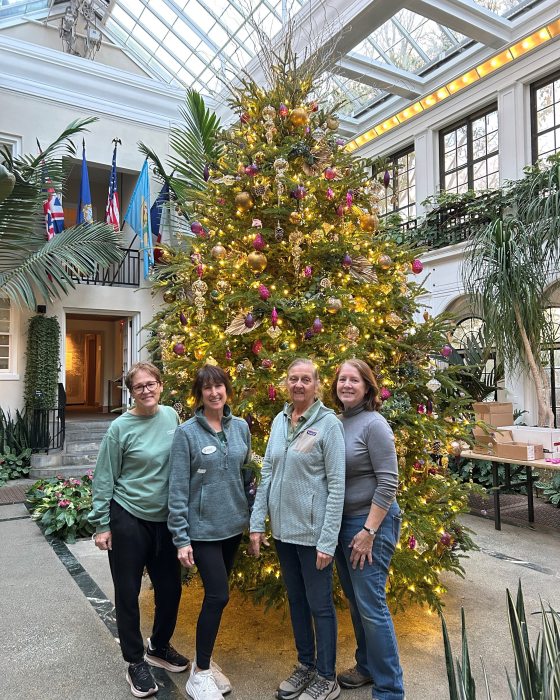
From left: Volunteers Connie Schmidt, Sharon Mosenkis, and Rhea Doherty and Floral Preparation Professional Janet Vibbert pause while decorating this year’s Peirce-du Pont House Christmas tree. Photo by Emerson Marine.
The program emphasizes both theory and practice. Students learn the mechanical skills needed to build stable, successful designs and the design principles required to make those arrangements visually compelling. They leave with a strong understanding of color, composition, and technique, along with the confidence to create floral designs for personal, professional, or community use.
Mosenkis, who contributed so significantly to this year’s tree, speaks highly of the program’s impact on her own journey. “The floral design classes sharpened my technique, and exposed me to design theory along with all the technical skills I needed to be a freelance floral designer,” she shares. Her experience reflects what many students discover through Continuing Education: that Longwood’s programs open doors, refine talent, and support meaningful creative growth.
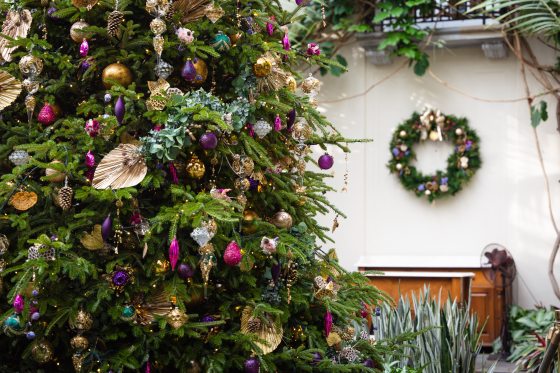
A close view of the finished tree. Photo by Holden Barnes.
The Peirce-du Pont House Conservatory tree beautifully embodies that transformative experience. Every element, from the glittering Protea (Banksia) flowers to the handcrafted eucalyptus garland, carries the touch of someone who learned, practiced, experimented, and created within Longwood’s educational community. Not only is it a stunning tree, but tells the story of students and volunteers who have turned their knowledge into art to be enjoyed and shared by all.
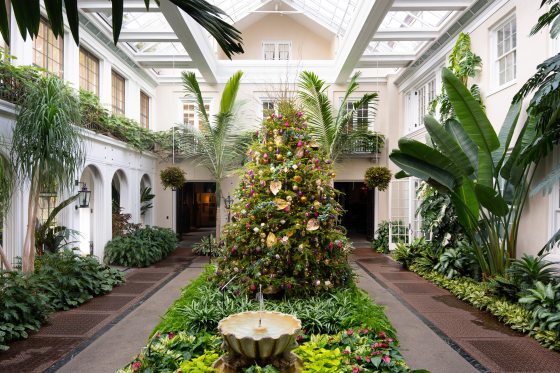
The Peirce-du Pont House Christmas tree awaits. Photo by Holden Barnes.
Thanks to the talents and the dedication of the Continuing Education floral team, the tree stands as a celebration of creativity, collaboration, and the joy of discovering new skills. It invites guests to see education not just as a process, but as a jewel—one that catches the light in unexpected ways and continues to sparkle long after the season ends.