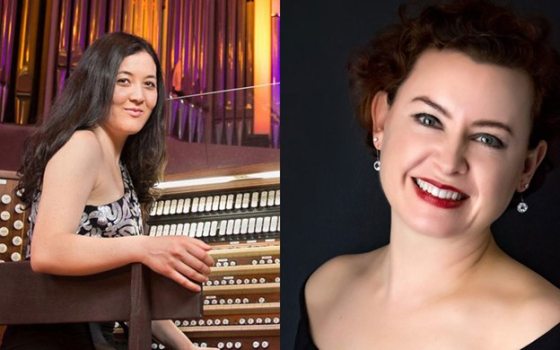
Musical brilliance awaits as two extraordinary organists soon make their Longwood debuts. One of America’s leading concert organists—as well as a Fulbright scholar and graduate of Juilliard and Yale University—Chelsea Chen is well-known for her unique blend of traditional organ repertoire, orchestral and piano transcriptions, and contemporary works. Soon after, internationally recognized performer and scholar—and the first American and first woman to record on the historic Fr. Willis organ at Hereford Cathedral—Damin Spritzer takes the stage with a program spanning Bach to Debussy, showcasing her remarkable range and interpretive depth. Read on to discover more about each performer, their artistic journey, and what they’re most excited to offer during their Longwood debuts.
Making her Longwood debut on March 4, Chelsea Chen currently serves as artist-in-residence at Emmanuel Presbyterian Church in Manhattan. Originally from San Diego, as a teenager Chen heard an “amazing” organ concert by Monte Maxwell at the Naval Academy in Annapolis. “I had taken a few organ lessons in San Diego at that point but was a much better pianist,” she shares. “That concert showed me how inspiring and majestic the organ could be. I completely changed my focus to the organ. Monte helped me prepare for college auditions just a couple years later.”
“All of my teachers from childhood on the piano, including Jane Bastien and Lori Bastien Vickers, and later on the organ, including Leslie Robb, Monte Maxwell, John Weaver, Paul Jacobs, and Thomas Murray, helped me become the artist I am,” shares Chen. “I’m proud to have studied with all of them.”
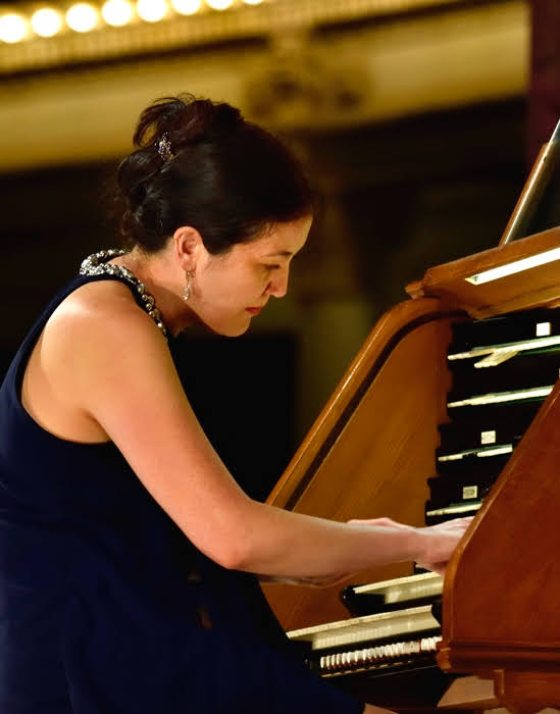
Organist Chelsea Chen performs at the Spreckels Organ Pavilion in San Diego, CA. Photo provided by Chelsea Chen.
Chen studied under Jacobs and Weaver at The Julliard School in New York, where she received her bachelor’s and master’s degrees. She also won the John Erskine Prize for academic and artistic achievement, awarded to one graduate per year. After college, she moved to Taiwan under a Fulbright scholarship, where she collected folk songs and wrote organ solo and chamber music. “I play a lot of my own compositions which are based on Asian folk songs as I think they are a unique part of the repertoire and reflect my own voice,” shares Chen.
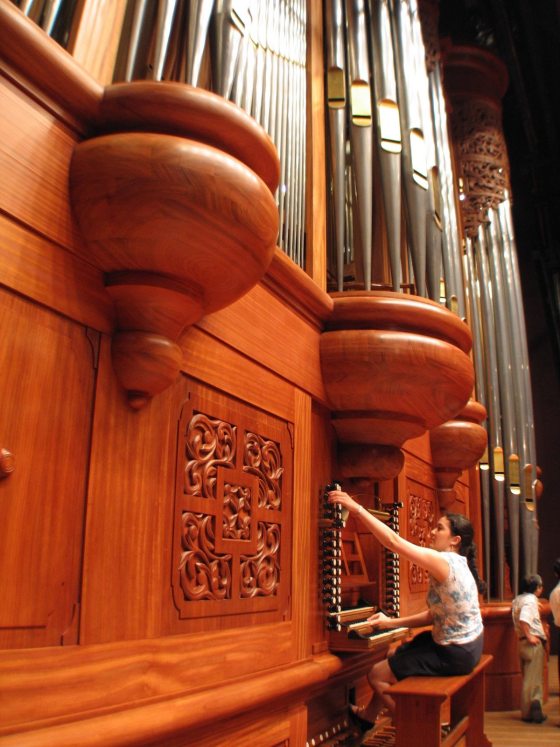
Organist Chelsea Chen, pictured at the National Concert Hall of Taiwan, as a 2006–2007 Fulbright Scholar. Photo provided by Chelsea Chen.
Chen returned to the US to study with Murray in the Artist Diploma program at Yale University and then served as Organist and Concert Series Director at Coral Ridge Presbyterian Church in Ft. Lauderdale. She has recorded multiple CDs and, committed to new music, has premiered works by composers throughout the world, performing to great acclaim such venues as Singapore’s Esplanade, Hong Kong’s Cultural Centre, and Los Angeles’ Disney Hall. “There is always an element of improvisation in every performance because it never goes exactly the same way,” she shares. “For one, the organ is different at each venue and so the sounds can vary dramatically,” shares Chen. “Sometimes I have to make changes to my interpretation during a performance itself, based on how the piece sounds.”
When reflecting on her upcoming performance at Longwood, Chen looks forward to playing the Longwood organ—at 10,010 pipes, it’s the largest Aeolian organ ever constructed in a residential setting. “It will be challenging as it always is to find the right sounds for each piece,” she shares. “The larger the organ, the more time it takes to figure it out and the Longwood Organ is not a small organ. Nonetheless, it’s a delight to put in that work because the end result is always so satisfying. For an orchestral organ like Longwood’s, I’m definitely performing pieces that are colorful and symphonic in nature.”
For her March 4 performance, Chen built that evening’s program around the Saint-Saëns Organ Symphony finale and Grieg’s “Peer Gynt Suite”, as well as her own pieces. “The Saint-Saëns and the Grieg are absolutely perfect for a large symphonic organ,” she shares. “I hope the audience will be inspired and delighted by the music I play. I want everyone to have a good time.”
Making her Longwood debut on April 23, Damin Spritzer serves as Area Chair and Associate Professor of Organ at the University of Oklahoma, Interim Director of Music and Organist for St. Thomas More University Parish in Norman, and Artist-in-Residence for Cathedral Arts at the Cathedral Church of Saint Matthew in Dallas. She received her doctorate from the University of North Texas, her Master of Music from the Eastman School of Music, and her Bachelor of Music from the Oberlin Conservatory of Music.
“My father used to play organ recordings for me when I was very little,” shares Spritzer. “In high school I won an American Guild of Organists scholarship for a year of free lessons. It changed the direction of my entire life.” Along the way, Spritzer has been inspired by organists such as Virgil Fox, E. Power Biggs, Diane Bish, Claire Coci, Pierre Cochereau, Marie-Madeleine Duruflé, and, as she shares, “my own organ teachers. My organ professors were enormously important to me, but I was also deeply influenced by my fellow students and colleagues when I was still in conservatory. Now, I am inspired by my students and their work and dreams as growing musicians. They are amazing.”
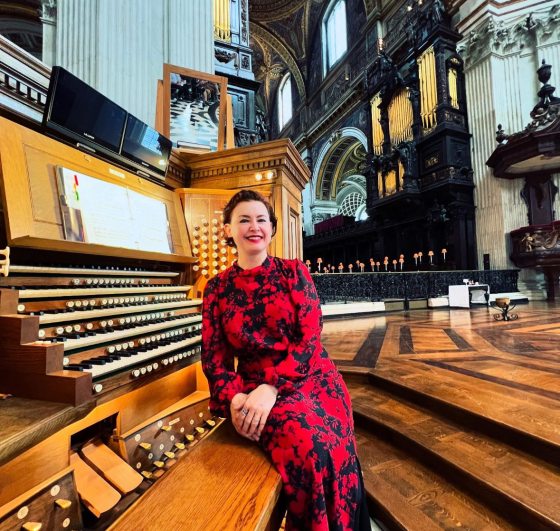
Organist Damin Spritzer at St. Paul’s Cathedral in London. Photo provided by Damin Spritzer.
Throughout her career, Spritzer has performed at historic churches and instruments throughout the world, including the Nicolaikirche in Leipzig, Germany; Sainte-Croix in Orléans, France; Igreja Nossa Senhora de Fátima and Paróquia Nossa Senhora da Boa Viagemin in Sao Paolo, Brazil; the La Verna Festival in Italy; performances with the Terra Sancta Festival in Israel; Wells Cathedral in England; and the Arctic Cathedral in Norway.
One of the most defining moments of her career just recently took place. “I have just returned from a two-month research sabbatical as a Visiting Fellow with Exter College at the University of Oxford in England,” shares Spritzer. “Being immersed in their archives and musical culture was revitalizing and so full of collegiality and awe. It was an intense and satisfying time.”
When Spritzer approaches interpreting works for the organ, she “looks at every piece through a series of lenses. What is the time period—Baroque? Romantic? Modern? What is the style—sweet? Dramatic? Playful? What do we know about the composer and the organs they played, and the occasions for which a certain piece might have been written,” she continues. “And then comes the delight of re-inventing each piece at each new organ. With 2,000 years of history to draw from for the evolution of the organ to its present forms, there is such a wealth of information to consider with every work and every composer.”
Looking towards her April 23 performance at Longwood, Spritzer also looks back to legacy. “It is an honor to have been invited to perform at Longwood, and I hold Longwood’s organ tradition and history of organists in the highest esteem,” she shares. “This organ and many who played it, including Firmen Swinnen, historically, loom large in my organ literature classes when we are discussing the history of the organ in the US in the 20th century,” she shares. “I am deeply mindful of that legacy and the expectations of the audiences who come to the Gardens and enjoy the music made at the Longwood Organ. It has such a marvelous and fascinating history, and such a compelling tradition of bringing audiences an absolute feast of organ works and organ transcriptions.”
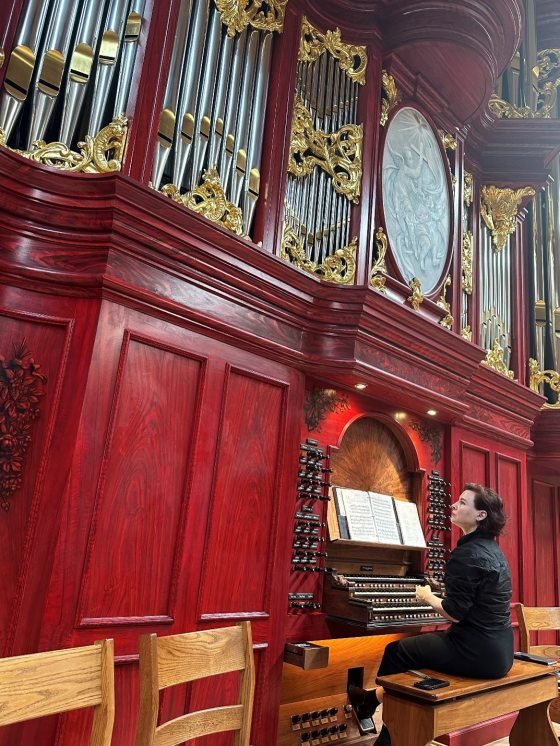
Organist Damin Spritzer at the Church of the Transfiguration in Dallas. Photo provided by Damin Spritzer.
For her April 23 performance, Spritzer looks forward to sharing transcriptions of works by Ralph Vaughan Williams and Claude Debussy, along with more traditional works by such composers as Sigfrid Kart-Elert and Charles Tournemire. “The Longwood Organ is so full of color, so I wanted to offer a variety program that reflects a number of different composers, styles, and—above all—truly uses as much of the vast organ as possible in timbres and registrations,” she shares. “As an artist it’s a pleasure to turn to music that I love but that not all organs can play. I feel very connected to the program, as well as the chance to bring new works to the audience because the instrument is so versatile and capable. It’s a truly symphonic organ so I hope to offer a symphonic program in every sense of the word.”
Editor’s note: Tickets are on sale now for both the March 4 performance by Chelsea Chen and April 23 performance by Damin Spitzer.