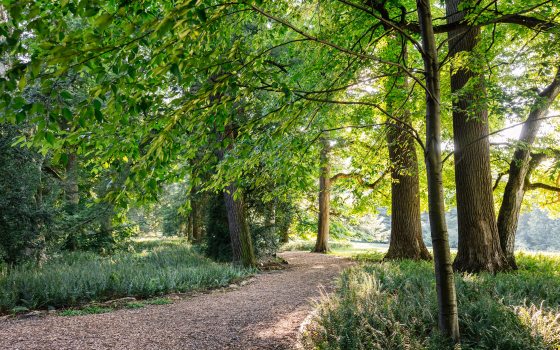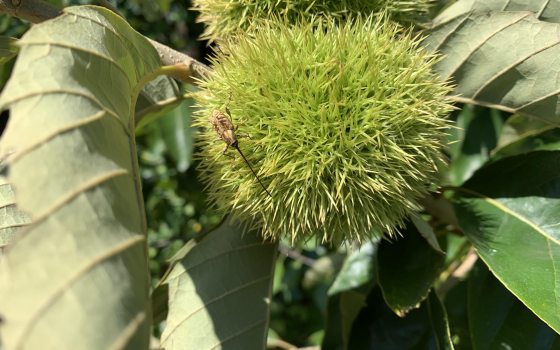
Nearly three years ago, a simple photograph challenged decades of scientific assumption. Neal Kelso, a guest at the Gardens, was walking through the northern edge of our Meadow Garden and paused beside one of our hybrid chestnut trees, finding an interesting insect perched among the spines of a chestnut burr—an insect that, until that moment, many believed no longer existed: the greater chestnut weevil (Curculio caryatrypes). Kelso took a photo of the insect and uploaded it to the iNaturalist app, used by a global community of observers and scientists. Weeks later, as Longwood Associate Vice President of Science, I received a voicemail from William Hill Professor of Biology at the University of Memphis, Dr. Duane McKenna, whose Ph.D. student Michael Charles had come across the iNaturalist observation. His message was calm but unmistakably energized. An observation posted from Longwood appeared to show a species long presumed extinct. What followed is a story about curiosity — but also about science, patience, persistence, and decades of thoughtful stewardship.
For generations, the greater chestnut weevil had declined and was thought to have disappeared alongside its host tree, the American chestnut (Castanea dentata). In the early 20th century, chestnut blight and Phytophthora root rot devastated American chestnut populations. An estimated four billion trees were lost. Eastern North American forests were reshaped, wildlife lost a critical food source, and entire ecological networks shifted following the decline of this once dominant tree species. The impact extended far beyond the regional flora. The greater chestnut weevil, highly specialized and closely tied to chestnuts, appeared to be one of the collateral losses.
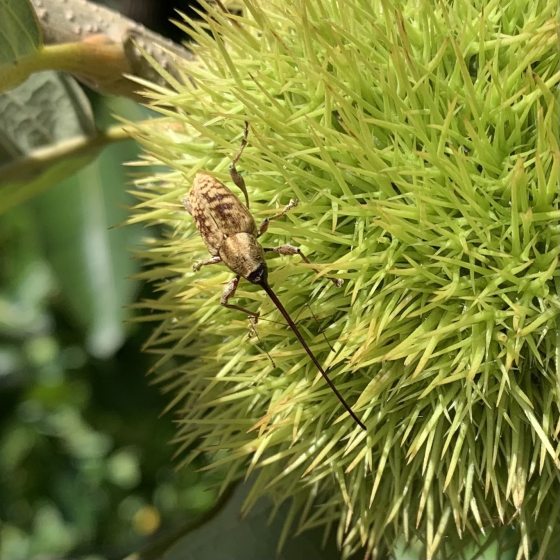
A closer view of the female greater chestnut weevil, photographed here in our Gardens; the first image of this blog post also shows this same specimen at Longwood. Both photos by Neal Kelso.
After extensive surveying of entomological collections, Dr. Robert Anderson of the Canadian Museum of Nature reported that the most recent confirmed specimen of the greater chestnut weevil was collected in 1997, with only a few additional specimens known from the last few decades of the 20th century. As of 2022, 25 years had passed without a verified sighting of the greater chestnut weevil. By then, the absence had begun to feel definitive. For Charles, a Ph.D. candidate in Dr. McKenna’s lab studying evolutionary relationships among weevils and co-author of this post, the greater chestnut weevil existed as historical specimens preserved in museum drawers and documented in the literature. He had first heard about it from Dr. McKenna, and its presumed extinction had become part of the scientific narrative framing his dissertation; that it was a species understood only through the documentation of his predecessors. But extinction is often inferred from absence. The absence of evidence, however, is not evidence of absence.
When the iNaturalist observation surfaced, it immediately caught Charles’s attention. The photograph appeared to show the unmistakable elongated rostrum of the female greater chestnut weevil—a remarkable adaptation that allows her to navigate between the spines of a chestnut burr and drill into the nut to lay eggs, structures shaped by millions of years of coevolution. Still, a photograph can be misleading. Several closely related weevil species share similar features, and definitive identification would require examining specimens directly. Careful not to let excitement outrun evidence, Charles wanted to see the tree at Longwood himself, collect samples, and confirm whether the insect was truly the greater chestnut weevil or a closely related species—prompting Dr. McKenna’s call to arrange a visit.
Several weeks after noticing the iNaturalist observation, Charles coincidentally attended an entomology conference in National Harbor, Maryland, at which point Dr. McKenna reached out via phone. After the phone call, Charles and Dr. McKenna decided it was best to follow up on this immediately, and Charles left the conference a day early and drove north to Longwood Gardens to examine the area firsthand and look for this elusive insect. Then-Longwood Associate Director of Land Stewardship & Ecology Lea Johnson and I met him at the gates and drove him to the cluster of hybrid chestnut trees, whose location had been pinned in the iNaturalist observation, and the search commenced. Opening chestnut burrs in the field is not delicate work. The spines are formidable, making leather gloves essential. A knife helped pry apart the husks. Eventually, practicality won out, and a nutcracker retrieved from home proved far more effective. Inside a few nuts he found small larvae, pale and indistinct.
To most of us, they could be any sort of insect. To Charles, they represented possibility. He collected some of the larvae and, following appropriate research protocols, transported them safely to Memphis for molecular identification. As the larvae would need to develop into adults before definitive morphological confirmation could occur, which could take up to two years, Charles sequenced the DNA and matched it to historical specimens. “It’s one thing to see a photo and suspect a species is still out there,” Charles reflects. “It’s another for it to be right in front of you. When I finally observed an adult and the molecular data confirmed the identification, it was a reminder that resilience and persistence often depend on conditions we may not fully recognize.”
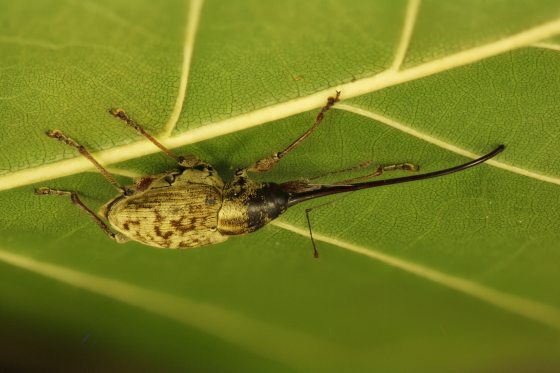
The greater chestnut weevil specimen collected by Charles, photographed in the lab. Photo by Michael Alexander Charles.
With this, it was certain the greater chestnut weevil was still extant and reproductive. Thanks to the iNaturalist observation, which formed one part of a scientific paper that was later published in the journal Current Biology, it was formally confirmed that a species presumed extinct had endured—not only at Longwood Gardens, but also in Delaware and Virginia.
The rediscovery raises an important question: Why here?
Longwood’s relationship with chestnuts spans nearly a century, long before restoration became a national priority. Chestnut blight impacted Longwood’s native groves of Castanea dentata in the early 1910s; archival photographs show attempts to treat the great chestnut trees in Peirce’s Park before they fully succumbed by 1915. Yet even as those original native trees were lost, the commitment to the genus did not disappear.
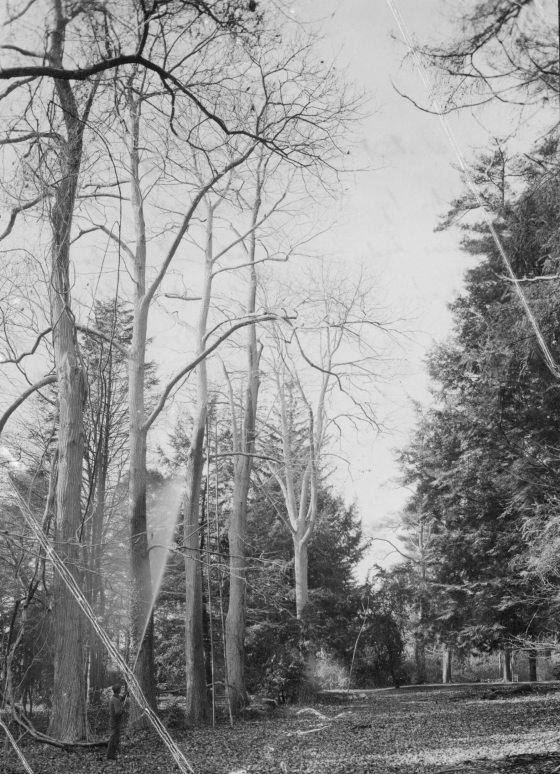
In this 1912 photograph, the gentleman in the bottom left corner is attempting to treat chestnut trees infected with blight. Unfortunately, no effective treatments were discovered, and the trees ultimately succumbed just a few years later.
In the 1930s, our founder Pierre S. du Pont planted hybrid chestnuts, Castanea × coudercii (a Japanese × European hybrid), in Oak Knoll. Though not American chestnut, these plantings ensured that chestnuts remained on the landscape during a period of widespread decline.
In 1961, Longwood entered a more experimental phase of stewardship when Longwood Director Dr. Russell Seibert accepted hybrid chestnuts from Dr. Haig Dermen of the USDA research station in Beltsville, Maryland. Approximately 20 of these experimental trees were planted in a back-of-house area south of what is now the horticulture equipment building. Three remain today, serving as living artifacts of mid-20th century breeding science.
As national restoration efforts accelerated in the 1980s, Longwood incorporated Castanea dentata × mollissima hybrids north of the Meadow Garden and began collaborating directly with The American Chestnut Foundation, receiving advanced backcross breeding lines for cooperative research. In 2018, we received seeds from some of the most advanced restoration lines—trees approximately seven-eighths Castanea dentata, bred to recover the stature of the historic American chestnut while carrying blight resistance—and planted them north of the Webb Farmhouse.
Across nearly a century, from du Pont’s early hybrids, to hybrid experimentation, to modern restoration backcrosses, chestnuts remained part of Longwood’s living landscape. And in doing so, they may have preserved more than a tree species.
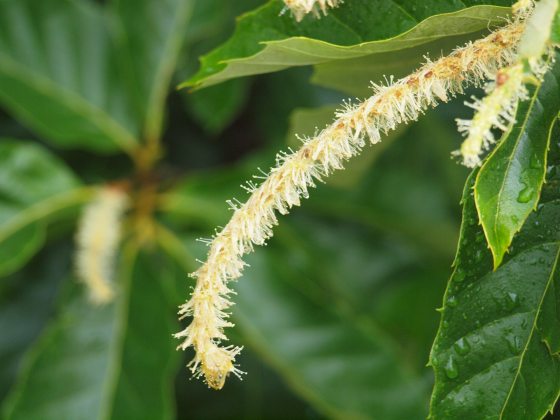
A close view of Castanea dentata × mollissima flowers, which appear in catkins in late spring to early summer. Chestnut trees are monoecious, producing male flowers toward the top of the catkin and female flowers at the base. Once pollinated, the female flowers develop into the edible chestnuts that mature in autumn. Photo by Nicole Havrilchak.
Botanic gardens are often celebrated for beauty and public experience, but beneath that lies something more foundational: the continuity of biodiversity. At their core, botanic gardens center on the preservation of plant diversity — safeguarding species, genetics, and lineages across generations. Yet plants do not exist in isolation. They anchor entire ecological networks. Living collections function as ecological infrastructure, maintaining host plants over decades and providing stability in landscapes where native populations may decline. In doing so, they sustain not only the plants themselves, but also the insects, birds, fungi, and other organisms whose survival depends upon them.
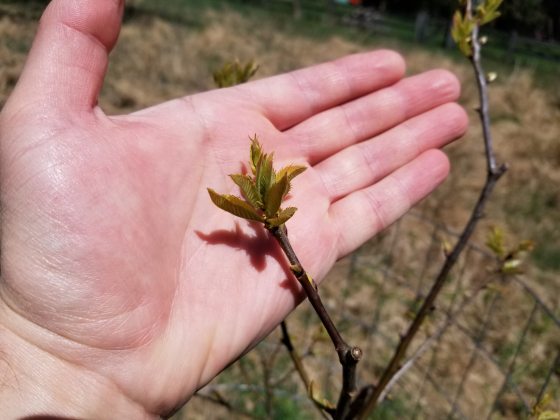
Young restoration chestnut seedlings leaf out after winter in 2021 north of the Webb Farmhouse. Approximately seven-eighths Castanea dentata, these trees represent advanced breeding efforts to restore the form of the historic American chestnut while carrying resistance to chestnut blight. Photo by Joseph Thomas.
The greater chestnut weevil appears to have persisted, at least in part, because chestnuts, whether hybrid, experimental, or restorative remained available. What was planted for breeding research, collections diversity, and conservation demonstration appears to also have functioned as refugia—stewardship sustained over time.
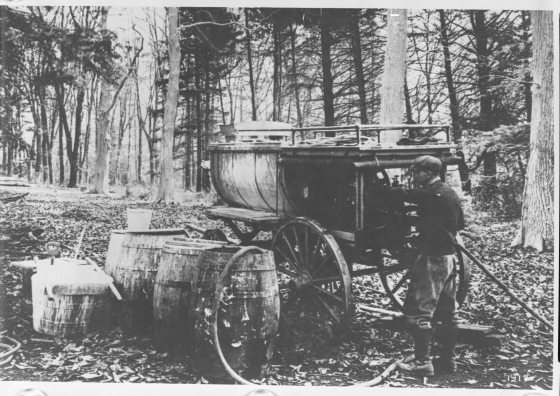
Horse-drawn spraying equipment deployed in 1912 in an effort to combat the devastating chestnut blight.
At Longwood, that stewardship reflects a broader scientific commitment: to conserve genetic and ecological diversity, to grow partnerships and applied research, to sustain resilient plant systems, and to inspire public engagement in science. The rediscovery of the greater chestnut weevil sits at the intersection of all four.
None of this would have unfolded without iNaturalist. Since its launch in 2008, the platform has grown into one of the world’s largest biodiversity monitoring tools, fueled by community scientists documenting the species they encounter. Neal’s photograph reshaped scientific understanding, bridging the gap between a meadow path and a research laboratory. In an era when biodiversity loss can feel abstract and overwhelming, platforms like iNaturalist remind us that observations still matter and that discovery is not confined to institutions alone.
It is also important to clarify that the greater chestnut weevil did not cause the decline of the American chestnut. The devastation of the tree resulted from introduced pathogens—chestnut blight and Phytophthora root rot—not from native insects with which it coevolved for millions of years. The weevil is not a villain. It is a survivor.
This rediscovery reminds us how interconnected our living world truly is. The loss of one species can reverberate widely, yet even after profound ecological disruption, some threads endure. What made this possible was not a single moment, but time: decades of planting, experimenting, stewarding, and refusing to let chestnuts disappear from the landscape entirely. This commitment continues today. As new threats emerge and impact native tree populations, Longwood remains deeply committed to safeguarding species such as our native ash (Fraxinus) and American beech (Fagus grandiflora)— preserving these living sentinels not only for their own sake, but for the intricate communities they support.
Conservation is rarely dramatic in the moment. It is patient, incremental, and often subtle. Yet over time, that patience preserves possibility. The greater chestnut weevil reminds us that disappearance is not always the end of the story—and that careful stewardship, scientific curiosity, and open collaboration can reveal resilience we did not know remained.