In gardens, science evolves our understanding, and with it, the way we see the plants that define our landscapes. Some plants once valued for their beauty are now also recognized for their ecological impact as invasive species. At Longwood Gardens, this situation is not theoretical; it is a lived reality within select areas of our cultivated landscape, including Paulownia Allée (est. 1937) and the Wisteria Garden (est. 1977). These spaces, and the plants that define them, are deeply tied to our history and to the vision of our founder, Pierre S. du Pont, and they continue to shape how guests experience our Gardens. They also require us to consider how we care for these spaces today, balancing their historical significance and legacy with our responsibility to manage ecological risk. As we prepare to celebrate Native Species Day on May 16, in this post we address one of the most frequently asked questions we receive in our Gardens: why do we have plants that fall within the invasive category here at Longwood?
The design vision for Paulownia Allée was for Paulownia tomentosa trees to form a grand entry to the recently built, larger than life conservatories opened to the public in 1921. The allée serves as one of the primary entry and exit points for the Gardens, the trees guiding guests beneath a tunnel of arching branches and framing a wide walkway lined with benches. In spring, lavender blooms emerge along the branches, appearing almost suspended in the air.
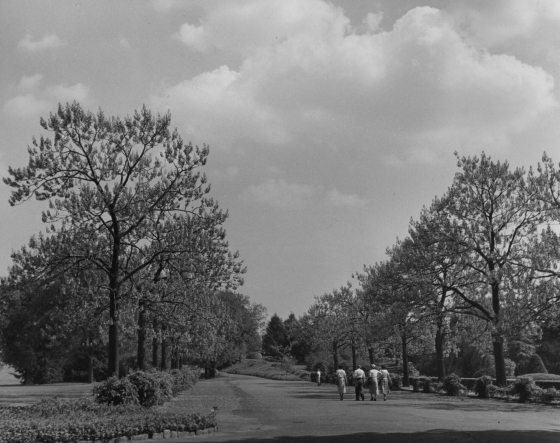
Paulownia Allée in 1950. Photo by Gottlieb Hampfler.
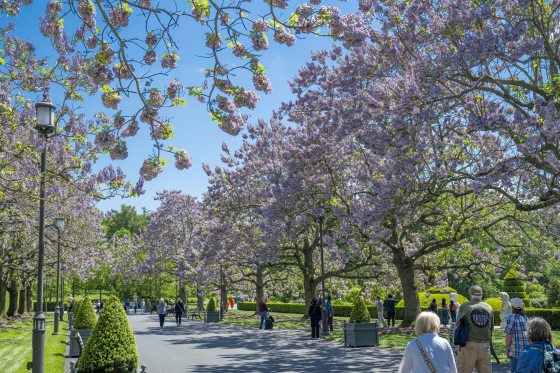
Paulownia Allée in 2024. Photo by Hank Davis.
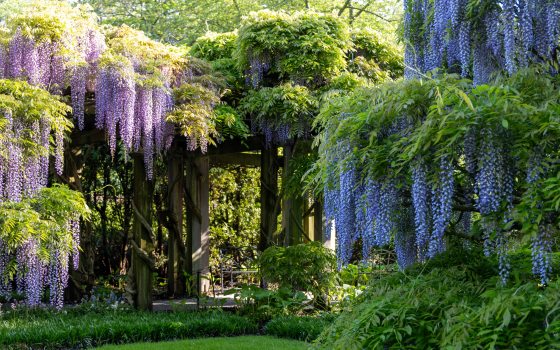
The Wisteria Garden offers a deliberate contrast. More secluded and less traversed, it is an intimate retreat—a quiet, almost hidden space where time slows beneath the cascading flowers, sculpted vines, and filtered light of Wisteria floribunda. Together, these spaces reflect a juxtaposition in garden design: the interplay between movement and pause, and openness and enclosure. Paulownia Allée invites passage and anticipation, while the Wisteria Garden offers refuge and reflection.
There is a long-standing connection between people and these plants. Cultivated in China for generations, Paulownia tomentosa is valued for its wood, association with tradition, and presence in cultural landscapes. Another long-celebrated plant, Wisteria floribunda is trained, shaped, and admired for its expressive form. These are plants that people have carried with them across time and geography, drawn to their beauty and architecture in framing natural spaces.
That same attraction is part of what brought these plants into gardens like ours, and many others. Pierre S. du Pont had a particular affinity for both wisteria and paulownia, planting multiple species of wisteria—both native and Asian—and incorporating paulownia already present on the landscape more intentionally into the garden. The Wisteria Garden, designed by Thomas Church, was a nod to the love of wisteria from our founder. These plant selections and the garden spaces they defined helped shape the identity of Longwood as a collection of gardens and horticultural experience. Our understanding, however, around the ecological impact of these plants as being invasive has evolved since their installation.
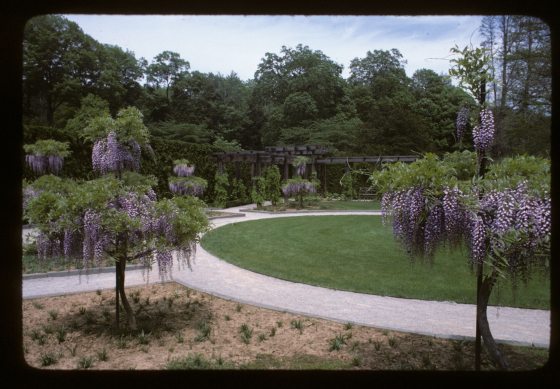
The Wisteria Garden in 1978, two years after its design by Thomas Church.
The United States Department of Agriculture defines an invasive species as one that is non-native to a region and has been shown to cause environmental, economic, or human health harm. Both conditions must be met.
This distinction is important. Not all non-native plants are invasive, and it is very common for gardens (public and private) to include a blend of native and non-native plants and when thoughtfully managed, can provide meaningful ecological value. The Royal Horticultural Society recently highlighted that well-managed gardens can function as biodiversity hotspots, places with a high level of plant diversity, and support a wide range of wildlife species and ecological interactions*. Gardens are not separate from ecological systems. They are part of them.
Gardens also play a critical role as global biodiversity refuges, conserving both locally native plants and globally rare and endangered species. By maintaining collections—or groups of plants that are intentionally gathered, documented, and cared for—of at-risk plants across multiple institutions, gardens help reduce the risk of extinction and contribute to the long-term preservation of plant diversity. Within this context, the coexistence of native and non-native plants in gardens is both intentional and essential. Gardens routinely bring together species from different regions to support conservation, research, and education.
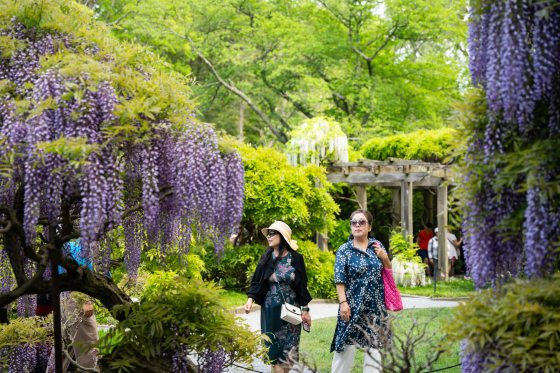
The Wisteria Garden in 2025. Photo by Holden Barnes.
Nonetheless, some non-native plants found in gardens do cause harm and are therefore classified as invasive. In some cases, even a relatively low abundance of an invasive species can have a disproportionate ecological impact—requiring ongoing management, or in some instances, fundamentally shaping how gardens are designed and stewarded. For this reason, invasive species are taken very seriously by gardens, including Longwood Gardens. This distinction is based on observation and research, where certain species have demonstrated the ability to move beyond cultivation, spread aggressively, and disrupt surrounding ecosystems. Paulownia tomentosa, for example, readily colonizes disturbed sites such as roadsides and forest edges, forming dense stands that can outcompete native vegetation. Similarly, Wisteria floribunda species can overcome trees and shrubs, shading out native plants and altering forest structure. These characteristics are what place them within the category of invasive species.
While the plants themselves have not fundamentally changed since they were selected for our Gardens, our understanding of how they behave and our classification of them as invasive has. Climate change adds another layer to this evolving understanding. Paulownia, for example, flowers on old wood, meaning it blooms from buds that formed the year before and must survive the winter to open in spring. Historically, periodic freezing winters limited flowering and seed production by causing the buds to abort before they could flower. As winters become milder, buds are less likely to be damaged by extreme cold, increasing the frequency of flowering—and, in turn, the potential for seed dispersal. More consistent flowering not only makes these trees more visible in the landscape but also increases their capacity to spread. More broadly, climate change may influence how invasive traits are expressed across plant species, requiring increased monitoring and management.
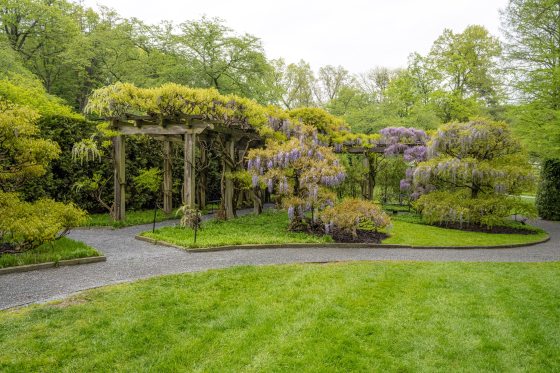
Wisteria floribunda in the Wisteria Garden. Photo by Eileen Tercha.
Longwood’s Living Plant Collections Policy defines how we select, manage, and care for our plants, and sets clear standards around invasive species. We work to prevent the introduction of invasive species and to reduce or eliminate them where they exist. Any non-native plants introduced into the Gardens undergo rigorous evaluation and trialing. We follow national codes of conduct and participate in the Public Gardens as Sentinels network, collaborating with peer institutions to monitor and respond to emerging risks. Across the Gardens and natural areas, we actively manage more than 80 invasive plant species to maintain a balanced and biodiverse system. In most cases, invasive plants are removed or excluded entirely, as explored in a recent Ecological Landscape Alliance article written by Longwood Land Stewardship and Ecology Technician Ellen Oordt.
The paulownia and wisteria described here are exceptions. They have been retained following careful review by Horticulture leadership because of their historic and design significance, and only under conditions where their spread can be actively controlled. This is not passive preservation. It is active, ongoing management. These plants are contained within highly cultivated landscapes, supported by a team of skilled horticulturists and continuous monitoring by experts. Wisteria vines are pruned extensively each year to maintain their form and prevent movement into adjacent landscapes. Paulownia seedlings dispersed by wildlife are routinely scouted and removed.
This brings us to a question without a simple answer. If we know these plants are invasive, and they require additional work to manage, why do they remain?
The answer is not absolute. These plants are part of designed spaces. They are controlled to prevent spread. They serve as part of cultural history, as the living legacy of our founder. They are part of how people experience and connect with place. Their removal would represent an experiential and historical loss. We are navigating this situation with intention—balancing ecological responsibility, long-term stewardship, and garden legacy with the realities of working in mature landscapes.
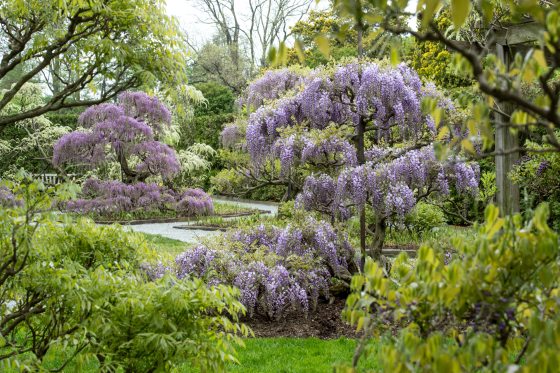
The Wisteria Garden, stewarded with the utmost attention and care. Photo by Hank Davis.
It is also important to be clear that the level of management required to contain these species does not translate to home landscapes or gardeners. These plants should not be introduced outside of managed environments by horticultural professionals. For home gardens, there are comparable alternatives that offer similar beauty without ecological impact, including native species such as Southern catalpa (Catalpa bignonioides), cucumber magnolia (Magnolia acuminata), and American wisteria (Wisteria frutescens)—all of which can be found growing here at Longwood. As we continue this work, serve as a trusted institution, and advance our science strategy, we aim to educate. Some of the plants guests admire carry ecological implications that may not be immediately apparent. By sharing that context today, we aim to deepen the experience of our Gardens, not diminish it.
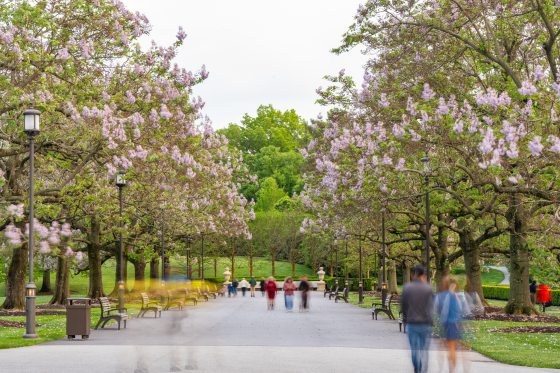
Paulownia Allée. Photo by Holden Barnes.
Paulownia Allée and the Wisteria Garden remain iconic because of the feelings they evoke, their seasonal anticipation, their sense of grace—and place—that unfolds over time. The plants themselves, Paulownia tomentosa and Wisteria floribunda, anchor and define these spaces, shaping how they are experienced and remembered, an effect grown and cultivated over time, by plants that people have connected with for generations. We steward these spaces with intention, actively manage their presence while allowing them to be experienced as they were designed.
At the same time, this responsibility informs how we move forward, ensuring that future plant selections and garden spaces reflect what we now understand about ecological impact. In this way, these gardens serve not only as cherished spaces, but as reminders that the choices we make today will shape both the beauty and the responsibility carried forward in the gardens of tomorrow.
Editor’s note: Join us on May 16 as we proudly join others in recognizing the fifth annual Pennsylvania Native Species Day. We’ll feature a variety of walks and talks, as well as opportunities to meet representatives from native species-focused organizations, from 10 am to 4 pm that day. Established by the Pennsylvania Invasive Species Council in 2022, Pennsylvania Native Species Day seeks to celebrate the state’s diverse native species and increase Pennsylvanians’ understanding of the importance of protecting them against the proliferation of invasive species.
Primary Reference: Griffiths, A., et al. (2025). RHS State of Gardening Report 2025. The Royal Horticultural Society, London, UK.
Supporting Article: RHS Science (2025). "Gardens are frontline in protecting biodiversity in face of climate change".