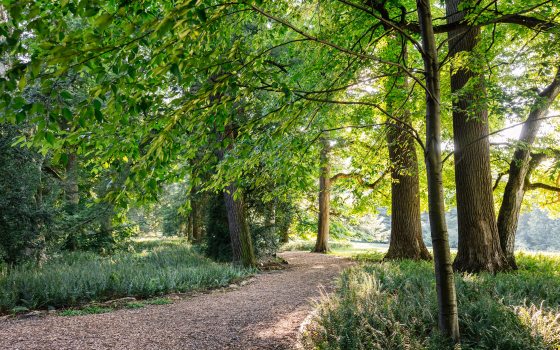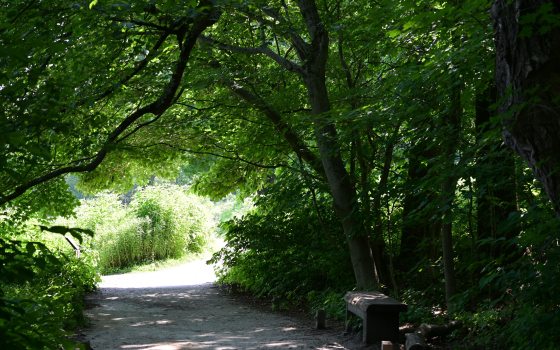
One of Longwood’s most beloved landscapes, our Meadow Garden is a place to reconnect with nature, recharge, and be surrounded by beauty. Since we opened the gates to an expanded, 86-acre Meadow Garden in 2014, this landscape has grown into its own—and has welcomed many guests. As our guests enjoy this space and as storms grow more intense, we have been reevaluating how our trail designs can best serve both people and the landscape, all while protecting its trees and supporting its habitats. From reducing steep slopes that are more vulnerable to erosion, to protecting our iconic trees, to thoughtfully rerouting its trails, the care we put into our evolving Meadow Garden is a fantastic example of adapting to changing conditions and stewarding a dynamic landscape, while creating meaningful, beautiful experiences for our guests.
Thoughtful, dynamic care is necessary to keep our Meadow Garden a thriving, ever-changing landscape. Some areas in the Meadow Garden landscape are too steep to mow or burn safely, and invasive species threaten to displace native meadow vegetation. Erosion and muddy conditions are occurring on steeper trail areas. In more shaded trails, tree roots have become exposed over time, which creates uneven walking surfaces. Each one of these challenges requires site-specific solutions.
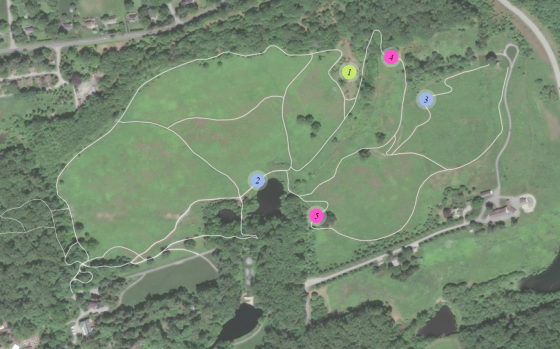
This map shows the locations of recent efforts in the Meadow Garden, as explored in this blog post. At location 1, we have planted nearly 1,000 trees in a sloped area to reduce erosion and improve management. At locations 2 and 3, we have completed trail projects to reduce erosion, including building turnpikes to redirect water (location 2) and realigning the Webb Farmhouse trail (location 3). At locations 4 and 5, we completed trail projects to protect tree roots at Beech Bridge (location 4) and around a historic beech tree (location 5).
One of the steepest areas of the meadow is the slope just east of Pollinator Pavilion, which leads down to the stream feeding into the Brandywine watershed. Too steep to safely provide the periodic disturbance that our meadows require, it has become overrun with non-native honeysuckles and bittersweet vines. As a result, we decided to transition this difficult-to-manage slope (shown as location 1 in the map above) from an herbaceous dominated meadow into more of a woody species-dominated landscape.. To do so, we took cues from the surrounding landscape’s already existing dense stands of native suckering sumac and sassafras trees.
In fall 2025, we planted nearly 1,000 trees, primarily sassafras and sumac, on this slope, filling in all the areas between existing scattered stands of trees. Sassafras and sumac both provide valuable habitat and food sources to a variety of birds, mammals, and insects. The seeds of the sumac are especially valuable in winter for overwintering and migratory birds. Sassafras and sumac are also species with outstanding fall color, so in addition to being a treat for wildlife, they should also be a treat to the eyes.
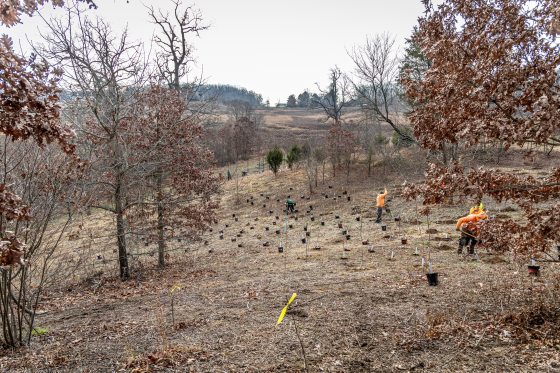
Sumac planting takes place. Photo by Richard Donham.
Deer enjoy munching and rubbing their antlers on young sumacs, so to protect these young plantings, we installed a temporary 8-foot deer fence around the planting area. Sumacs grow rapidly, so we hope to remove the fence once the plants have fully established in the next three to five years. We also added collars to the base of every plant to protect them from vole damage, which is a common occurrence in grassland habitats.
Growing conditions differ in the low, flat area of the planting, just outside the fence and buffing the stream. In this area we planted more moisture-loving species including American Sycamore (Platanus occidentalis), Pawpaw (Asimina triloba), Umbrella Magnolia (magnolia tripetala), and Black Willow (Salix nigra).
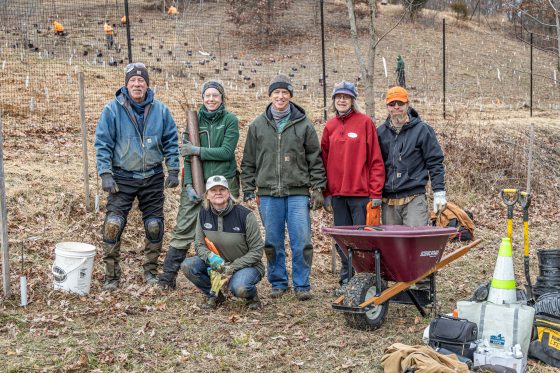
From left to right: Longwood Volunteers Rich Wagner, Laura Judd, John Taylor, Jenny Goodall, and Chris Cinquina with Longwood Senior Land Stewardship Technician Pandora Young (second from left), plant sassafras and sumac trees along the slope. Photo by Richard Donham.
Heavy storms and the popularity of our well-loved paths contribute to erosion and compaction of trails over time and have led us to implement a variety of trail improvements, each tailored to suit specific areas. In some areas, we hardened the paths by replacing turfgrass with stone aggregate. In areas where heavy rain would wash out paths, we built turnpikes to redirect water below the pathway. By building turnpikes, the walking path is elevated above pipes that allow water to flow underneath, which his helps prevent erosion of the path surface. You can see this in low areas, such as near the Hourglass Lake Pavilion.
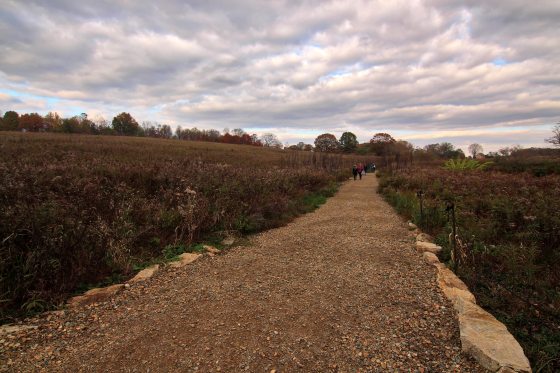
A section of turnpike trail (shown as location 2 in the map above), where the walking path is elevated above pipes that allow water to flow underneath. Photo by Scott Hummel.
In other areas, more dramatic measures were required. The trail leading west from the Webb Farmhouse (shown as location 3 on the map above) has a long history of washing out during major storms, but over the years it became a problem nearly any time it rained. Filling holes, armoring the surface with gravel, embedding large stones, and even well-constructed waterbars could not stop the erosion from happening.
It wasn’t until we conducted a prescribed burn in the area that the cause became apparent. Well-hidden by the tall meadow vegetation was a remnant of the old farm: a drainage channel, following the edge of what used to be an agricultural field. This cryptic feature ran through the meadow and let out at the steepest part of the trail, causing our erosion problems.
With this knowledge, we decided to realign the trail to take a gentle meander down the hill rather than a steep plunge. Working in the field with experienced designers from Penn Trails, we marked and mapped a new alignment for this trail. The following summer, we mowed the length of the path and worked with the Pennsylvania Outdoor Corps to shape the pathway itself and reduce cross-slope for a better walking experience.
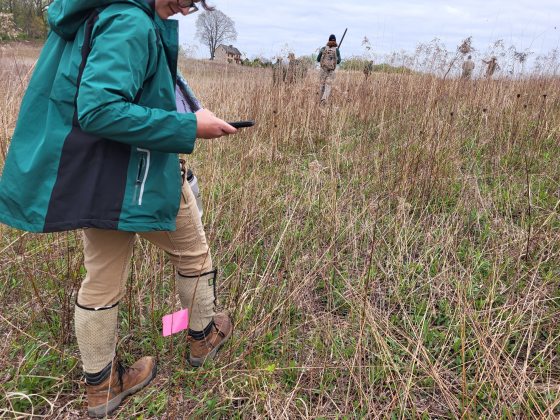
Longwood Land Stewardship & Ecology Manager Kristie Lane Anderson maps out the new trail alignment using GIS during a trail building workshop with Penn Trails. Photo by Joe Thomas.
The next step was restoring the old trail back to meadow. Until the new plants could grow roots and hold the soil together, we had to take measures to keep the area from washing out again. Longwood’s Civil Division team helped install a series of waterbars to redirect water—much more extensive than we had been able to do on a traversable path—and we laid netted erosion control matting across the planting area. We then planted more than 3,700 plants and several pounds of seed across the area.
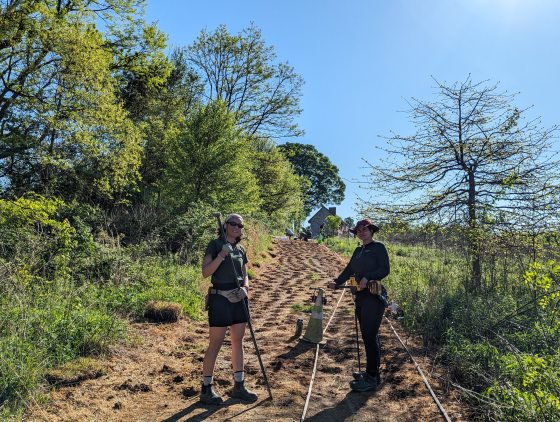
Longwood Professional Horticulture Program students Kelsey Chai (left) and Monica Castro dig holes with a digging bar and an electric auger to prepare for planting. Photo by Pandora Young.
Rerouting our trails has also served as an opportunity to boost native biodiversity in the Meadow Garden as we revegetate retired trail areas. Wildflowers are very dominant in the eastern Meadow Garden. To support a greater number of species while revegetating areas that were once trails, we emphasized native grass species, including little bluestem (Schizachyrium scoparium), big bluestem (Andropogon gerardii), switchgrass (Panicum virgatum), and yellow prairie grass (Sorghastrum nutans). These grass species also grow quickly and put down deep roots, controlling erosion. We also introduced Wood betony (Pedicularis canadensis), a hemiparasitic plant that is often found in grass-rich meadows.
Improving trail conditions also provided us an opportunity to protect the roots of trees by limiting their exposure to foot traffic, as tree roots are sensitive to trampling and compaction. We’ve entirely rerouted several paths in the eastern Meadow Garden, reducing erosion while also making the trails more winding and gently sloped: a win-win! On a shaded trail near the Beech Bridge (see location 4 on the map above) we added a hexagonal-shaped mat to act as a structural grid to keep small-sized gravel from washing out of the trail and to redistribute weight from foot traffic and reduce compaction on tree roots in the area. Just this month we completed rerouting a trail that was both steep and located in an area that was detrimental to a historic beech tree, shown as location 5 on the map above. The path beneath the limbs of this tree was too shaded to grow turf, as well as too steep to hold woodchips or other materials to help protect roots on paths, so we rerouted. The new route is a gently snaking S-shape, providing new views of the Webb Farmhouse, as well as of the historic tree, while keeping all foot and vehicle traffic off the exposed roots.
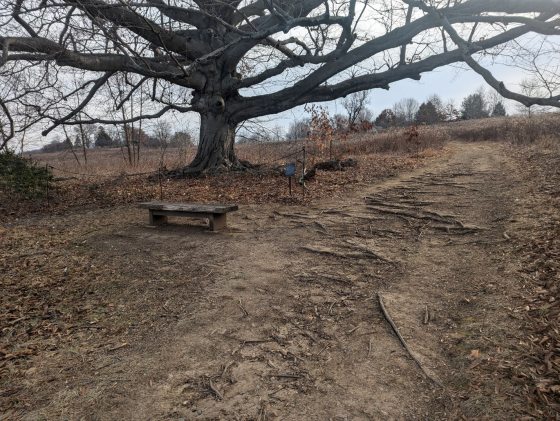
Compaction and erosion of the path under the historic beech tree is negatively impacting its roots. This path is now retired and a new path winds around the iconic tree. Photo by Pandora Young.
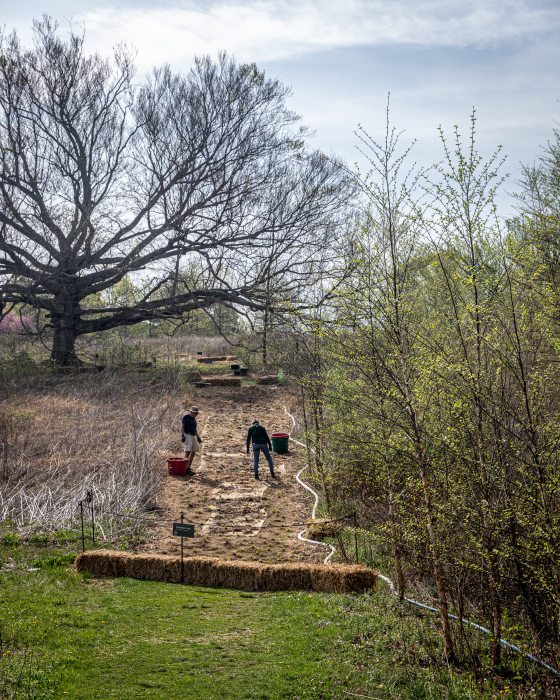
Longwood volunteers add a thin protective layer of straw on the newly seeded and planted retired path. Photo by Richard Donham.
We started this expansive reroute and revegetation project in March 2025, carefully laying out the new trail using a clinometer (an instrument used to measure angles of slope) and marking flags. Then we removed the thick vegetation along the new path—primarily thorny blackberry bushes—and prepared the area to be seeded with turf in late summer 2025. We allowed enough time for the new turf to grow in as the new walking surface so when the plants arrived to revegetate the retired trail in April, the new trail was ready for our guests, providing a seamless transition!
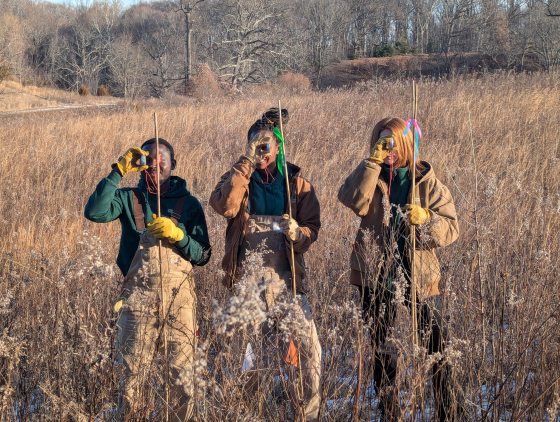
From left, Longwood students and trainees Ayokunle Joel, Wendy Ngcongo, and Holly Radford use clinometers to ensure the new slope is not too steep, in this January 2025 photo. Photo by Pandora Young.
To restore the old trail back to meadow, we planted more than 5,000 perennial plugs, consisting of native grasses for the sunny areas and more shade-loving ferns and wildflowers under the beech tree’s canopy. We planted an additional 5,000 individual grass plugs of various species to enhance the landscape around the Webb Farmhouse.
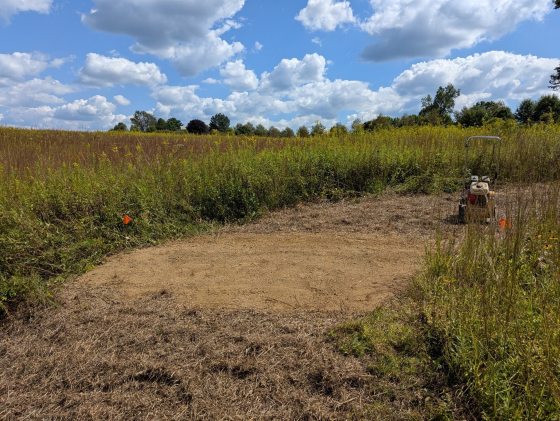
We added a waterbar to help direct stormwater off the new trail. This acts as a “speed bump” to slow water down and move it away from the path into denser vegetation, thereby reducing erosion. Photo by Pandora Young.
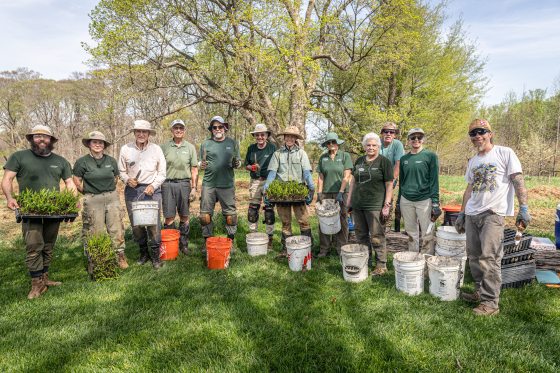
Longwood interns Ben Middleton and Meg Spittal; volunteers Ray Dion, Michael Bolanos, Tom Kalina, and Burt Rothenberger; Senior Land Stewardship Technician Pandora Young; and volunteers Pam Borys, Toni Gorkin, Rich Wagner, Isabelle Neal, and Chris Cinquina are some of the many who helped with spring 2026 plantings. Photo by Richard Donham.
Planting to reduce erosion, adapting trails, and protecting trees—while welcoming guests into one of Longwood’s most beloved and dynamic landscapes—demands a high level of care. While this stewardship is clearly visible in the Meadow Garden, it represents a far broader commitment across Longwood’s 750 acres of natural areas. The Meadow Garden offers a unique opportunity to share this actively stewarded, ever-evolving landscape with our guests, while fostering reciprocity with the plants and animals who call it home—and we are honored to do so.
Editor’s note: Join us as we recognize the fifth annual Pennsylvania Native Species Day on May 16 with a variety of walks and talks, as well as opportunities to meet representatives from native species-focused organizations. Established by the Pennsylvania Invasive Species Council in 2022, Pennsylvania Native Species Day seeks to celebrate the state’s diverse native species and increase understanding of the importance of protecting them against the proliferation of invasive species.