Central to the art of bonsai and kusamono is the subtle yet essential relationship between plant and container. In fact, bonsai translates to “tree in a shallow container”, underscoring the pot’s role in shaping the overall composition—it must harmonize with and enhance the tree without drawing focus away from it. A similar balance exists in kusamono, the Japanese art of small, potted grasses displayed alongside bonsai as seasonal accents, where plant and vessel work together in quiet harmony. At Longwood, we take great pride in our collection of more than 500 artisanal pots for bonsai and kusamono. Displayed in the Bonsai Workshop, this diverse collection spans ancient Chinese pieces to contemporary works by artists from around the world, including regional potter Gayle Fiato. Known for their natural, organic forms that depart from traditional shapes, as well as subtle variations in color and patina, Fiato’s containers honor bonsai tradition while gently pushing its boundaries. Read on to uncover the artistry behind Fiato’s work—and how her containers, in conversation with the plants they support, are truly special.
Fiato’s path to ceramics, and ultimately to bonsai pottery, was anything but linear. She first encountered clay in college, where she learned the basics of ceramics, but the medium didn’t immediately take hold. Instead, her career led her elsewhere, spending decades as a high-end general contractor in Boston. It wasn’t until 40 years later, after purchasing property in upstate New York, that she found her way back.
It’s there that a chance connection with a local bonsai club reignited her lifelong affinity for plants. Surrounded and inspired by others who devoted extraordinary care not only to trees but to the pots that held them, Fiato’s curiosity returned. When she discovered a nearby community kiln, she began experimenting and creating again. To her surprise, her technical skills returned. “It was like riding a bike,” she shares. “I couldn’t resist it.”
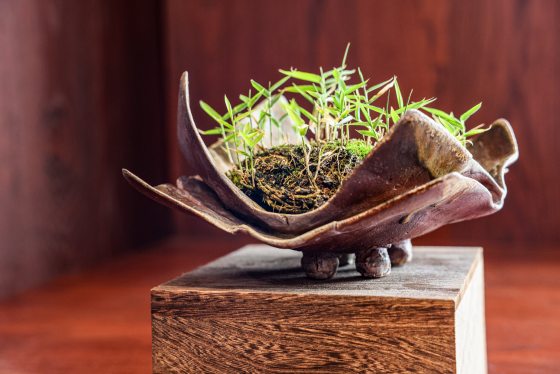
To Fiato, “Earth’s Cradle features a protective, nurturing shape. The high, swooping, organic walls look like cupped hands rising from the soil, offering a natural sanctuary for the delicate life growing inside. The container highlights the striking contrast between the rugged, dark, bark-like texture of the wood-fired clay and the soft, vibrant brightness of the moss and shoots. Its name suggests a living extension of the forest floor itself; a safe, weathered hollow where nature has found a way to take root and flourish.” Photo by Carol Gross.
She became increasingly involved in bonsai, as well as in pottery, the two becoming deeply intertwined. Her interest deepened when she discovered wood-firing, a process that now defines her work. Unlike more controlled methods, wood-firing introduces unpredictability and collaboration with natural elements—qualities that resonate strongly with Fiato, as she favors individuality over repetition and uniformity. To that end, Fiato embraces and finds beauty in the unknown and in the uncertainty of the process itself—even staying up for days at a time during firings.
Living among gardens and towering locust trees, Fiato draws inspiration from the textures, colors, and forms she observes daily. “The last thing I want to have is a set style,” she shares. “But my sensibility is wood-fired wabi-sabi.” To Fiato, it’s an organic aesthetic rooted in simplicity and quiet imperfection. In her work, she actively seeks out irregularities and imperfections in the clay and builds on them, allowing each piece to tell a story. “For one, you can see a piece of plaster that’s in the clay, you pull it out, and it creates a spider web effect,” she shares. “When something like that happens, I play off of that. It’s moments like those that spur a lot of my ideas. It’s appreciation of the imperfection.”
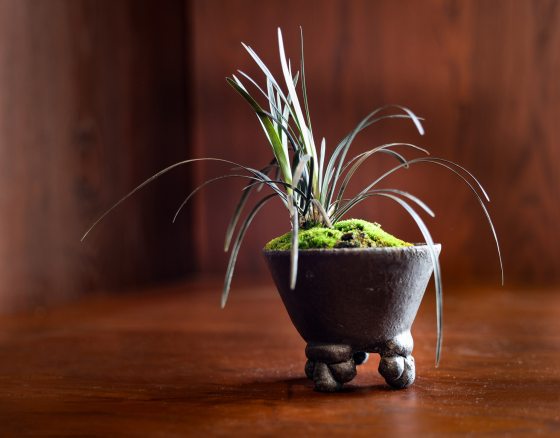
Through the container named Obsidian Root, Fiato emphasizes how this “heavy ceramic base acts as an anchor for the delicate arching grasses that live there. It creates a stunning visual weight that balances the airy, sweeping movement of the plant, making the pot feel less like a container and more of a permanent piece of bedrock from which life emerges.” Photo by Carol Gross.
Fiato’s time studying fashion design at Pratt Institute informs her approach, as does her experience as a contractor, particularly in the problem-solving aspects of both aesthetics and structure. That sensibility carries through in her bonsai work, where the relationship between tree and container is key. To Fiato, a successful bonsai pot is never just a base—it is an equal partner, enhancing the movement, color, and presence of the tree. “I want a pot to move like a tree moves,” she shares. “You could start out with a basic pot, but when you put the tree into it, you have to let the two work together. You have to let the color bounce, or the tree twist around it a little bit to complement the curve of the pot. When they work as one, it’s a showstopper moment.”
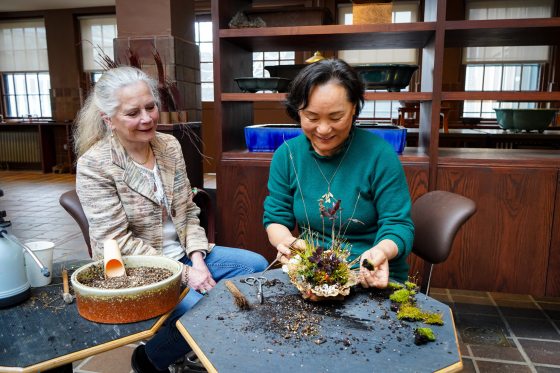
During a recent visit to Longwood, kusamono artist Young Choe (right) created several kusamono within Fiato’s containers. Here, Fiato (left) looks on. Photo by Carol Gross.
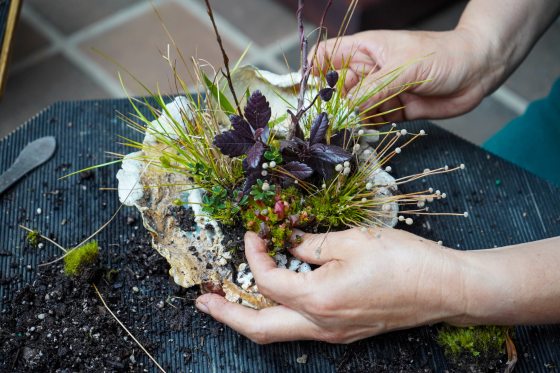
A close view of the kusamono, in process. Photo by Carol Gross.
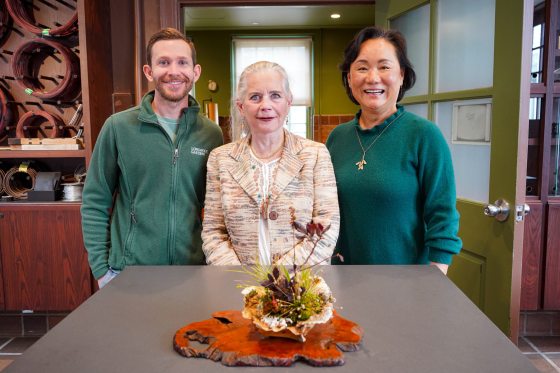
From left: Longwood Bonsai Curator Kevin Bielicki, artist Gayle Fiato, and kusamono artist Young Choe, pictured in Longwood’s Bonsai Workshop. Photo by Carol Gross.
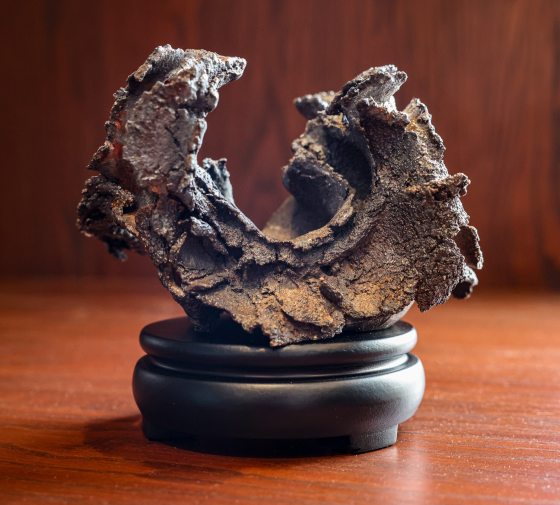
Working primarily with wood-fired kilns, Fiato embraces the communal nature of the process. Without a kiln of her own, she participates in shared firings that can last anywhere from one to four days, requiring teamwork and patience—especially since the results are never fully known until the kiln has opened. “It’s the ultimate excitement.” To Fiato, the first container pictured in this post, titled Ember’s Edge, “captures the dramatic threshold where clay meets the raw fury of the wood-fired kiln. The surface is dictated by the path of the flame through the volatile landing of the ash, creating a natural gradient of color and texture that looks as though the clay was pulled directly from the perimeter of a dying fire. Ember’s Edge evokes a beautiful tension between the quiet stability of the ceramic form and the wild, unpredictable energy of the embers that scorched it.”
Her pieces are often guided by her relationships within the bonsai community, and by the desire to create something that complements and elevates a living tree. She sees each pot as part of a larger dialogue—one that includes not just the object itself, but the plant, the environment, and ultimately the person who will care for it.
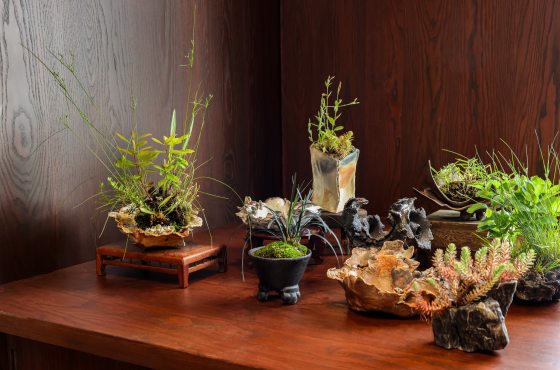
A selection of Fiato’s containers, some of which feature Choe’s kusamono, in the Bonsai Workshop. Photo by Carol Gross.
At Longwood, we are honored to be the caretakers of 10 of Fiato’s containers. We have displayed her work in the Bonsai Courtyard as kusamono paired with larger bonsai, as well as on the shelves of our Bonsai Workshop. “I’m always struck by the artistic quality and unique take Gayle has on containers,” shares Longwood Bonsai Curator Kevin Bielicki. “Her work respects the tradition of bonsai containers while pushing its boundaries, all while letting her personality shine through. When you see a container by Gayle, you instantly know it’s made by her.”
Titled The Four Dragons, Fiato created this bonsai pot in 2024 to honor the Year of the Dragon. The work features four dragons, symbolizing strength, wisdom, vitality, and transformation. In Eastern traditions, dragons are revered as benevolent beings associated with prosperity and good fortune. The number four represents the cardinal directions, balance, and harmony. Fiato fired the pot in a traditional wood kiln, a process that imbues the stoneware with unique textures and natural wood ash finishes, reflecting the unpredictable beauty of nature. This technique not only enhances the aesthetic appeal but also symbolizes endurance and resilience, qualities attributed to dragons in various cultures. Photo by Carol Gross.
As a creator, Fiato feels the quiet, persistent pull of the studio, and finds herself restless when she is away from it for too long—describing it as becoming “congested with ideas.” But when she returns to her studio and works with raw clay? “It’s freedom.” And when others view her work, including her pots at Longwood? “It’s pride. And, above all else, excitement.”
Editor’s note: Learn more about Gayle Fiato and her work here. Don’t miss the artistry of our inaugural Bonsai Festival, a six-day celebration welcoming bonsai artists, enthusiasts, and anyone curious about the beauty of this remarkable artform, taking place June 24 through 29. Experience an exceptional bonsai display, engaging demonstrations and lectures from leading artists, a curated selection of vendors, an auction, and awards. Learn more about our Bonsai Festival.