Learning wildflowers is a little like getting to know an extended family. At first, everyone may seem to look alike, especially among the abundant yellow-flowered members of the Asteraceae family, often described as the sunflower family. Their sunny, daisy-like blossoms share a common, cheerful form, making it difficult to distinguish their differences. The closer you look, however, their individual personalities emerge. Once you understand why these flowers resemble one another and learn the features that set them apart, you begin seeing something very different when it comes to this family of yellow flowers—many of which are painting our Gardens in gold right now. Read on as we take a closer look at these late-summer blooms.
From midsummer through early autumn, Asteraceae family members color gardens across Longwood, from sunflowers that rise in the Ornamental Kitchen Garden and Flower Garden Walk, to coneflowers that brighten Peirce’s Woods and Hillside Garden, to prairie wildflowers that mingle with grasses in the Meadow Garden. Our fascination with sunflowers extends beyond the garden. Vincent van Gogh became so closely associated with them that he once declared, “The sunflower is mine, in a way.”
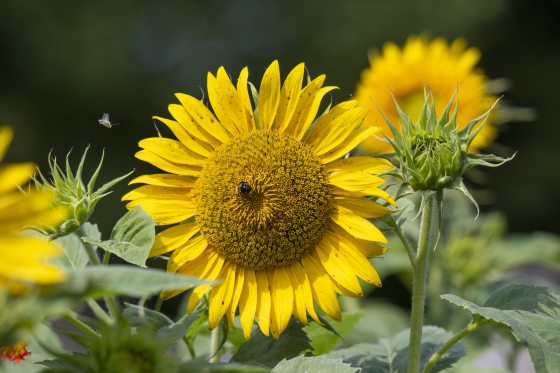
Whether studied by botanists, tended by gardeners, visited by pollinators, or captured on an artist’s canvas, members of the sunflower family have a remarkable ability to make us look more closely. Photo by Hank Davis.
Research suggests yellow might have been the ancestral flower color of the family, which has since diversified into a remarkable range of hues. Throughout those in the family, what appears to be a single flower is actually a flower head composed of many individual florets. In a typical sunflower, petal-like ray florets surround fertile disk florets in the center. The resemblance is no coincidence, as this basic design unites an astonishing diversity of plants.
Helianthus: The True Sunflowers
The genus Helianthus includes more than 50 species, nearly all native to North America. The familiar annual sunflower, Helianthus annuus, is just one member of a group inhabiting prairies, meadows, woodland edges, wetlands, and roadsides.
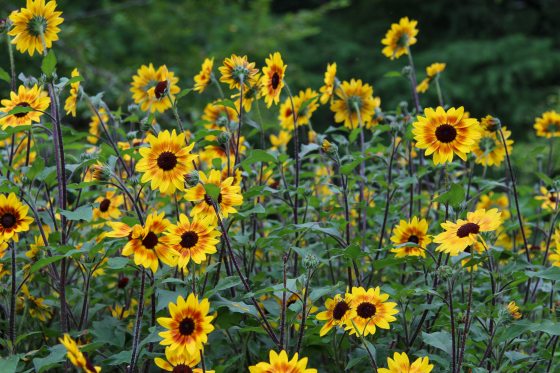
Hybrid Sunflower Helianthus (Suncredible® Saturn) along Flower Garden Walk. Photo by Meghan Siano.
True sunflowers generally have sturdy stems, coarse foliage, and broad flower heads, but their forms vary widely. Leaves may be opposite or alternate, plants may carry one enormous head or dozens of smaller ones, and mature plants range from a few feet to well over 10 feet. When two yellow composites look almost identical, turn the flower over; the green bracts behind the bloom can provide one of the best clues to a true sunflower and, with practice, even its species.
Annual sunflowers have another remarkable trait. Developing flower heads track the sun from east to west during the day and reorient eastward overnight, a behavior called heliotropism. As flowers mature, this movement stops and the heads generally remain facing east, where morning sunlight warms them earlier and encourages pollinator visits.
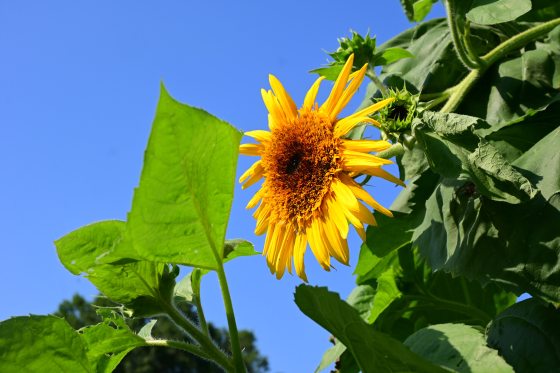
A blooming sunflower in the Ornamental Kitchen Garden. Photo by Cathy Matos.
The sunflower’s relationship with people stretches back thousands of years. Indigenous peoples of the Americas cultivated H. annuus for food, oil, dye, and medicine long before Europeans encountered it. Sunflowers also became associated with the sun itself; the Aztec and Inca connected their radiant flowers with solar deities, and Inca priestesses are said to have worn golden sunflower disks as emblems of devotion. After seeds reached Europe in the sixteenth century, sunflowers eventually became one of the world’s most important oil crops.
Today, garden sunflowers range from lemon yellow and cream to bronze, mahogany, and burgundy. Whatever their color or size, that familiar “flower” remains a coordinated community of florets, and a small echo of thousands of years of human fascination.
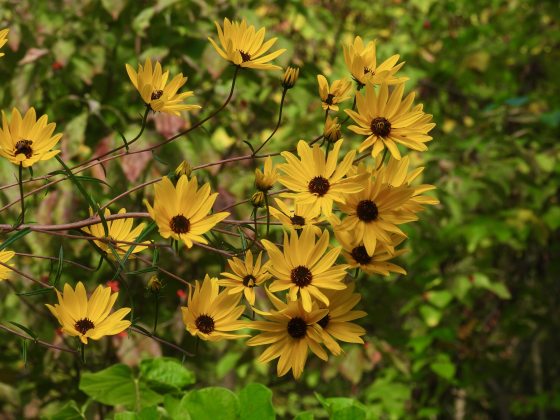
Helianthus angustifolius. Photo by Candie Ward.
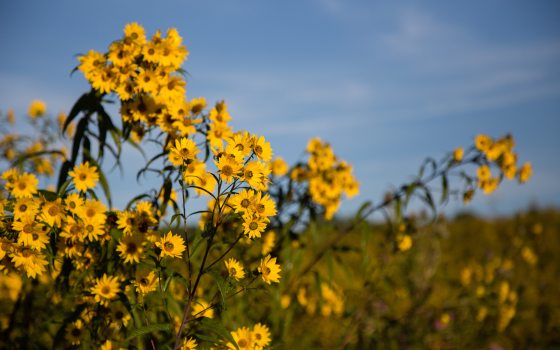
Several perennial sunflowers at Longwood reveal the diversity of the genera. Swamp sunflower (H. angustifolius), found in Peirce’s Woods, reaches up to 8 feet but has unusually narrow foliage, while woodland sunflower (H. divaricatus) in the Meadow Garden thrives along woodland edges and in open woods. Willow-leaved sunflower (H. salicifolius), found in the Idea Garden and Hillside Garden, may be easiest to recognize by its exceptionally long, narrow leaves cascading from tall stems before clusters of yellow flowers appear late in the season. In the Ornamental Kitchen Garden, annual sunflowers provide another striking display of heights, colors, sizes, and forms.
Heliopsis: Ox-Eye or The False Sunflower
Also called false sunflower, Heliopsis helianthoides can easily be mistaken for the real thing. Its name means “sun-like” which is an apt description for this dependable North American native.
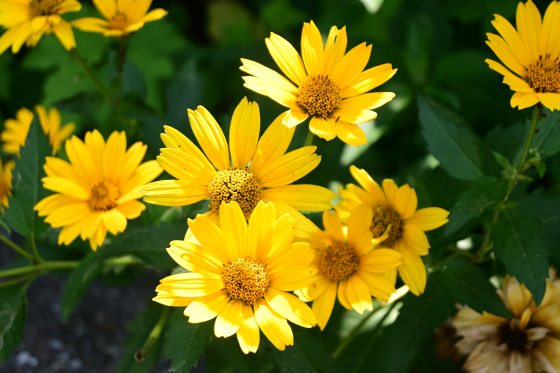
Heliopsis ‘Sommersonne’ in the Hillside Garden. Photo by Cathy Matos.
A small botanical difference is hidden within the flowers. In Heliopsis, the petal-like ray florets are fertile and can produce seed; in Helianthus, the rays are sterile and seeds develop from the disk florets. Fortunately, no dissection is necessary to know the difference: opposite leaves and persistent rays offer easier clues.
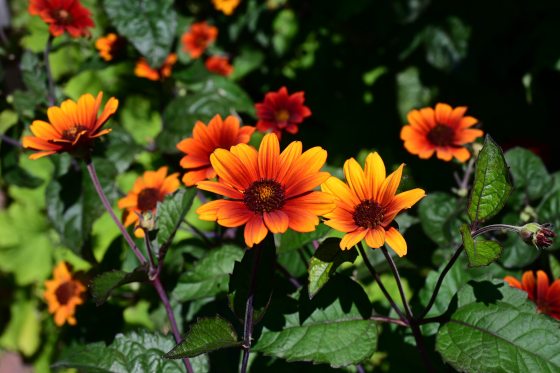
Heliopsis ‘Bleeding Hearts’. Photo by Cathy Matos.
Cultivars reveal another side of the genus. Look for the warm orange flowers of western ox-eye ‘Summer Eclipse’ in the Hillside Garden; dark foliage and fiery red-orange blooms of ‘Bleeding Hearts’ in a Peirce’s Woods container; and golden, semi-double bright yellow blooms of ‘Sommersonne’ (“summer sun”) in the Hillside Garden. Heliopsis grows best in full sun and well-drained soil.
Helenium: Sneezeweed
Helenium, or sneezeweed, brings yellow, gold, orange, copper, and mahogany to the summer garden. Rounded, button-like centers surrounded by slightly drooping rays give the flowers a lively, windswept appearance.
The common name is misleading. Helenium is insect-pollinated and unlikely to cause fall allergies. Instead, dried and powdered Helenium was once used as snuff to induce sneezing, thought to help clear illness. Its botanical name carries a more romantic tale: garden lore associated Helenium with Helen of Troy, claiming the flowers sprang from ground touched by her tears, a lovely, if geographically impossible, story for a genus native to the Americas.
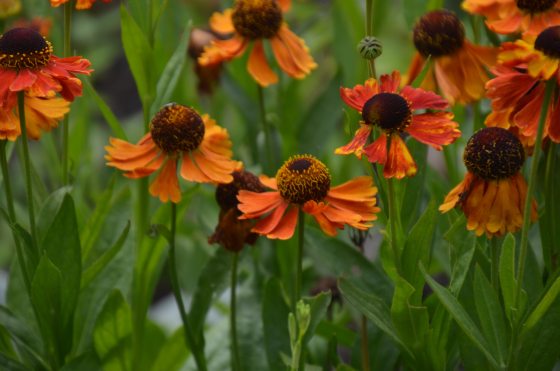
Helenium ‘Mardi Gras’ Sneezeweed. Photo by Amy Simon Berg.
In the Meadow Garden, purplehead sneezeweed (H. flexuosum) has drooping yellow rays around a purplish-brown center, while ‘Mardi Gras’ on Flower Garden Walk lives up to its name with splashes of yellow, orange, and red.
Meet the Relatives
The sunflower family extends far beyond familiar sunflowers. Some relatives are towering prairie plants with enormous leaves; others bear slender cones, finely divided foliage, or clouds of small flowers. Each is a variation on the same remarkable flower-head design.
Silphium: The Prairie Giants
Long-lived prairie perennials, Silphium are known for bold structure, golden-yellow, strap-like yellow flowers, and substantial root systems. They also turn the familiar sunflower pattern somewhat inside out. Their seed-producing flowers occur around the outer edge of the flower head rather than throughout its center.
The name reaches back to antiquity. Silphium recalls a Mediterranean plant so valuable that it appeared on coins from the North African city of Cyrene and was said to have disappeared by the first century after intense harvesting. Linnaeus later borrowed the storied name for this very different group of American prairie plants.
Cup plant (S. perfoliatum), growing along Flower Garden Walk, in the Meadow Garden, and in Peirce’s Woods, is among the easiest to recognize. Large opposite leaves join around its square stem to form cups that collect rainwater, sometimes enough to attract birds and insects seeking a drink.
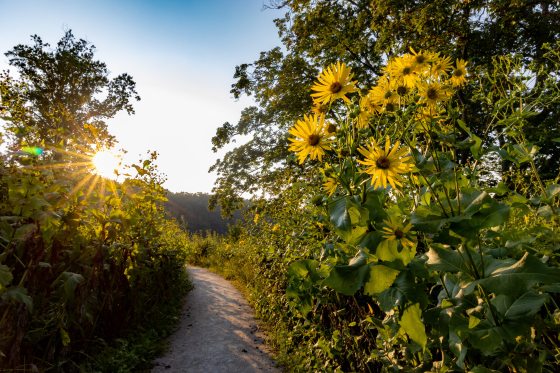
Silphium perfoliatum (cup-plant). Photo by Carol DeGuiseppi.
Other species reveal the genus’s striking architecture. Compass plant (S. laciniatum) bears deeply divided leaves that tend to orient north to south, while prairie dock (S. terebinthinaceum) sends golden flowers 6 to 9 feet above enormous basal leaves. Shorter whorled rosinweed (S. trifoliatum) stands out in the Meadow Garden with whorled, lance-shaped leaves and profuse yellow flowers.
Rudbeckia: The Coneflowers
If Silphium are the architectural giants of the family, Rudbeckia often provide clouds of late-summer gold. Yellow rays surround raised centers ranging from greenish to deep brown, while differences in foliage, flower size, and habit distinguish the species.
The genus also carries a story of friendship and gratitude. Linnaeus named Rudbeckia for his mentor Olof Rudbeck the Younger and his father, Olof Rudbeck the Elder, writing, “So long as the earth shall survive and as each spring shall see it covered with flowers, the Rudbeckia will preserve your glorious name.”
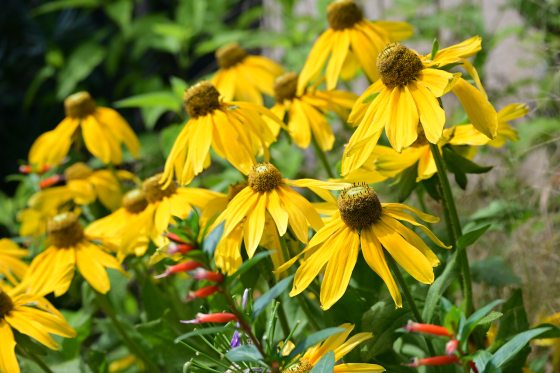
Rudbeckia hirta (Gloriosa Daisy). Photo by Cathy Matos.
The familiar Rudbeckia fulgida var. sullivantii ‘Goldsturm,’ growing in the Meadow Garden and Peirce’s Woods, forms particularly dense clumps and has become one of the best-known garden selections. Horticulturist Heinrich Hagemann noticed an exceptional planting in 1937 at a nursery in what is now the Czech Republic. Karl Foerster later named it ‘Goldsturm’ “gold storm” and introduced it commercially in 1949.
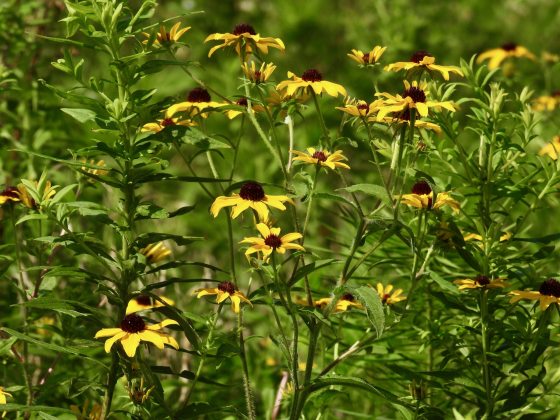
Rudbeckia triloba. Photo by Candie Ward.
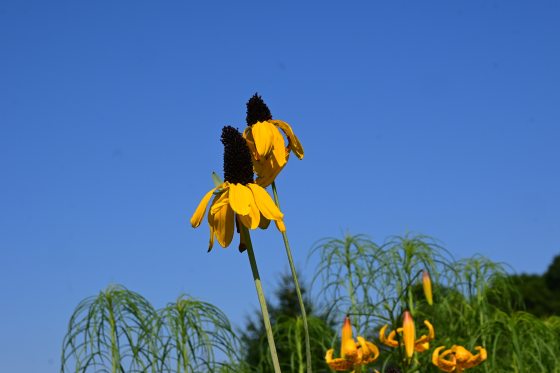
Rudbeckia maxima. Photo by Cathy Matos.
Other Rudbeckia at Longwood demonstrate the genus’ range. Gloriosa daisy (R. hirta) in the Meadow Garden and Peirce’s Woods has bristly stems and sandpaper-like leaves, while giant coneflower (R. maxima) in the Hillside Garden pairs enormous blue-gray, waxy leaves with tall stems bearing yellow flowers around prominent, elongated dark cones. Brown-eyed Susan (R. triloba) in the Meadow Garden and Peirce’s Woods produces scores of small flower heads, creating an airy cloud of bloom from late summer into autumn.
Ratibida: Prairie-Coneflowers
Prairie-coneflowers are easy to recognize by elongated central cones rising above gracefully drooping rays. The name Ratibida itself remains a mystery: botanist Constantine Rafinesque coined it in 1818 without explaining what he meant.
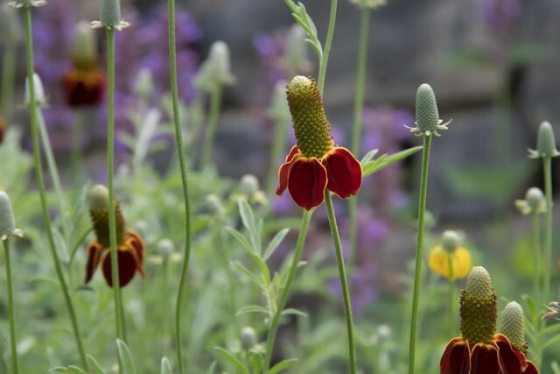
Ratibida columnifera. Photo by Duane Erdmann.
Upright prairie-coneflower (R. columnifera) in the Hillside Garden is particularly distinctive. A tall cylindrical cone rises above strongly drooping rays that may be mahogany-red edged in yellow or entirely yellow, creating a silhouette reminiscent of a broad-brimmed sombrero. As the head matures, tiny flowers open in a band that gradually moves upward along the cone.
Coreopsis: The Tickseeds
Unlike its sun-named cousins, Coreopsis was named for something far less glamorous. The name derives from the Greek koris, meaning “bedbug,” referring to the small, flattened fruits early botanists thought resembled ticks, proof that not every member of this golden family received a flattering name.
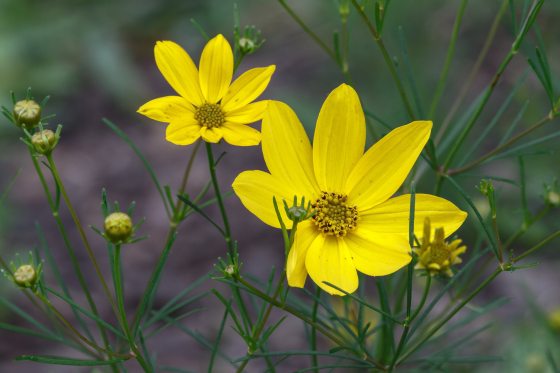
Coreopsis verticillata. Photo by Tom Potterfield.
Tall tickseed (C. tripteris) grows throughout Longwood, including the Meadow Garden, Rose Garden, Flower Garden Walk, Hillside Garden, and Idea Garden. Tall, smooth stems branch near their tops to carry numerous small golden flower heads with dark reddish-brown centers. Selections include ‘Gold Standard’ and ‘Lightning Flash.'
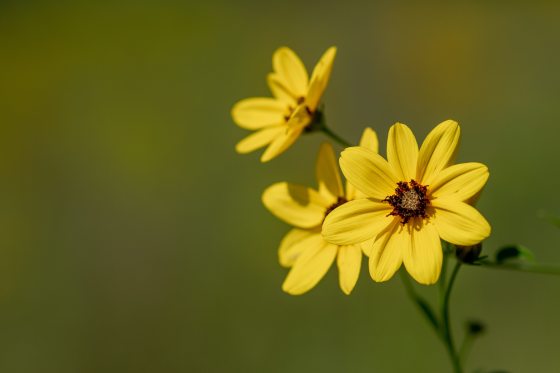
Coreopsis triptera. Photo by Hank Davis.
This is only a sampling of the sunflower family at Longwood. You can encounter many more golden-flowered relatives in the Asteraceae family in nearly every hue throughout the Gardens, giving you ample invitation to keep looking, comparing, and discovering the family resemblance.