Bonsai invites us into a world where time slows, details sharpen, and the quiet, patient dialogue between nature and the artist come into view. Among these living sculptures, some stand out not just for their form or beauty, but also for the stories they carry and for the hands that have shaped them across generations. One such bonsai recently joined Longwood’s collection as its newest addition, ready to begin a new chapter in its century-long journey. More than a remarkable specimen, this bonsai is a witness, a teacher, a testament to the artists who have cared for it, and a spectacular model of the enduring art of slowing down.
For more than 80 years, this Yatsubusa Chinese cork bark elm (Ulmus parvifolia ‘Yatsubusa’) grew quietly in Oregon’s Willamette Valley. Planted in a propagation field, it spent those decades developing its deeply textured bark and its delicate leaves that turn brilliant yellow in the fall. When the land was sold for residential development, bonsai artist Ryan Neil rescued the tree, among others, with the intent of guiding it into its next chapter of life as a bonsai. Since then, thanks to bonsai artist Sergio Cuan, the elm has been thoughtfully shaped and refined into a remarkable bonsai, adding more chapters to its storied history.

Artist and bonsai practitioner Sergio Cuan, pictured with the Yatsubusa Chinese cork bark elm in the Bonsai Workshop. Photo by Carol Gross.
Based in New Jersey, Cuan is a renowned multi-disciplinary artist and mostly self-taught, deeply respected bonsai practitioner with nearly 40 years of experience in the art and practice of bonsai. Cuan is especially known for his exceptional work with deciduous species, which captivate him with their expressive branching and sculptural form. Trained as a painter, he approaches bonsai with the same sensitivity and expertise that informs visual art, and he weaves in his long-standing fascination with horticulture. “Growing up in Spain, I would watch my mom grow flowers in amazement,” shares Cuan. “With my background in art and my love of plants, I found a perfect marriage between the two with bonsai. There are many aspects common between visual arts and bonsai: negative and positive areas. Balance. Harmony. Line. Contrast. All that you learn as a painter applies to bonsai.”

One of the hallmark features of the cork bark elm is its fine, delicate twigging that lends to its graceful structure. Photo by Carol Gross.
Cuan was first drawn to the elm because of its plated, textured bark. Combined with its tiny leaves typical of Yatsubusa (dwarf) varieties and its fine twigging that reinforces the impression of an ancient full-sized tree, Cuan knew the tree was special from the start. In fact, it became more of a conversation partner, revealing its direction slowly over time. To Cuan, bonsai is a dialogue in which the tree guides the artist. “I don’t come to a tree with a set idea of how to shape and nurture it,” shares Cuan. “I have my thoughts, but above all I listen to the tree itself. With that listening, the tree tells me what it wants to be. If a tree wants to be traditional, so be it. If it wants to be more abstract, I let that be as well.”

A defining characteristic of the cork bark elm is its plated, textured bark. Photo by Carol Gross.
In training since 2010, the 44-inch-tall elm has evolved through years of careful pruning, root refinement, and seasonal styling. During its years with Cuan, it also held a place of honor at the center of his garden. For that reason, Cuan nicknamed it The Sentinel, as it seemed to stand watch, its presence quiet yet unmistakably protective. “This elm, in particular, has taught me patience and discipline,” shares Cuan. “In painting, I can create an effect immediately. In bonsai, I must wait for the tree.”
Yet in bonsai, nothing is ever truly finished—and neither is Cuan’s fascination with the artform. “There’s never really a ‘finished’ tree in bonsai,” he says. “There is always more to develop, more to listen for. And so it is with my continued fascination with bonsai. With painting and drawing, there’s a clear beginning and end. With bonsai, there is no end. It keeps evolving. That’s what keeps me so engaged.”

“When you look at bonsai, you have an intimate view of nature,” shares Cuan. “Bonsai provides the viewer with a deeper connection and a chance to pay close attention to details.” Photo by Carol Gross.
In December 2025, the elm made its way to Longwood, transported by Cuan himself and carefully placed in the Bonsai Workshop. For Cuan, Longwood’s combination of horticultural excellence, artistic sensitivity, world‑class bonsai collection, and educational offerings that all “get people into this beautiful artform and help them create a more emotional connection with nature” made the Gardens the ideal steward for the tree. His connection to the region is also deeply personal—his daughter, who first encouraged him to visit Longwood, graduated from the University of Pennsylvania, and his admiration for local artists Thomas Eakins and Andrew Wyeth further strengthens that bond.

Longwood Bonsai Curator Kevin Bielicki (left) and Sergio Cuan (right) pictured during the arrival of the cork bark elm. Photo by Carol Gross.
Since its arrival at Longwood, we’ve been stewarding the elm and patiently awaiting the right weather to transition it outdoors to our Bonsai Courtyard—where it stands now. To Longwood Bonsai Curator Kevin Bielicki, it’s unique to our collection in that it “offers an accurate representation of how an ancient version of this tree may grow in nature. It pulls some from the Japanese model but offers a more natural look with its branch size and placement. The proportions and scale give it a truly monumental sense. Like our forest compositions, this tree captures the imagination as if one were encountering the tree while walking among it in nature.”
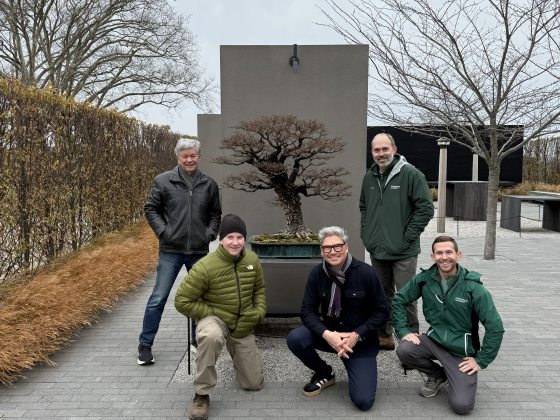
During Cuan’s December 2025 visit, he and members of the Longwood team tested placement of the cork bark elm in the Bonsai Courtyard. Pictured, from left to right: Longwood Volunteer Steve Ittel and Dan Snipes; Sergio Cuan; Longwood Bonsai Grower Matt Turner; and Longwood Bonsai Curator Kevin Bielicki. Photo provided by Kevin Bielicki.
Cuan hopes that, upon encountering the tree, guests will feel inspired by the art and practice of bonsai and discover the beauty of slowing down. “Everything moves so fast today,” he shares. “Bonsai teaches you to slow your pace. It forces you to look around you and within you. It connects you.”

The cork bark elm, on display in the Bonsai Courtyard. Photo by Carol Gross.
We are honored to be the next chapter in this remarkable bonsai’s story. It’s a continuing story of stewardship, care, commitment, and a deepening connection to nature that we can all continue to cultivate, knowing it is a journey that—thankfully—is never truly complete. The next time you visit our Bonsai Courtyard, we invite you to slow down, look closely, and connect with the cork bark elm: a living sculpture and a testament to patience, artistry, and care.
Editor’s note: Join us for the inaugural Longwood Gardens Bonsai Festival from June 24 to 29, a six-day celebration featuring regional clubs from the tri-state area and welcoming bonsai artists, enthusiasts, and anyone curious about the beauty of this remarkable artform. Experience an exceptional bonsai display, engaging demonstrations and lectures from leading artists—including a June 26 lecture and live demo led by Cuan—a curated selection of vendors, auction, and awards.
For those looking for personalized instruction, register for the June 26 Bonsai Master Class with Sergio Cuan , a hands-on experience during which students style their own Chinese elm and strengthen their skills along with Cuan.