Designed and maintained by the students in our two-year Professional Horticulture Program, the Student Exhibition Garden in our Idea Garden is a place of creativity, beauty, and thought-provoking concepts. It also serves as the capstone project for our nine Professional Horticulture students who will graduate in July. These students were responsible for designing and planting these three garden spaces within a given budget, theme, and design requirements. This year’s theme, “Gardens of the Future”, challenged students to consider the role that gardens—places of hope and promise—can have in the future. As climate changes, biodiversity is threatened, and social isolation, gardens offer a place to reimagine the future and develop solutions – gardens are full of hope and promise. Three of the students’ concepts, conceived by Joshua Ferris, Melanie De La Cruz, and Ellie Schlehr and supported by their classmates, are on display now through mid-October. Here, they share the inspiration behind their designs—from conservation to community to connection with the natural world—and what you can expect to experience there.
Melanie De La Cruz: Common Ground
For the past several months, my teammates and fellow Professional Horticulture Program students Matthew Fleishhacker, Rachael Adams, and I have been working to bring “Common Ground” to life. The garden grew out of what drew me to horticulture in the first place: I wanted to create green third spaces that reconnect us to each other and to the planet. The reality is that we are more disconnected than ever, and the effects have reverberated into every aspect of our lives. Why and when did we stop talking to each other? Gardens have always had the power to slow us down, to root us, and to remind us that we are part of something larger. Common Ground is a space designed to make those small moments feel possible again and to show that the places we grow things can be part of how we find our way back to each other.
Horticulture has always been about connecting people to nature, to each other, and to a sense of place. I grew up in New York City and spent my adulthood in Philadelphia, and I believe that greenifying cities and bringing people together can genuinely change the world and guide us into a better future through horticulture.
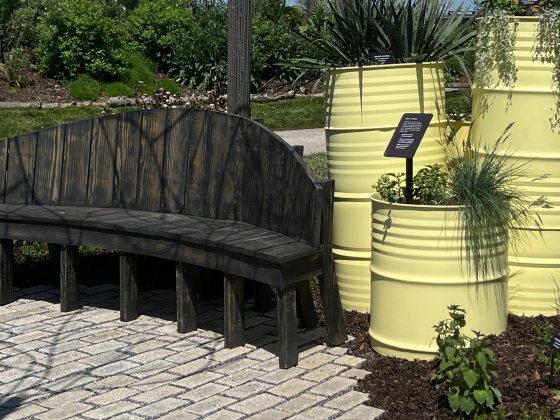
One of the benches in Common Ground. Photo by Candie Ward.
Every material choice in this garden reflects that. The planters are repurposed drums and the path is laid with leftover Belgian Block from the Longwood Reimagined project: these pieces had lives before they arrived to the garden. The path curves through the space and leads guests to a central seating area with two benches facing each other, which I designed specifically so that sitting down means looking at another person. Above the seating, a rebar trellis draws inspiration from the way cities are built upward rather than outward, a canvas for plants to climb rather than waiting years for a canopy to grow. We grew our Cobaea scandens from seed, and it is already winding its way up. I'm expecting it to really take off by midsummer.
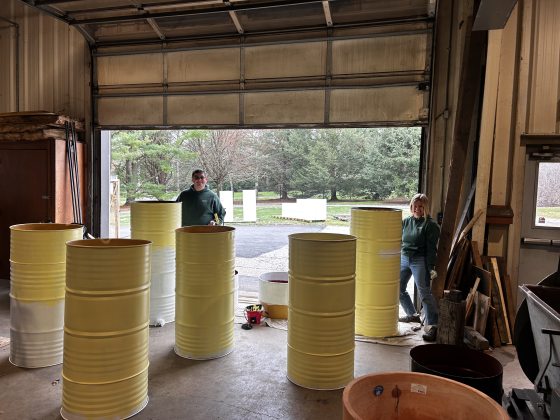
Professional Horticulture Program Students Rachael Adams and Matthew Fleishhacker paint the repurposed oil drums that would become the garden's container planters. Photo by Melanie De La Cruz.
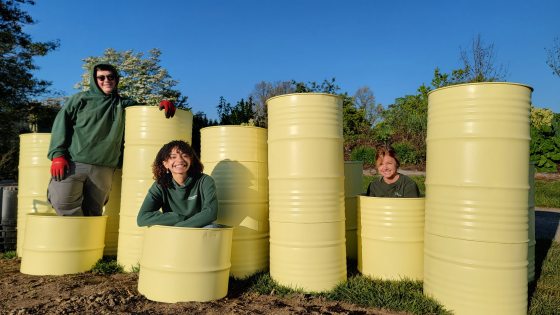
The team pauses for a family photo in the drums before they go in the ground. From left to right: Professional Horticulture Program Students Matthew Fleishhacker, Melanie De La Cruz, and Rachael Adams. Photo by Danilo Maffei.
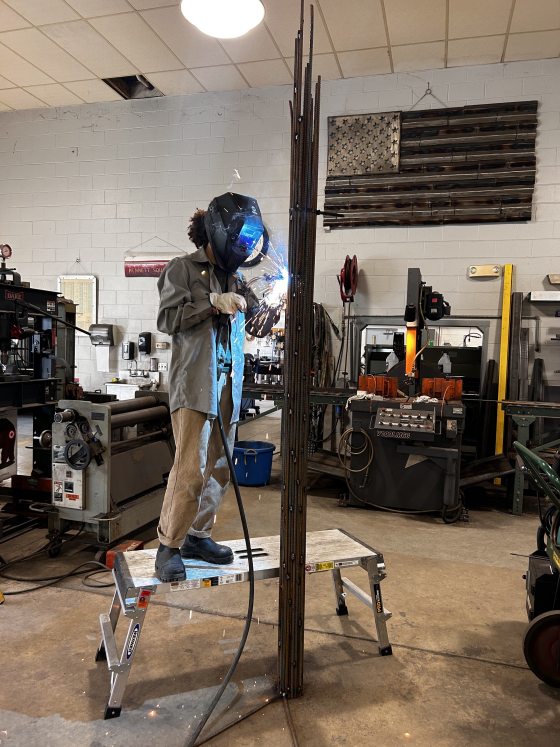
Professional Horticulture Program Student Melanie De La Cruz welds the rebar trellis structure in Longwood's metal shop, with guidance from Senior Mechanic and Fabricator Dave Beck. Photo by Dave Beck.
Matthew led the planting design and put in hours going through combinations and thinking through how each plant would interact with the next. The plantings move from shorter and softer at the edges, with Agastache 'Poquito Butter Yellow', Heuchera 'Autumn Bride', and Bouteloua gracilis 'Blonde Ambition', to taller and more enveloping as you move toward the center, where Physocarpus opulifolius 'Seward', Daucus carota 'Purple Kisses', and Rudbeckia maxima take over.
One of my favorite things about the garden is the way the deep foliage of the Physocarpus plays against the painted barrels and the warm tones of Dahlia 'Mystic Illusion'. The containers are planted with drought-tolerant species like Salvia farinacea 'Victoria Blue' and Evolvulus glomeratus 'Blue My Mind', a nod to what's possible when all you have is a barrel and a season. Matthew also built the benches with Longwood's wood shop. Rachael handled everything on the facilities side, coordinating across the carpenters, metal shop, paint shop, and masons, navigating every department we needed to make this garden happen. Between welding the trellis, building the benches, and painting barrel after barrel, the three of us put in more than 60 hours of fabrication work before a single plant went into the ground.
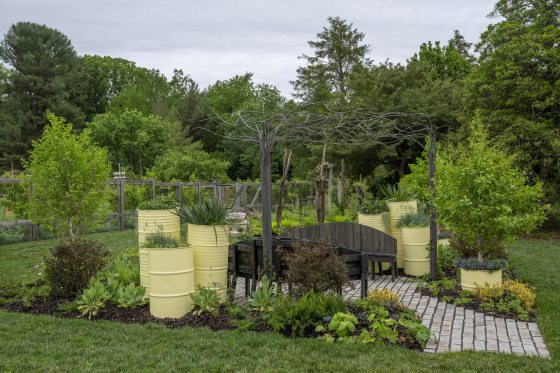
The completed Common Ground garden. Photo by Hank Davis.
All of that work, from every discipline and every person involved, was in service of a place where people might slow down and connect. A couple of days ago I was out watering when I noticed two groups of guests had sat down across from each other and started talking. By the end of the conversation they'd figured out they were from the same city. My city. I don't think I could have asked for a better sign that this garden is doing what it was meant to do, and I can't wait to see how many more of those moments happen as the season goes on.
Joshua Ferris: Second Nature
When I first heard the theme for this year’s Student Exhibition Garden I was struck with inspiration and excitement. I knew I wanted to incorporate my experiences working with the US Forest Service and The Nature Conservancy, as well as my experiences here at Longwood Gardens. I wanted to create a garden that reflects what the natural world is currently experiencing, while also offering hope for a brighter, more creative future. My goal was to inspire guests to create more sustainable, natural gardens that embrace change and uncertainty.
This garden is named “Second Nature” because it demonstrates how a garden can be given a second life, even after experiencing transformation or loss. It incorporates dead trees, root balls, logs, and other natural elements to create a more sustainable vision for the future while still preserving the memory of what once existed there.
While creating this garden, one of the biggest challenges was sourcing all the wooden elements. Fortunately, I was able to connect with past Professional Horticulture Student Mark Volpe, who works just a few miles down the road at Anson B. Nixon Park. Through that partnership, we sourced most of the wooden materials from the park grounds, with additional pieces provided by Longwood’s Land Stewardship & Ecology team.
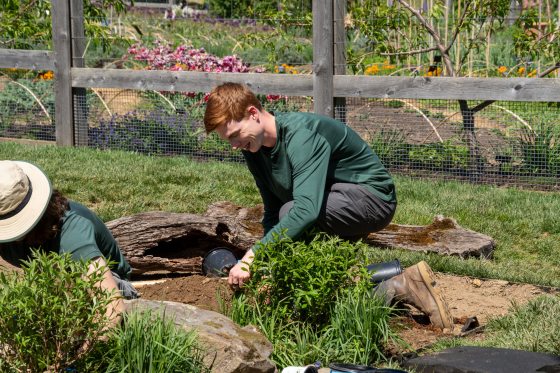
Professional Horticulture Student Travis Cox helps install Second Nature. Photo by Amy Simon Berg.
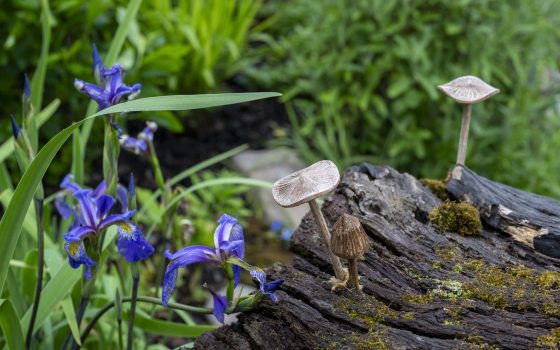
Once the materials were gathered, my team and I began the creative process of arranging and transforming the wood elements within the garden. From there, we selected, sourced, and thoughtfully designed plants into the garden. We also incorporated rocks from a nearby quarry, along with pine saplings, wooden and dried mushrooms, moss, and several other unexpected details that for guests to discover.
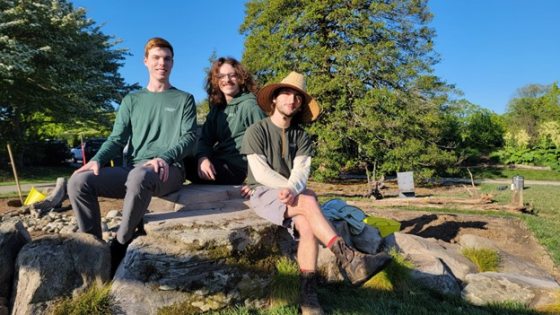
Members of the Second Nature team during the second day of installation, left to right: Professional Horticulture Program Students Travis Cox, Logan Kline, and Joshua Ferris. Photo by Danilo Maffei.
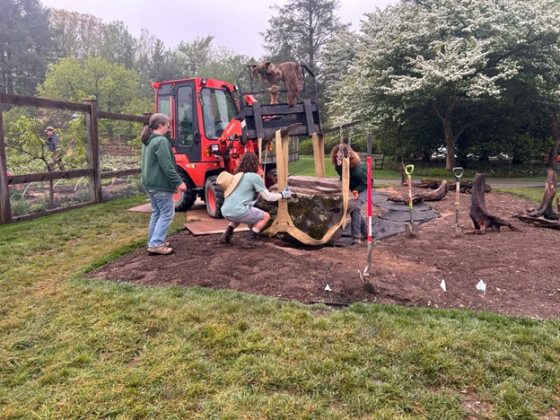
One Second Nature element that couldn’t be brought in by hand was a large, mossy sitting rock. Weighing more than two tons, the rock was forklifted in with straps, where we then rotated the rock into place. Photo by Melanie De La Cruz.
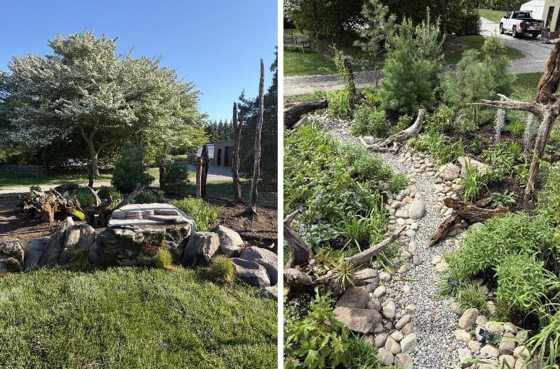
Left: Taken on day three of install, this photo shows the finished rock and turf sitting area with all the wooden elements placed and the stream bed planted. The turf is intended to show human interaction with the space. As people walk on this grass, a foot path will form, creating a resemblance to what would form in wild garden space. Right: This is the view looking down at the garden from the large sitting rock, showing the dried riverbed with root balls and fallen logs along the sides with tall, upside-down dead trees and a shade garden corner created by pine trees and mound formation. Dead wood creates space for new life, providing habitat for birds, insects, fungi, and small animals. As they break down, they return nutrients to the soil, help retain moisture, and support the growth of new plants. Photos by Joshua Ferris.
Second Nature shows that landscapes, even after disturbance or change, can have new life. As landscapes change, remnants of the past—such as dead trees, abandoned streams, and weathered land—can be used to build something new. By keeping and reusing these parts, this garden cultivates ecological diversity, promotes sustainability, and inspires creativity. This garden proves that we do not need to erase the past to make something beautiful—we can include it and make it part of the future.
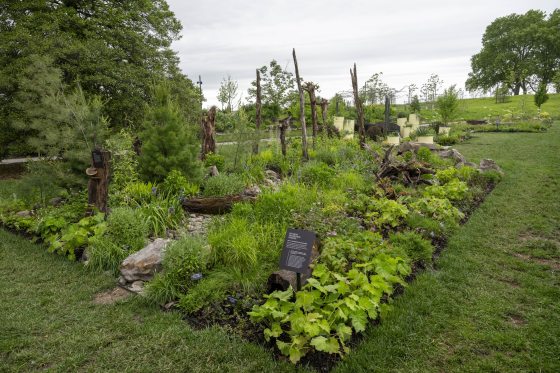
The completed Second Nature garden. Photo by Hank Davis.
Overall, the creation of this garden was an opportunity to showcase our creativity and apply everything we have learned in the Professional Horticulture Program here at Longwood. Looking back, I learned many new ways to approach garden design and discovered that it truly takes a well-organized, cohesive team to bring a project like this to life. I would not have been able to see this garden completed without my teammates and fellow Professional Horticulture Program Students Logan Kline and Travis Cox. Each brought unique skills and perspectives to the creation of this garden, and the experience would not have been nearly as positive without them.
As our class approaches graduation, I know this experience has brought us closer together and given us the opportunity to give back to the Longwood community and to the guests who will visit the garden.
Ellie Schlehr: A Garden to Rest
A Garden to Rest reflects a personal exploration with a timeline that extends beyond the Professional Horticulture Program. Addressing our future from the lens of sustainability, cultural values, social taboos and fears, A Garden to Rest is a garden about natural burial. After many months working on this project and many lessons in adaptability, fellow Professional Horticulture Program Students Lauryn McMiller, Micah High, and I were able to see this design come to fruition and thrive.
A design rooted in death may seem like an odd concept choice for a “Gardens of the Future” theme about a future of hope and optimism. The inspiration behind this garden comes from challenges in my life where I was forced to confront my ideas around death and, ultimately, reframe them. Prior to being at Longwood Gardens, I used to work and study in medicine, where I would face death without a lot of conversation around it. An illness in my own family led me on a journey where I found myself having those conversations and researching the realities of burial. It was at a tour of a natural cemetery, a beautiful, vibrant meadow, where I found peace and a different path for the future. Natural burial’s goal of sustainability and ethos of approachability and community-centeredness provides comfort and peace in a way some people have a hard time finding in traditional practices.
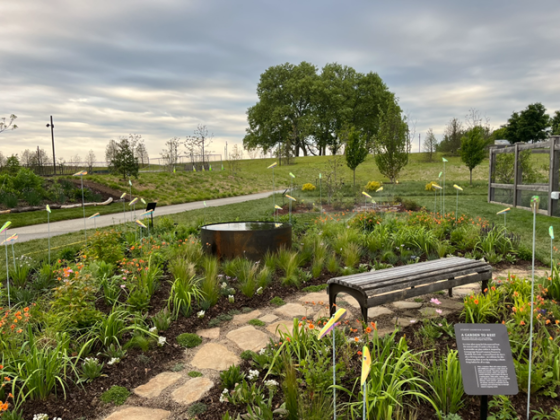
A Garden to Rest in the early stages after installation. Photo by Ellie Schlehr.
This design resonates with me not only because I believe in the concept; the stylistic choices are selected not just for beauty but also for purpose. Part of the beauty of natural burial is the ability to celebrate life and acknowledge the cycle of it. The land in a natural cemetery can be planted and support a biodiverse ecosystem. The plant palette of the garden echoes this. I chose native grasses, perennials, things that would grow together in a naturalistic style, support wildlife, and would take full advantage of the breeze experienced in the north plot. I think that element of movement gives the garden such life.
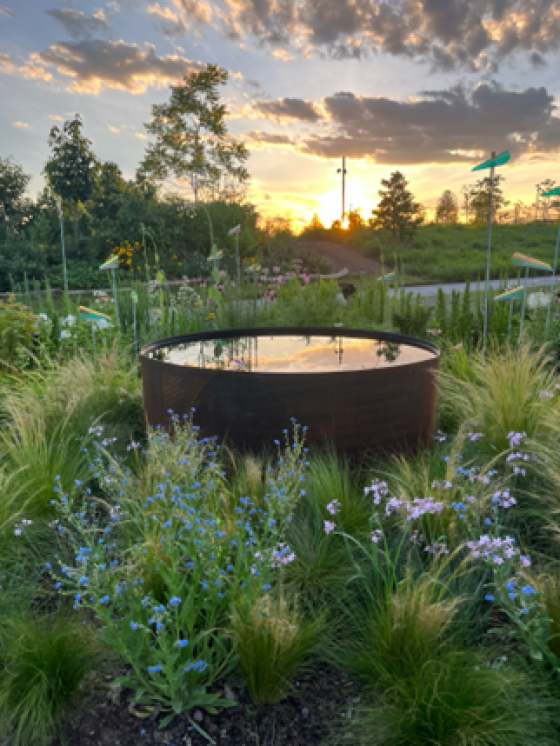
When the wind blows and I see the pops of pink Tulbaghia heads bobbing through the sea of rippling golden Nasella, I feel such serenity at heart and really enveloped in the garden and the microcosm of it. When the wind calms and the rustling quiets, you can hear the hum of all the bees, in such an amount it's surprising not to have noticed them before, enthusiastically bumbling around the Cynoglossum. It's fun to see their fuzzy yellow bodies on the vivid blue forget-me-not flowers. If I sit long enough, birds will dip in to perch on the reflecting pond’s edge and bob down to the water for a drink. It’s a sight that makes me laugh, seeing the birds add their likeness to the mirrored sky and clouds in the water. All this life and joy reinforces the message of the garden, reframing ideas around death and grief by bringing us back to the cycle of life; promoting approachability, comfort, peace.
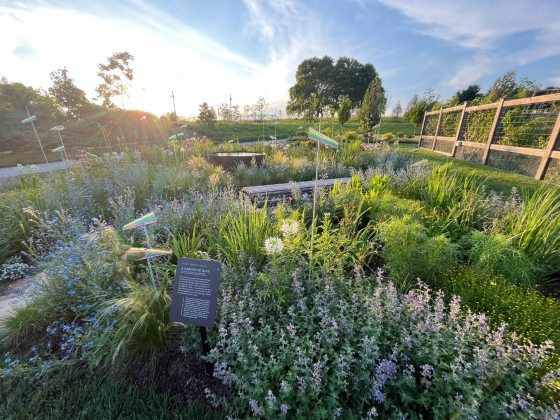
A more grown-in A Garden to Rest amid a June sunset. Photo by Ellie Schlehr.
From the pavers to the central feature, the garden’s non-plant elements were also all purposefully chosen for their meaning as well as their aesthetic value. As part of the process, Micah, Lauryn, and I painstakingly chose each paver in the path. They are a nod to the practice in natural burial of not allowing traditional markers but, instead, native field stone to preserve the natural landscape and the space.
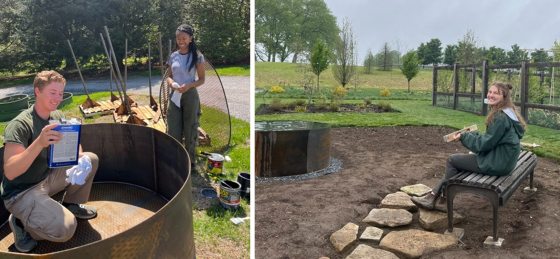
Left: Professional Horticulture Program Students Micah High and Lauryn McMiller clean and seal the water feature before installation. Photo by Ellie Schlehr. Right: Professional Horticulture Student Ellie Schlehr takes a break from installing hardscape and leveling features. Photo by Micah High.
We also integrated more than 60 handmade windcatchers; these sculptural features, like the plants, take full advantage of the breeze. They are a feature that capture light and movement with their colorful, holographic, lightweight material but they also hold symbolism important to the ethos of the garden. They represent the presence in the space and our memory, and how our departed contribute to it and are a part of the cycle of the garden and imbue the space with deeper meaning.
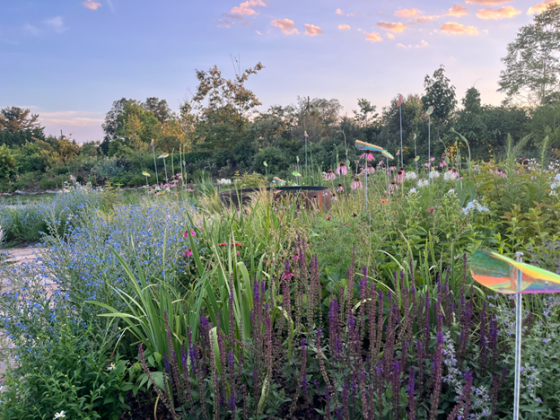
Native plants grow around the windcatchers. Photo by Ellie Schlehr.
Our reflecting pond centerpiece is the detail I think we settled on last. The centerpiece underwent many different iterations before landing on the right thing. I’m glad the reflecting pond was what was decided on in the end, as it feels like it was always meant to be. It provides a centering moment and it’s a thoughtful impact on the eye; a weighty element as opposed to the plants, nods to the deep meaning of the space.
This garden and the process of creating it have felt deeply personal to me and yet it’s something so universal. This idea has meant something to me for so long and I am incredibly humbled to see how guests interact with the garden. There are some particularly poignant moments that have left a lasting impression on me. To reach people emotionally has truly been humbling. With this garden, I wanted to ask the question: can we reframe how we see death? Can we unlearn our discomfort and taboo around death and grief and acknowledge them as a part of the cycle of life? Can we see ourselves as a part of that cycle? The oneness of the garden’s name speaks to that concept. Just as we put a garden to rest, so do we rest. Can we see even death as a beautiful part of life, like in a garden? I look forward to seeing how the garden grows in.