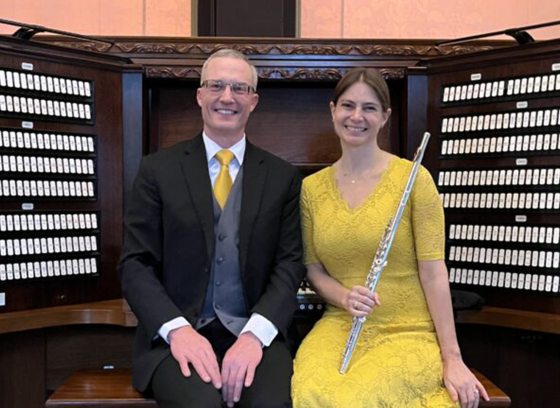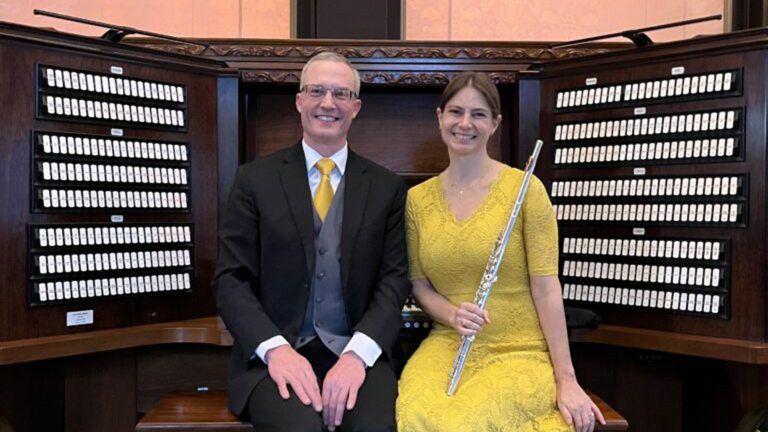
Known for their impeccable ensemble, continual expansion of repertoire, and ability to connect with the audience, flutist Melissa Freilich and organist Vincent M. Ryan are the duo Doppelflöte, specializing in flute and organ concerts that are not just heard, but experienced. Teachers at heart, Freilich and Ryan are committed to sharing a deeper understanding—and therefore a fuller enjoyment—of the music with the listener.
Since 1998 they have performed together in numerous communities in the Philadelphia region and in 2022 made their international debut in both the Castle Church and Town Church of Wittenberg, Germany. They are honored to have presented several premieres, including Ryan’s November 2021 Suite for Baroque Flute and Organ and Börjesson’s Sonatina for Do-Organ; Ryan’s April 2023 Doppelflöte for Orgelkids; and the May 2025 commissioned piece Portman: Seascapes.
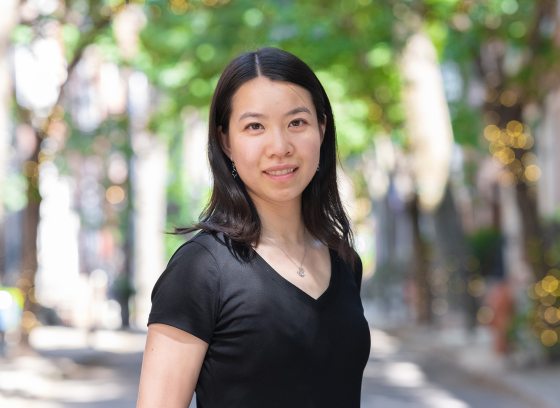
Active as a flute teacher since 1998, Freilich has appeared as a soloist with the Ambler Symphony, the North Penn Symphony, and Young Peoples’ Philharmonic, and has given recitals in the Philadelphia, Cleveland, and Ann Arbor areas. She holds a Bachelor of Music from The Cleveland Institute of Music and a Master of Music from the University of Michigan School of Music. She has performed under several prestigious conductors including Leonard Slatkin and Franz Welser-Möst. Freilich can be heard on the 2005 Grammy Award-winning recording of William Bolcolm’s Songs of Innocence and Experience.
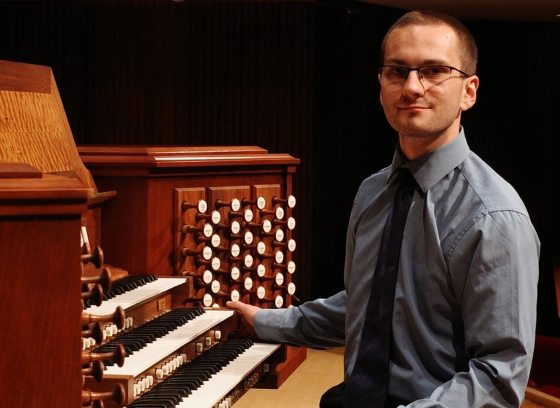
Since 1997, Ryan has been the Minister of Music at Advent Lutheran Church, Harleysville, PA. He is a vastly experienced accompanist for soloists and ensembles alike, including the Gospel Choir of Wittenberg, Germany; the Souderton Men’s Chorus; and The Franconia-Lancaster Choral Singers. He holds a Bachelor of Arts in piano and Master of Arts in organ from Indiana University of Pennsylvania. He is a champion of outreach for the pipe organ, and is a steward of the OrgelkidsUSA organ, a real portable pipe organ that one builds and plays and has demonstrated it more than 60 times for more than 1,000 people ages 5–95.