It is the most-asked question in our Gardens: What is that plant? As such an important part of the guest experience, it is not surprising that the creation, accuracy, and management of plant display labels is an ongoing priority in the Gardens, so much so that Longwood has a dedicated Plant Information and Mapping team that documents, labels, and maps our extensive plant collection of more than 13,000 living accessions. With a plant collection as expansive as ours, and with displays that evolve so frequently, creating and maintaining plant display labels is a continuous and essential process. Recently, we recognized the need to refine that process to support the highest level of accuracy, clarity, and guest experience.
Plant display labels have been a feature of Longwood’s horticultural displays from the mid-1950s, when then-Education Department Head Walter Hodge called for the development of a formal plant records system. His vision was to inventory every plant growing at Longwood, establishing a comprehensive record of lasting value, and, in turn, a system of plant display labels. This commitment to detailed record‑keeping not only ensures that Longwood maintains accurate, up‑to‑date information about our collections, but also helps guests identify and appreciate the plants they encounter throughout our displays.
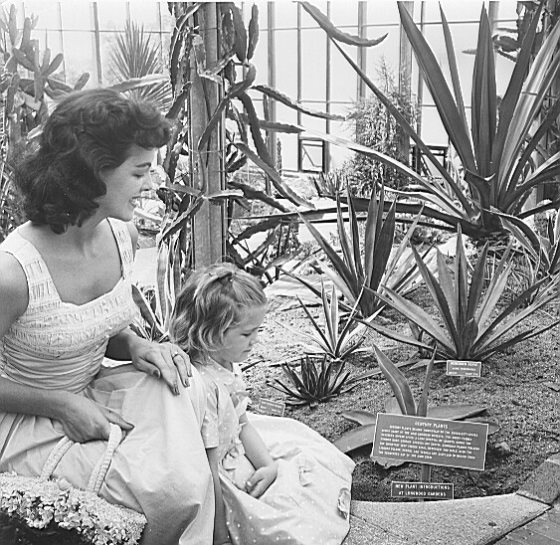
Guests look at plant labels in the Desert House in this 1958 photo.
One of the most time-demanding aspects of the work of Longwood’s Plant Information and Mapping team is the creation and management of thousands of plant display labels used throughout the conservatories and outdoor gardens. As part of creating plant display labels for our Longwood Reimagined spaces, the team recognized early on the need for a centralized Plant Label Room to support the growing demands of guest-facing displays. While the creation of the Plant Label Room may be a behind-the-scenes venture, its impact is already clear—it streamlines procedures, improves access, and enhances the guest experience through the creation of clear, consistent plant labels.
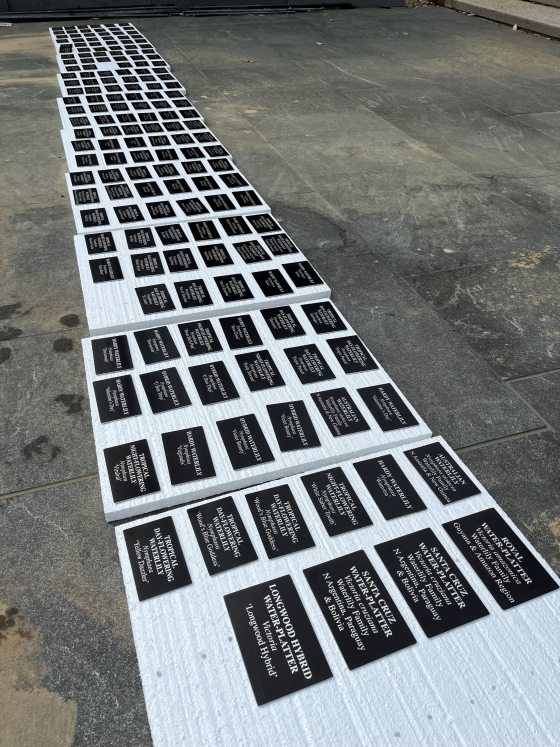
Plant display labels are laid out in the Waterlily Court in preparation for planting the waterlilies and water-platters in 2025. Photo by Joyce Rondinella.
Prior to the Plant Label Room, the former method of label storage was that of disparate storage cabinets stored in horticulturists’ offices and garages throughout the Gardens. These cabinets included many labels that were out-of-date or those of plants that were no longer in the collection. Given how much time was needed to manage such a collection of labels, horticulturists rarely had time to weed out the unused labels. Thus, the need for centralized label storage.
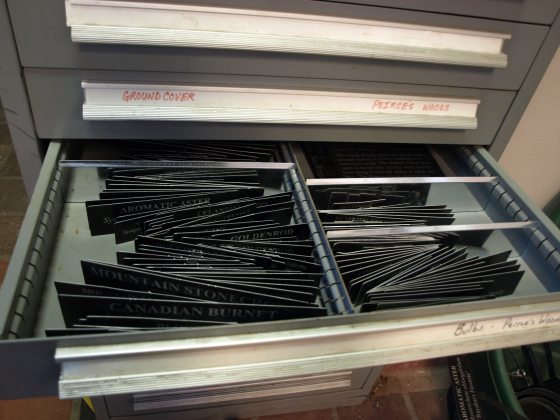
A peek inside a former display label storage cabinet in a horticulture work area. Photo by Kristina Aguilar.
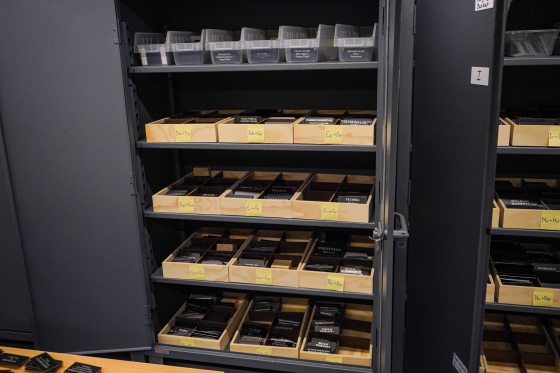
Our current, more organized approach in the Plant Label Room. Photo by Carol Gross.
When we started this venture, the Plant Information and Mapping team did not have a dedicated space for such label storage. With such a large plant collection, a dedicated, central space for cabinets and organization would be necessary. We found such a space below our Bonsai Workshop. Now designated the Plant Label Room, this resourceful space is filled with cabinets ready for new labels, and cabinets housing already-created labels. Its centralized location offers easy access for Horticulture staff to pick up and drop off labels as needed, making it a practical and efficient part of daily operations.
To create this functional space, we first collected labels from across the Gardens and brought them to the Plant Label Room. There, they were organized into two groups: those that had current plant names and label formats and those that did not. The labels that were deemed out-of-date were recycled and the remaining current labels were alphabetized according to scientific name. Wooden label storage cabinets with drawers retained from our former Potting Shed are now used for storing our largest groups of labels including tulips, poinsettias, chrysanthemums, and orchids.
Thanks to 80 custom-made boxes crafted by Longwood Carpenter Joe Cornette, we were able to retrofit standard storage cabinets to securely and efficiently house the plant display labels. One box can hold up to 225 labels. In 2025 alone we created more than 2,700 new display labels. Many of those went out into the Gardens, but because of the seasonal changes in our displays, the space must be flexible to store tens of thousands of labels if needed.
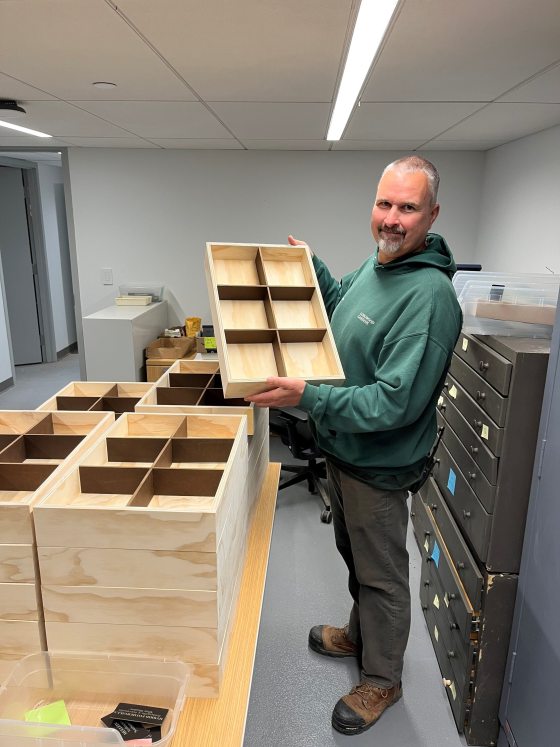
Longwood Carpenter Joe Cornette delivers the first set of wooden boxes he crafted to be fitted in the new label cabinets. Photo by Joyce Rondinella.
Our students and volunteers have been working hard cleaning, sorting, and filing hundreds of labels with care and precision. With help from staff, students, and volunteers, a majority of our plant display labels are now housed in one organized filing system within the Plant Label Room.
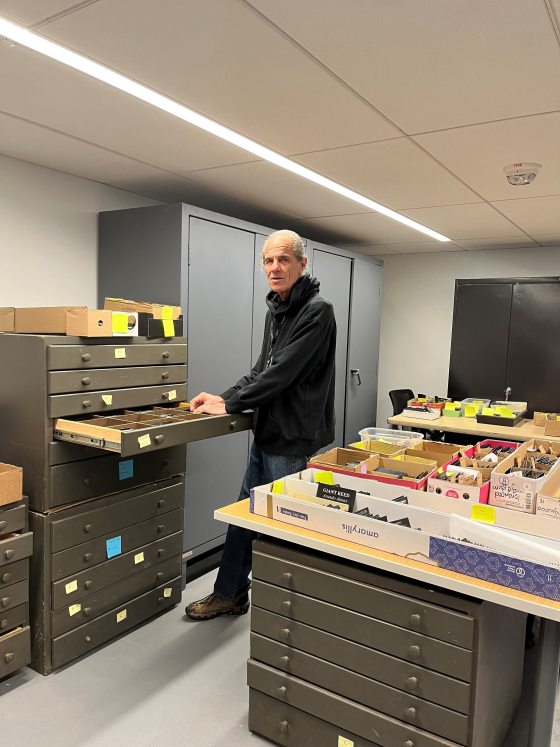
Longwood Volunteer Michael Pillagalli alphabetizes and files plant display labels in the Plant Label Room. Photo by Joyce Rondinella.
Our ongoing process to organize, file, and produce new labels is a dynamic one—new plants arrive daily, destined for future displays. During peak spring and summer planting seasons, and seasonal displays such as Chrysanthemum Festival and A Longwood Christmas, our new label requests can reach 500 per season.
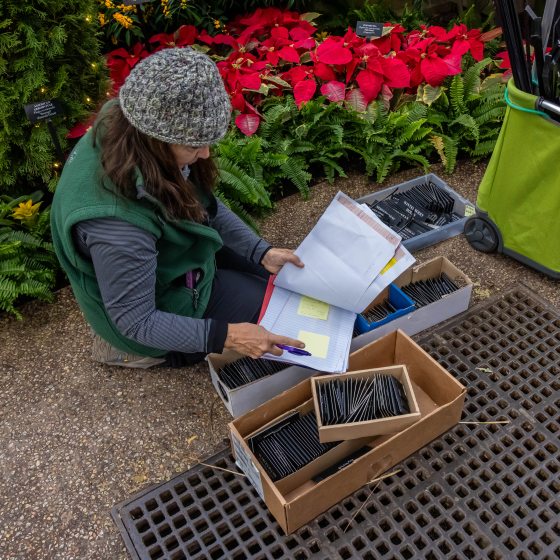
Longwood Plant Information Field Specialist Joyce Rondinella prepares to place labels in the Main Conservatory for A Longwood Christmas, after pulling them from the Plant Label Room. Photo by Duane Erdmann.
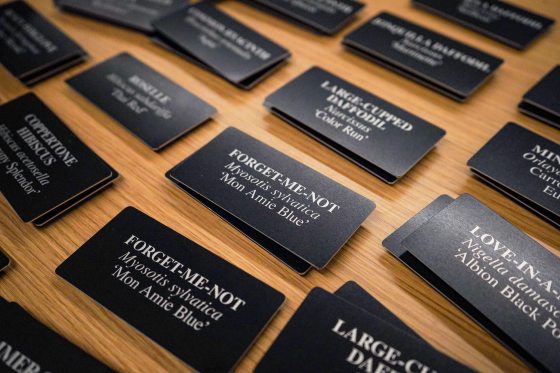
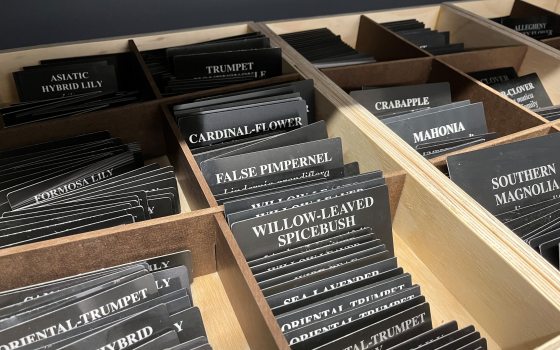
A fraction of the plant display labels on hand in our Plant Label Room. Photo by Carol Gross.
The horticulture staff request and return plant display labels daily, and we often pull, print, and order thousands of labels each season. It’s a task that truly requires an all-hands-on deck approach, and we are incredibly grateful to have such a dedicated and talented team supporting this essential work. These labels don’t just answer the question, “What is that plant?”; they also enrich each visit by sparking curiosity, deepening understanding, and inspiring a greater connection to plants and nature.