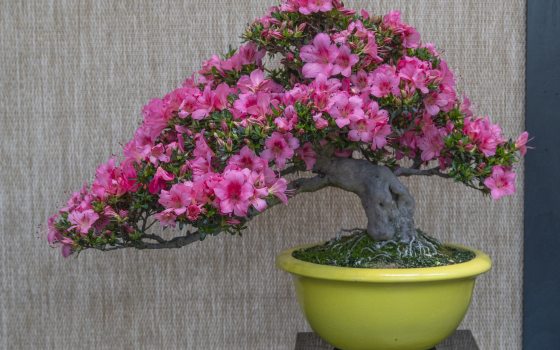
Our Exhibition Hall has been beautifully transformed for our Satsuki Azalea Bonsai Display—a colorful, expressive display you won’t want to miss. On view now through June 15, this rotating display showcases the remarkable diversity of Satsuki azaleas (Rhododendron indicum), renowned for their dramatic blooms, wide range of colors, and varied petal shapes. Many on display even feature multiple flower types appearing on opposite sides of the same tree, highlighting their extraordinary individuality. Drawn from standout specimens in Longwood’s bonsai collection, as well as exceptional works on loan from The Kennett Collection, the display also includes trees by Hiroharu Kobayashi, one of the most influential Satsuki bonsai growers in the world. Read on to discover what makes these remarkable trees so unique and why this display is not to be missed.
Satsuki azaleas are unlike any other flowering bonsai. As they’re genetically diverse even within a single tree, individual trees can produce multiple flower colors simultaneously; striped or flecked petals; or a variety of bloom sizes and forms. Originating from Japan, the name “Satsuki” refers to the fifth month of the traditional Japanese lunar calendar, corresponding to late May and June—the natural flowering season of these azaleas. While most azaleas finish flowering by May, Satsuki azaleas are just beginning.
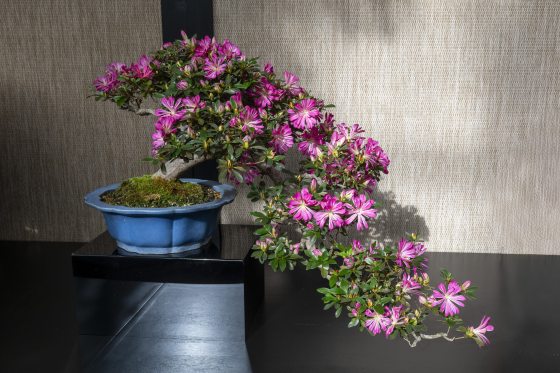
Approximately 30 years old, this cascade-style bonsai features a delicate tree form that complements its unique flower. Photo by Hank Davis.
This unique bloom time makes their bloom highly anticipated but also serves as a reminder that each tree is its own unique individual, responding differently to care and conditions. To prepare for and achieve this synchronized-bloom display, we carefully rotated the trees between varying temperatures at critical times, sometimes holding them in cool environments to delay bloom or to encourage their flowering at just the right moment. Given the fact that individual trees can weigh anywhere from a few pounds to a couple hundred pounds—and that we had to respond to recent hot and cool spells—this was no small task.
In addition to the synchronized bloom, what makes our display particularly special is both its scale and its authenticity. There are very few places in the United States where guests can encounter such a large and diverse collection of Satsuki azalea bonsai presented at once. Throughout the display, you’ll find 30 to 40 trees in the Exhibition Hall, drawn from a broader collection of more than 60 Satsuki azalea bonsai. Spanning more than 20 distinct cultivars, the display demonstrates the extraordinary diversity of Satsuki azaleas—from elegant shohin‑sized trees to larger, commanding specimens—and shows firsthand why Satsuki azaleas are so compelling to bonsai artists.
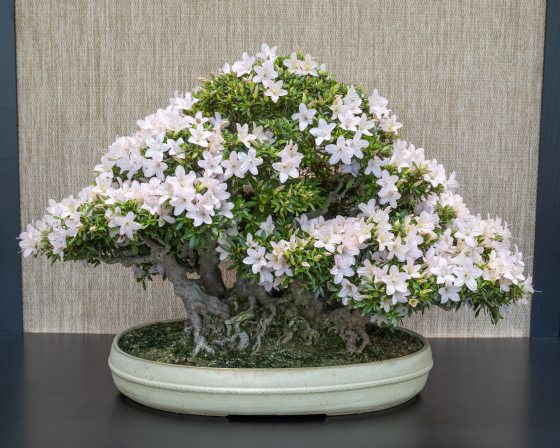
For this clump style bonsai, multiple trunks were planted together and have fused as one over time. Photo by Hank Davis.
Over centuries, Satsuki azaleas have been carefully cultivated and hybridized specifically for the use of bonsai, thanks to their leaf size and flower size that lend themselves to bonsai, as well as their ability to thrive in shallow containers while undergoing continual shaping. The forms themselves reflect traditional Japanese bonsai design principles. In nature, azaleas grow as unstructured shrubs, but through training they are transformed into compositions that guide the viewer’s eye. Classic branch placement—left, right, and ascending upward—creates balance and movement, while fine branching supports a layered canopy of flowers. While their vibrant flowers may first draw the eye, it’s also the craftsmanship of the tree’s structure that sustains them.
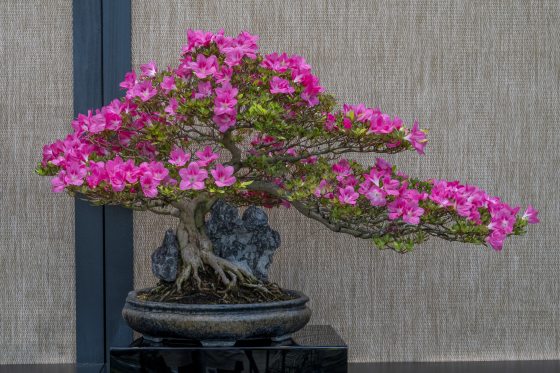
Approximately 60 years old, this Rhododendron indicum ‘Suzu-no-Homare’ is in root-over-rock style. Photo by Hank Davis.
What also sustains them is the expert care each has received. All of the trees on display were imported from Japan, each carrying its own lineage and history. Some have been trained and refined over multiple generations, reflecting a deep tradition of family stewardship and dedication to the Satsuki azalea craft. Selections include important works from Hiroharu Kobayashi, owner of Kobayashi Sangyou and one of the most influential Satsuki bonsai growers in the world. Kobayashi’s trees represent decades of refinement, seasonal discipline, and deep knowledge passed through generations of Japanese azalea specialists.
Among the many varieties on display, certain cultivars stand out. Kinsai, for example, is celebrated for its vivid, true red flowers. Its slender, elongated petals radiate outward like fireworks—earning it nicknames such as “firecracker” or “firework”. Other varieties have equally captivating traits, including flowers that invert, twist, or express multiple colors and patterns on a single plant. This diversity means that no two trees are exactly alike.
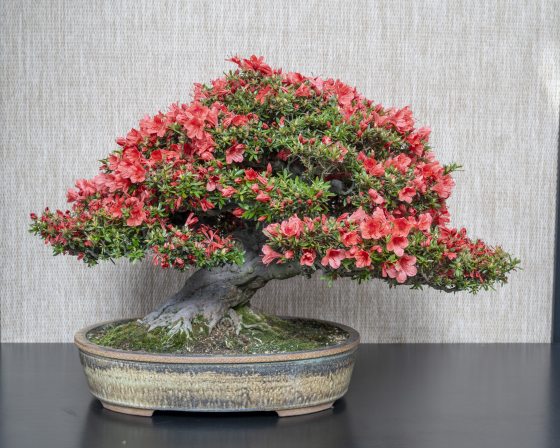
This slant style bonsai features the stand-out Kinsai cultivar, often referred to as “firecracker” for its vivid hue and slender, elongated petals that radiate outward. Photo by Hank Davis.
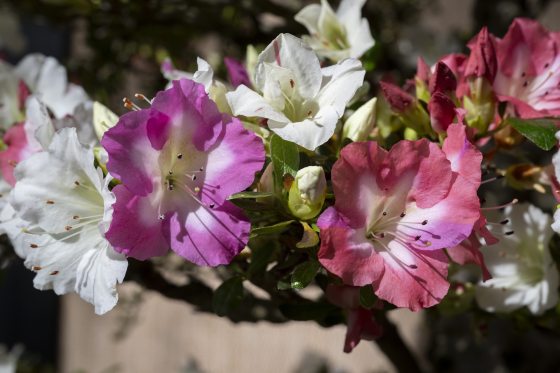
This close view shows the variety of flowers, from variations of red, to white, to striped, on a singular Satsuki azalea bonsai. Photo by Hank Davis.
Scale also plays an important role in the exhibition. Larger specimen trees command attention with their dramatic presence, while smaller bonsai—often tabletop-sized—offer intimate moments of detail. Some feature exposed roots that twist and grip dramatically above the soil, adding another layer of visual intrigue. These variations evoke the natural world in miniature, suggesting distant mountain landscapes or ancient trees shaped by time and weather.
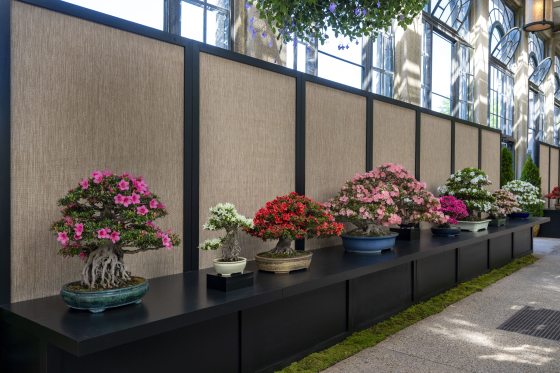
Showcasing a variety of styles, sizes, and colors, a glimpse at just a view of the rotating Satsuki azalea bonsai on display in our Exhibition Hall. Photo by Hank Davis.
The display itself has been thoughtfully designed to tell a story. Carefully crafted by Longwood’s team of carpenters, custom wooden stands support each bonsai. Custom fabric backdrops add more context, inspired by traditional Japanese presentation. Rather than arranging the trees in a linear sequence, the exhibition adopts a more dynamic, landscape-inspired composition. Trees of varying sizes are grouped together to create a sense of depth, with larger specimens appearing closer and smaller ones receding into the distance. This approach encourages guests to experience shifting perspectives and relationships between the trees.
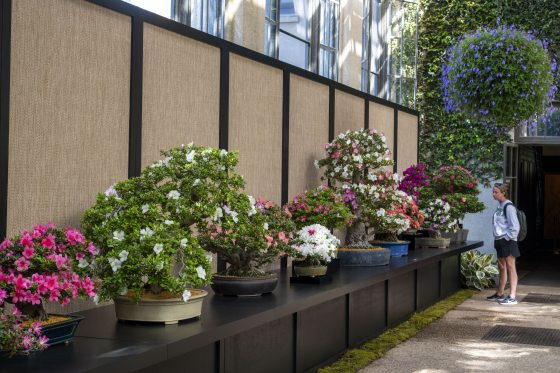
A guest takes a close look at the Satsuki Azalea Bonsai Display. Photo by Hank Davis.
Longwood Bonsai Curator Kevin Bielicki encourages guests to slow down and fully experience each tree. “Every Satsuki azalea has so much to offer,” he says. “Start by taking in the flowers with their color, their shape, and their beauty, and then look more closely at the structure. You’ll begin to notice the detail, the craftsmanship, and the many layers that come together to create something truly remarkable.”
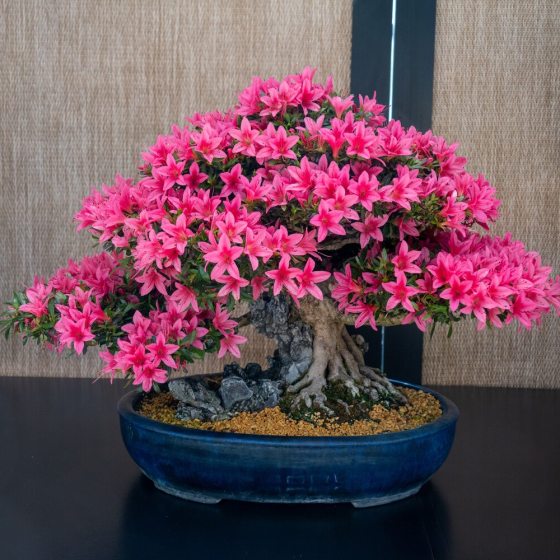
This large Satsuki azalea bonsai was once featured in the prestigious Kokufu-ten exhibition at the Tokyo Museum of Art. Photo by Hank Davis.
Whether you are new to bonsai or a longtime admirer, the opportunity to see so many of these remarkable trees together is rare. In their brief season of bloom, Satsuki azaleas remind us to slow down, look closely, and appreciate the beauty that emerges when nature and human artistry are brought into balance … and right now is the time to do so, here at Longwood.
Editor’s note: Experience our Satsuki Azalea Bonsai Display, on view now through June 15. Then, be sure to return for our inaugural Longwood Gardens Bonsai Festival, on view June 24–29. This six-day celebration features an exceptional bonsai display in partnership with participating clubs, as well as engaging demonstrations and lectures from leading artists, a curated selection of vendors, an auction, and awards.