I find it fascinating how a garden does not end at its outer walls, where green meets a road or a house. Instead, it extends far beyond its physical boundaries through the people, places, and stories it touches. Gardens are dynamic environments that cannot simply be frozen in time. They are living, evolving spaces where knowledge is shared, traditions are sustained, and stories are passed from one generation to the next. As one of Longwood’s international interns, here I share three interconnected stories from around the world that reflect these connections and explore how knowledge, experience, and a sense of place are carried forward by those who steward a garden.
The first story takes place at Villa San Michiele, a historical museum and garden on an island off the Neapolitan coast, where I learned how to prune orange trees (Citrus × sinensis) while getting to know my riveting coworkers in 2024.
“Lean over the ivy, make sure you hold on to the railing, and yell if someone is walking underneath!” the head gardener called as we carried heavy branches. The last thing we would want is for a tourist to get a branch on them and then we’d get in trouble, he joked. We had spent the first hour of the work day sharpening our pruning shears and saws with sandpaper, and we were now making our way up the mountain to the citrus grove.
He was eager to show me how his uncle, the head gardener before him, taught him how to prune fruit trees. The walk through the gardens up to the grove reminded me of home in Sweden but Capri certainly had more lizards dashing across the stone steps of the grove stairs as we climbed. He asked me if I’ve ever pruned trees before and I answered that I had had multiple pruning exams in university. He snickered and confessed that he thinks it sounds so silly to have exams in school about such “simple” gardening tasks.
He showed me where to cut and which branches he wanted gone and we got started. The goal was to get a tighter branch system and more oranges on each branch the following year. He started on the trees to the right, me to the left, to then meet in the middle. My arms got tired quickly. I looked over to him, who hadn't even broken a sweat. The Italian heat did not seem to get to him after almost 40 years of service in the gardens.

The view from the Villa San Michele in Capri. Photo by Sofia Kling Isernia.
The cuts turned out nice with the help of our sharp saws. We executed safety cuts on the heavier branches and made sure not to leave any stumps; if we did the tree would struggle more to heal the wound we made and would make it more susceptible to diseases. We removed branches that crossed over each other and those that grew straight up into the crown of the trees. After that, we looked at the branches that displayed an acute angle towards the trunks and discussed whether we should cut those down as well. We decided to leave them until next fall.
By noon, the ground was covered in decadent smelling branches. I had no idea that the branches of the orange tree smelled so lovely. When I asked which compost pile I should toss the branches on, He reached for a ball of string from his belt and said that we had to bring them to the chipper—which was clear across the garden. We collected a big bunch, tied them together, and tossed them onto our backs before making our way through the garden. The tourists looked at us quizzingly, and it felt like we resembled two gnomes heading home on a winter's eve with firewood. We had to go back and forth multiple times.
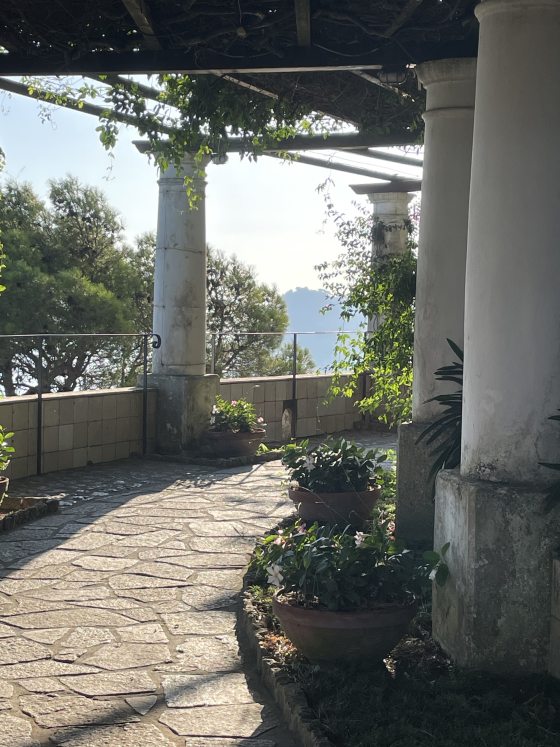
The walkway from which we pushed the branches down to the garden in Capri. Photo by Sofia Kling Isernia.
It was then that herevealed his system: a rope line and a collection of homemade S-hooks. We waited for a gap in the visitor traffic before sending the bundles flying down toward the olive grove below. We kept watching and waiting for clear moments without tourists to push all the branches down. Then, his apprentice appeared at the end of the line where the bunches had collected. The apprentice was just far enough away to have to yell if you wanted him to hear you. I realized that he was busy bringing us the chipper for the branches.
How thoughtful of him, I thought. It would have taken us ages to get to the chipper and bring it down the narrow stone stairs. At that exact moment, the head gardener hooked another large bunch of orange branches, tugged at the string, and glided it directly into the apprentice, who let out a few good-natured Italian swear words that echoed up the hillside as the head gardener howled with laughter. In that moment, I was reminded that horticultural knowledge is passed down through more than instruction alone. It lives in relationships, shared work, and the stories, sometimes humorous, that become part of a garden's legacy.
My second story revolves around a 200-year-old tree in the garden attached to the childhood home of the author who created a character who is dear to many: the wondrous Pippi Longstocking! Astrid Lindgren’s writing continues to captivate readers today, just as they did when the first Pippi books were published. During my time working in that garden, countless families visited, and this is a story about how my fellow gardeners and I helped bring some magic into the garden.
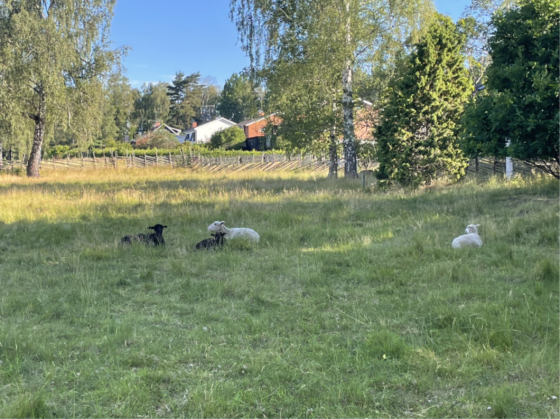
The sheep we took care of at Lindgren’s childhood home graze on the property. Photo by Sofia Kling Isernia.
Lindgren grew up in a small red house in the charming Swedish town of Vimmerby. Near the house was a large elm (Ulmus sp.) that inspired the iconic “Old Lemonade Tree” from the Pippi stories and films, a tree that could magically produce lemonade from inside its trunk. Lindgren and her family knew it as the “Owl Tree”, as owls would nest in its hollow trunk, and she and her siblings could hear their calls at night.
My story begins at dawn on May 21, 2025. Pippi was given an honorary birthday based on the day when the very first manuscript was given to Lindgren’s daughter Karin as a birthday gift in 1945. Each year, the gardens and museum at Lindgren’s childhood home celebrate the occasion. That year, we were tasked with decorating the Owl Tree.
As props associated with Pippi arrived, we brought out giant ladders and harnesses. We then had a great idea! We decided to place her knapsack filled with golden coins in the perfect spot and laid out her oversized leather boots beneath the branches. Strapping into the harnesses and climbing on the ladders, we then hung a 4-meter-long knitted scarf in Pippi’s signature style and glass lemonade bottles suspended from strings. We climbed the tree and checked throughout to make sure the scarf had a perfect placement in the branches. By the time the sun started to peek over the horizon the elm had colorful hangings of reds, yellows, blues and greens in between the branches. We looked at each other in satisfaction, and we placed the final touches of carrots nibbled on by Pippi's white horse Little Old Man or as he was simply called in the books, The Horse.
We waited patiently for the first guests of the day to arrive at 10 am, knowing that that multiple school groups were scheduled for that day. We worked in the area around the tree that day and oh how fun it was to tell the children that a very special girl had visited her favorite tree on the night of her birthday. Many of them seemed to believe it might just be true.
Perhaps that is part of a garden's magic. Beyond caring for plants, we help steward stories, memories, and imagination, creating moments that connect people to a place and encourage them to carry a little of its wonder with them long after they leave.
The third story is a recent one. It comes from a chilly October 2026 morning at the very start of Longwood’s Chrysanthemum Festival install, when a group of friends and colleagues joined forces to tackle a task.
In the early morning hours, the interns selected to help excitedly started pulling plants out from a conservatory walkway. Plant after plant was lifted out of the soil and tossed into giant bins for composting. As the hours passed, more and more people joined us and the piles of compost grew. We wiped our brows, shook the soil out of our boots, and continued.
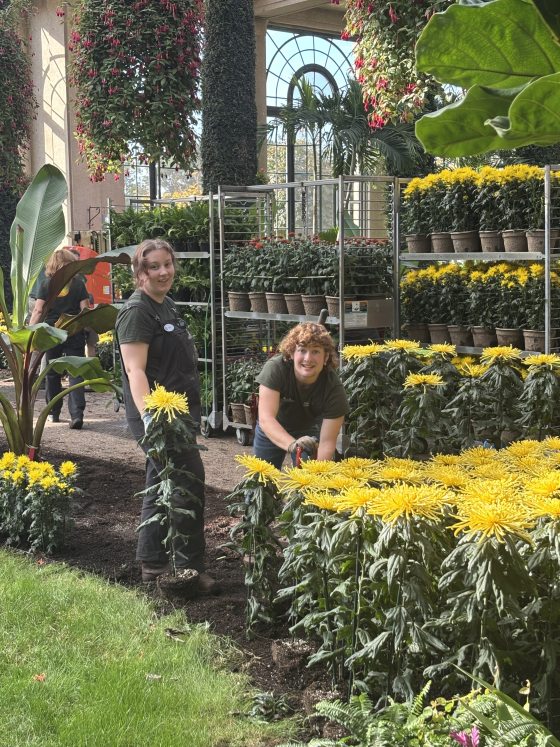
From left: Interns Sofia Kling Isernia and Kenny Henk work on digging and planting chrysanthemums in the East Conservatory. Photo by Janet Bagnell.
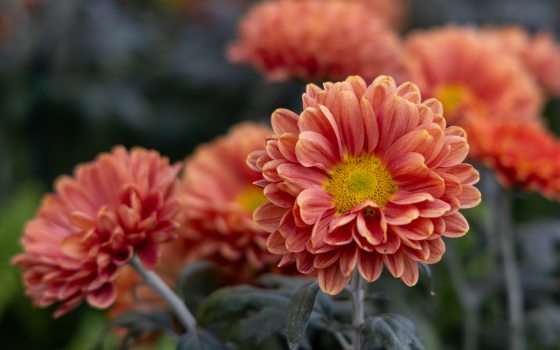
Before long, the majority of the conservatory staff was working side by side to plant mums, mums, and more mums. Carts arrived overflowing with towering single-stem chrysanthemums, disbudded chrysanthemums, and chrysanthemum sprays, all in countless shades of color. Spades, troughs, and kneeling pads were handed to us and we started digging. One person dug while the other unpotted and passed mums down the line. The towering single stems required very deep holes because of their height. Despite the hard work, laughter was shared, stories were told, and we all felt a little closer to each other.
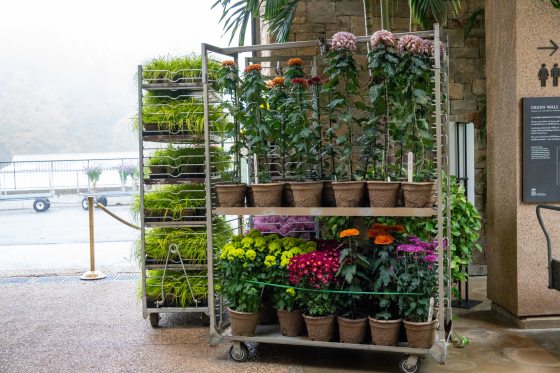
Carts overflowing with chrysanthemums arrive to be planted. Photo by Amy Simon Berg.
By afternoon, the walkway that only a few hours before had been reduced to bare soil was transformed into a river of crimson, orange, and green. There’s no better feeling than hard work turning into something so beautiful. Although I haven't been here for very long yet, I feel as though I have learned loads and met so many interesting fellow horticulturists. I am amazed every day by what we accomplish together. Alongside the other international interns, domestic interns, staff, and volunteers, we get so much done while bringing magic into the Gardens every day.
Looking back on these three stories, I am reminded that the heritage of gardening lives on through sharing, teaching, and storytelling—a concept that I explored when I wrote my thesis on intangible cultural heritage within gardening. Plants may be at the heart of a garden, but it is people who carry its knowledge, traditions, and memories forward. One conclusion I have drawn is to give to your garden, because you never know what it will give back to you. In doing so, you may find your own horizons widened and your perspective shifted. From Capri to Vimmerby and now to Longwood, curiosity and openness have allowed me to connect with people, places, and stories across gardens and cultures. Those connections have become just as meaningful as anything I have learned about plants. And there’s much more to come.
Editor’s note: Interested in Longwood’s internship program? Applications open December 1 for our International Internship and Training program, as well as our College and University Internship Program. Learn more.