On a brilliant afternoon in late October, hundreds of guests gathered in The Fountain Room, talking excitedly as they enjoyed views of the fountains dancing against a backdrop of peak autumn color. Soft music filled the space while sunlight streamed through the windows, matching the mood that was both celebratory and full of anticipation. They had come to learn and connect. These professionals in landscape architecture, design, horticulture, and related fields had gathered to exchange ideas, explore new perspectives, and deepen their understanding of the issues shaping their professions. We were honored to welcome these thought leaders and practitioners, providing a forum for meaningful dialogue while advancing the conversations that help shape the future of the field.
The group had convened for the fifth Oberlander Prize Forum, an event that celebrates the achievements of the most recent laureate of the biennial Cornelia Hahn Oberlander International Landscape Architecture Prize, which is awarded to an individual who is “exceptionally talented, creative, courageous, and visionary” and has “a significant body of built work that exemplifies the art of landscape architecture.” The prize is named for the late Cornelia Hahn Oberlander, an enormously influential Canadian landscape architect who contributed to many significant designs in both Canada and the United States, and is administered by The Cultural Landscapes Foundation (TCLF) in Washington, DC.
Longwood had the distinct honor of co-hosting this celebration of the 2025 laureate, Mexican landscape architect Mario Schjetnan. Schjetnan, based in Mexico City, was chosen from more than 300 nominations by an international seven-person jury. He has taught at numerous institutions in both the United States and Mexico, belongs to the Academy of Arts of Mexico, is a Fellow of the American Society of Landscape Architects, and is a founding member of the Mexican Society of Landscape Architects.
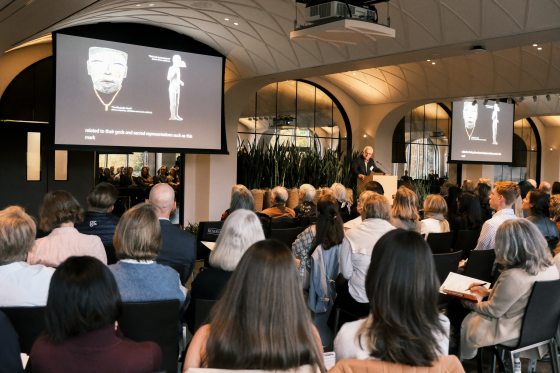
Founder of Grupo de Diseño Urbano and 2025 Oberlander Prize Laureate Mario Schjetnan presents in The Fountain Room. Photo by Allen Greller, courtesy of The Cultural Landscape Foundation.
Schjetnan founded and continues to lead his own firm, Grupo de Diseño Urbano (GDU), which works extensively on projects throughout Mexico, Latin America, the Middle East, and the United States. Among the firm’s most significant projects are Chapultepec Park, the oldest park in the Americas, and Xochimilco Ecological Park, a UNESCO World Heritage site with origins in the tenth century. Parks account for nearly half of GDU’s portfolio, which also includes residential development, post-industrial sites, and museums. Across all their projects, Schjetnan and his collaborators emphasize water sustainability, the recycling and repurposing of post-industrial sites, and the rehabilitation and improvement of urban and natural public spaces. Schjetnan says, “the major question of my life is to improve livability [both] in the poorest sections of Mexico and Latin America—to provide social justice and urban equity—and also in the richest sections.”
Among Schjetnan’s many inspirations he lists Roberto Burle Marx, the Brazilian landscape architect who designed Longwood’s own Cascade Garden. The name of this year’s Forum, Re:Search, and the decision to hold the event at Longwood, are both rooted in this inspiration.
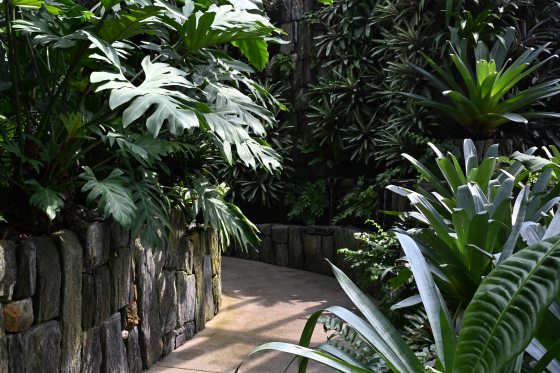
A rare work of landscape art, Longwood’s Cascade Garden is a verdant sanctuary inspired by an equatorial coastal rainforest. Photo by Brian O’Neill.
As the steward of the Cascade Garden, the last remaining Burle Marx-designed landscape in North America, Longwood already had a strong line of connection with Schjetnan. TCLF was further inspired by the parallels between the depth of research that informs the design work of Grupo de Diseño Urbano and the recent transformation and reconstruction of the Cascade Garden by landscape architects Reed Hilderbrand and architects Weiss/Manfredi.
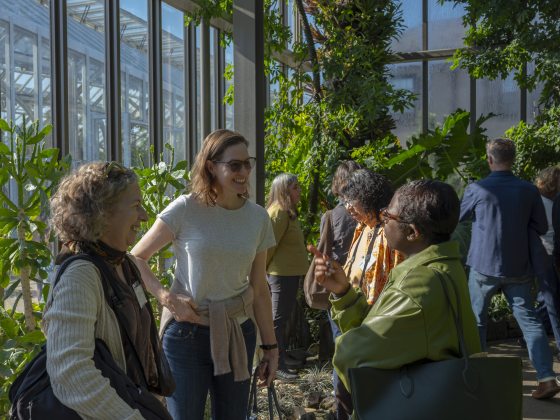
Groups gather in the Roberto Burle Marx-designed Cascade Garden during the Forum. Photo by Daniel Traub.
Charles A. Birnbaum, President and CEO of TCLF, considers the Cascade Garden project to be a prime example of a “holistic research-driven design process that values both natural-ecological and historic-cultural systems, providing inspiration to explore how today’s practitioners are building and sharing knowledge with the joint quest of revealing, honoring, and integrating cultural systems and lifeways in the face of inevitable change.”
From this inspiration, a roster of well-established leaders and emerging influential practitioners was assembled for the event. The star-studded schedule included Anne Whiston Spirn, Cecil and Ida Green Distinguished Professor of Landscape Architecture and Planning at the Massachusetts Institute of Technology; Walter J. Hood, Creative Director and Founder of Hood Design Studio; and Longwood President and Chief Executive Officer Paul B. Redman. This incredible group fostered a day of deep discussion through plenary presentations and panels, inspiring and challenging attendees in equal measure.
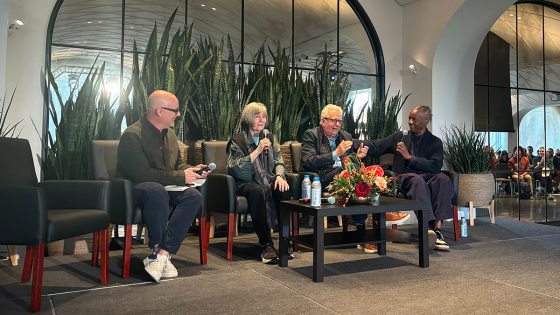
President and CEO of The Cultural Landscapes Foundation Charles A. Birnbaum; Cecil and Ida Green Distinguished Professor of Landscape Architecture and Planning at the Massachusetts Institute of Technology Anne Whiston Spirn; Founder of Grupo de Diseño Urbano and 2025 Oberlander Prize Laureate Mario Schjetnan; and Creative Director and Founder of Hood Design Studio Walter J. Hood share their thoughts during the fifth Oberlander Prize Forum. Photo by Allen Greller, courtesy of The Cultural Landscape Foundation.
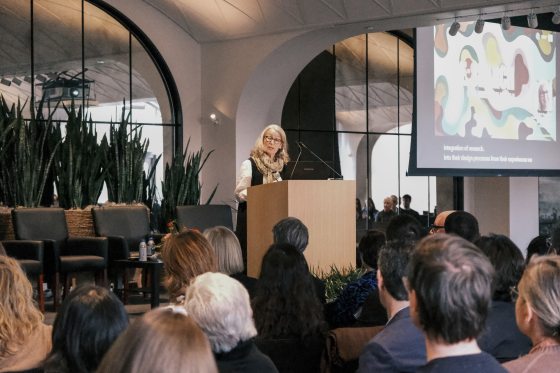
Merrill D. Peterson Professor of Landscape Architecture at the University of Virginia School of Architecture Elizabeth K. Meyer, FASLA shares remarks during the conference. Photo by Allen Greller, courtesy of The Cultural Landscape Foundation.
The following day, smaller groups ventured to Longwood at Granogue, Mt. Cuba Center, Chanticleer, and Winterthur Museum, Library, and Gardens, exploring the rich, interconnected cultural and natural landscapes of the Brandywine Valley. One group also returned to Longwood to dive deeper into the preservation of the Cascade Garden during a session led by Eric Kramer and Kristen Frederickson, Principals at Reed Hilderbrand. Throughout the multiple days of the Forum, the air of curiosity and connection was continuous and palpable.
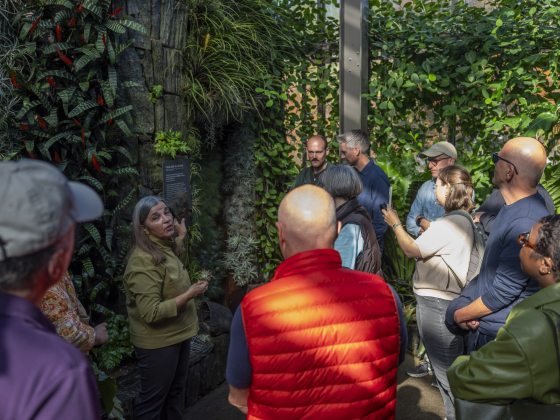
Longwood Plant Information Field Specialist Joyce Rondinella, who stewarded the Cascade Garden for nearly 20 years, leads the Forum tour. Photo by Daniel Traub.
It seems eminently appropriate that Longwood played the role of convener of both people and ideas in this case. Since founder Pierre S. du Pont purchased this property more than a century ago, generations have shaped the Gardens through horticulture, design, and innovation, honoring the past while imagining new possibilities. Across the Gardens, one can see evolving ideas about beauty, stewardship, accessibility, and guest experience inscribed on the landscape. Every era has contributed something new while building upon what came before, fostering a continual dialogue between history and innovation. Hosting this gathering, one that asked attendees to consider how a deeper understanding of place can inform the landscapes that they steward, continued that tradition of bringing people together to explore the important ideas of our time, as well as how landscape architecture in particular can shape communities and enrich lives.
“It was a privilege to host RE: SEARCH at Longwood and to welcome so many thoughtful practitioners to the Gardens,” said Paul B. Redman, President and CEO of Longwood Gardens. “We are grateful to The Cultural Landscape Foundation for its leadership in convening this important conversation. The conference showed that the best landscape design is grounded in deep research into both natural and cultural systems, and that commitment will shape our field well into the future.”
Editor’s Note: In addition to serving as a convener of thought leaders and practitioners, Longwood Gardens also offers educational opportunities for those new to design and horticulture.We encourage anyone interested to review our Continuing Education offerings, particularly our Landscape Design Certificate.