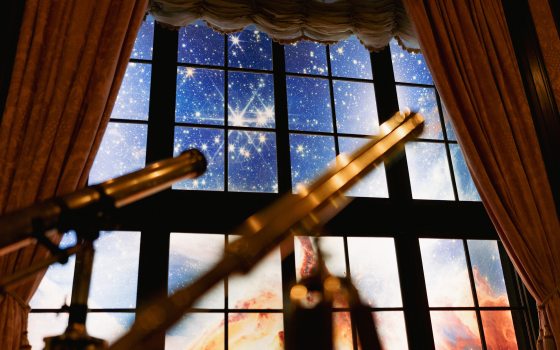
As you experience A Longwood Christmas this season, you’ll enjoy awe-inspiring views of a second type of garden: the garden of the cosmos. These monumental vistas, set outside and within Longwood’s Visitor Center, and as part of the astronomer’s observatory display in the Main Conservatory’s Music Room were captured by two of NASA’s flagship observatories: the always-active Hubble Space Telescope, which has operated since 1990 and the James Webb Space Telescope, which first wowed the world with its images and data in 2022. Staff at the Space Telescope Science Institute (STScI) act as stewards for these missions on behalf of NASA, and we were delighted to help curate these images as part of A Longwood Christmas. Here, we share how these images of space serve as windows into a very different kind of landscape. Come tour the cosmos with us, as we explore stars, star-forming regions, and galaxies, and the fascinating life cycles of each.
Gardens are always growing and changing. They exist in a constant cycle, with every ending feeding a new beginning. The same is true in space. Stars are born in clouds of gas and dust, live out their lives over millions or billions of years, and die, sometimes in magnificent explosions known as supernovae that blow and scatter newly forged elements into space. Those new materials become part of the next generations of stars, planets, and—eventually—the lush flora at our feet. The carbon in a leaf, the calcium in a petal, and the nitrogen in our DNA began in a star. We all formed from cosmic soil.
Hubble’s image of the Tarantula Nebula, which greets you on the right side of the Visitor Center entrance, captures the brightest star-forming region in our Milky Way galaxy. Just as the flowers and trees at Longwood start as protected seedlings, these bright yellow and orange stars exist in a stellar nursery. Individual stars can take thousands or millions of years to fully form. As they mature, stars emit strong stellar winds that sweep out the material in their immediate surroundings, carving intricate landscapes among the lattice-like pink, brown, and blue gas and dust.
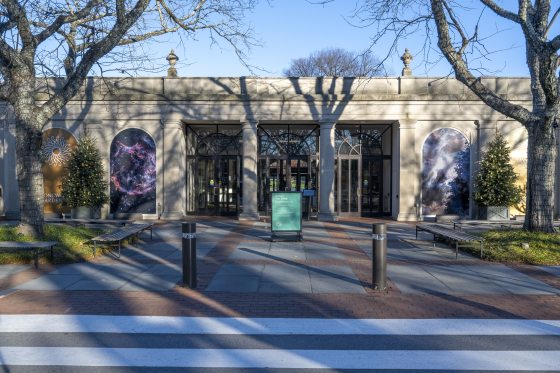
The Visitor Center entrance, with Cassiopeia A on the left and Tarantula Nebula on the right. Photo by Hank Davis.
On the left side of the Visitor Center entrance is Webb’s image of supernova remnant Cassiopeia A, which shows the intricate details of an exploded star. The remnant is spherical, like a blown glass ornament. Explosions of massive stars are among the most energetic events in the universe, tearing stars apart from the inside out while at the same time forging new elements and blasting them through interstellar space. Supernovae enrich everything around them. As you’re viewing the image, look closely for a hole toward the top left. Here, material was blown beyond the shell. Also notice the blue stars that dot this scene—they not part of this supernova remnant. They are either in the foreground or background.
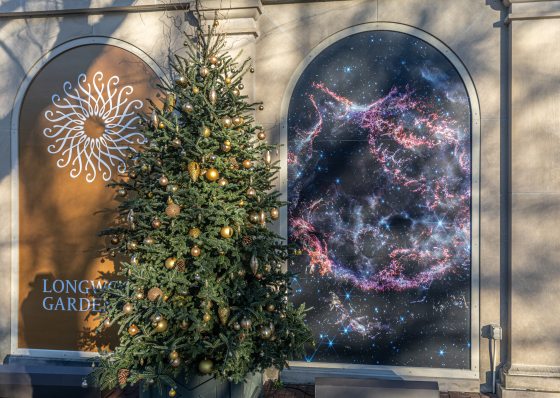
Cassiopeia A, outside of the Visitor Center entrance. Photo by Richard Donham.
Let’s zoom out to a grander scale: an entire galaxy. Look for Hubble’s portrait of spiral galaxy Messier 83, in the Visitor Center on the right side as you make your way to the Gardens. Galaxies can host billions of stars, and each of those stars have the potential to host a planetary system, like our own solar system. Messier 83 is dazzling with individual stars and star clusters. The galaxy’s oldest stars are in its bright pink core. Brown dust lanes trace the galaxy’s brightly lit spiral arms, which look like string lights on the grandest scale. Its pink and blue star clusters are made up of younger stars, which emit strong ultraviolet light. Hubble is uniquely able to show us even more of the dazzling stars in this image because the telescope captures ultraviolet light in addition to visible light. Like all galaxies, the drama of stellar birth and death unfold over billions of years, never ceasing. Many of the galaxy’s older stars exploded long ago, going on to enrich subsequent generations of stars that light up the scene today.
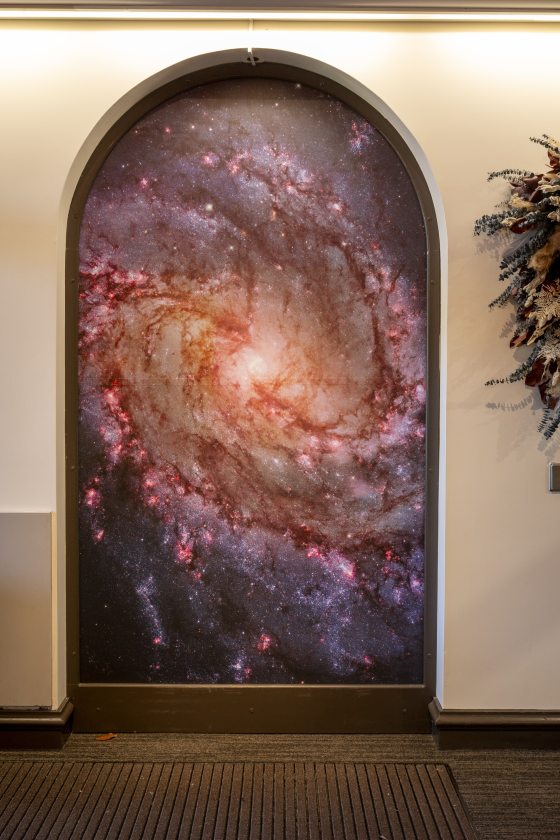
Messier 83, inside the Visitor Center. Photo by Hank Davis.
Perspective is everything. Our visual perception of a flower can change depending on how we hold it. The same rule applies to objects in space. Hubble and Webb’s view of Cigar Galaxy, displayed on the left side of the Visitor Center as you walk toward the Gardens, shows the galaxy edge-on. Orient yourself by locating the central blue disk. If we were to see this from the top, it would take the shape of a spiral.
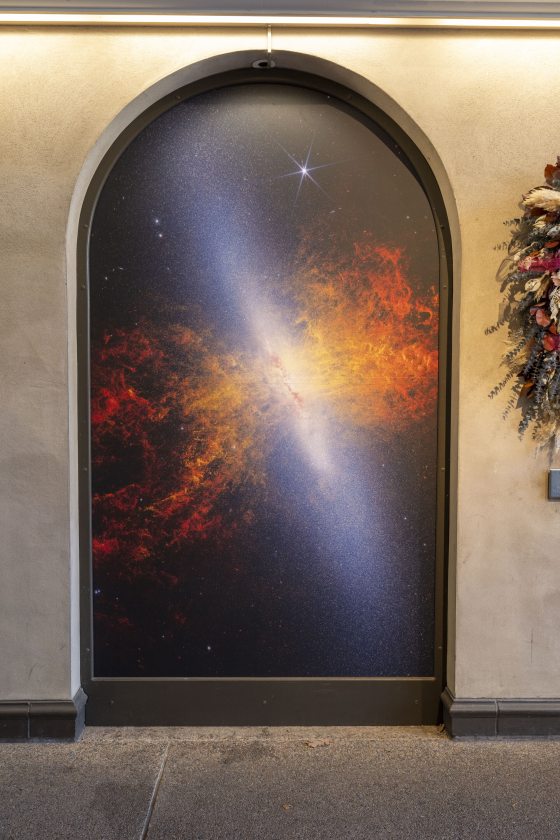
Hubble and Webb’s view of the Cigar Galaxy. Photo by Hank Davis.
Millions of stars appear in this galaxy. They pop out like bright blue bulbs. The majestic red and orange plumes at the top and bottom are the results of extreme star formation in the galaxy, which is causing material to be ejected beyond the galaxy’s central disk. Hubble detected the yellow tendrils, revealing they are made up of hot hydrogen gas. Webb detected the red-orange material farther away, and showed the material is made of small dust grains.
Like botanical ecosystems, galaxies—the homes of stars—come in many shapes and sizes, from small dwarf galaxies to large spiral galaxies like our Milky Way. Galaxies evolve over billions of years, and sometimes collide and merge, combining and compressing their gas and dust to create new generations of stars and enrich the cosmic landscape.
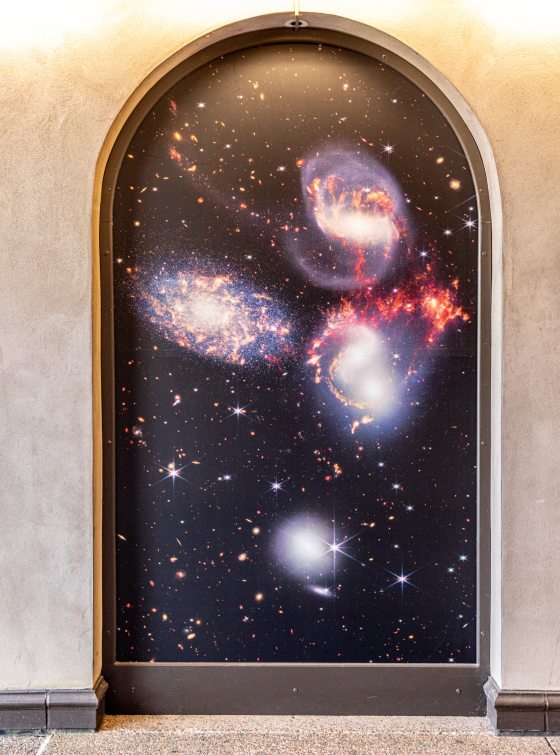
Stephan’s Quintet, on the right side as you enter the Gardens. Photo by Richard Donham.
Webb’s view of Stephan’s Quintet can be found in the Visitor Center, on the right side as you walk toward the Gardens. While this scene shows five large galaxies, scientific research has shown that only four are close to one another. Which one “snuck into” the photo? The galaxy on the left, which is significantly closer to us. Webb observed these galaxies in both near- and mid-infrared light. Near-infrared light shows innumerable stars—like tiny grains of sand. Mid-infrared light highlights all the dust, including glowing dust that is being heated by new star formation as the galaxies exchange material.
The closeness of the quartet has huge implications for the future of these galaxies. They are actively interacting with one another—exchanging material, changing their shapes, and combining and compressing their gas and dust to create new generations of stars. Just like ecosystems on Earth, galaxies evolve over time. Dramatic encounters like these are common throughout the life of a galaxy and their future is uncertain. They may combine into a larger, more massive galaxy. Or they may graze each other and follow their own paths. Their interactions will play out over billions of years.
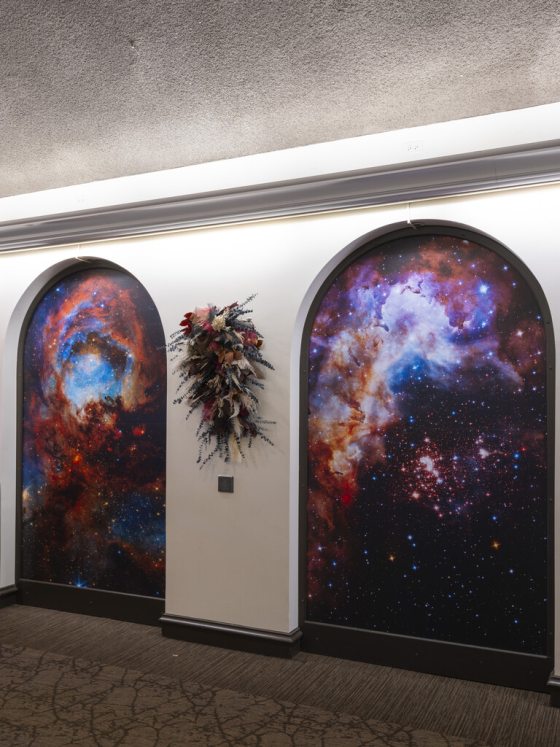
Webb’s closeup of the Cat’s Paw Nebula, where massive stars are forming (left) and Hubble’s observation of Westerlund 2, which is filled with more than 3,000 stars (right) in the Visitor Center. Photo by Daniel Traub.
We’ve been taking in entire galaxies and galaxy groups. Now, it’s time for a tight shot within our Milky Way, a jewel-like region of star formation. When you enter the Music Room, which has been transformed into an astronomer’s observatory, find Webb’s near-infrared light image of Pismis 24 past the room’s massive windows and steady your gaze.
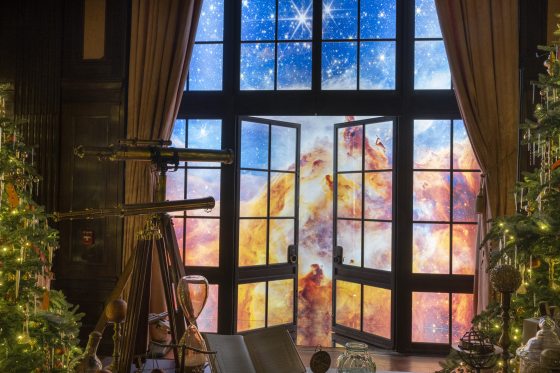
Pismis 24 serves as the awe-inspiring view in the Music Room. Photo by Hank Davis.
Peaks of gas and dust have been sculpted and eroded by light and winds from the most massive stars. These stars have already cleared the immediate areas around them and shine brightly with Webb’s signature eight-pronged diffraction spikes. Inside these brown pillars, dense clouds of gas and dust continue to collapse under their own gravity, forming the next generation of stars. These stars will remain hidden for hundreds of thousands of years. When they emerge from their dusty pods, their light and winds will clear the areas around them. Take a 3D tour or “fly” to this location.
You will find a similar scene in the Visitor Center interior, on the left side before you enter the Gardens. Webb’s near-infrared view of an area known as the Pillars of Creation, also in our galaxy, shows where new stars are forming within dense clouds of gas and dust. This image was made famous by Hubble with its visible-light observations. Let’s compare the two views.
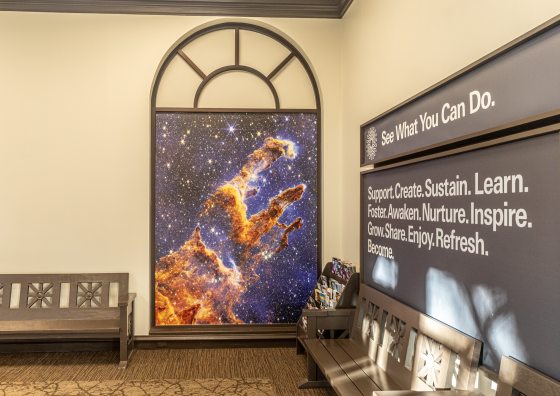
The Pillars of Creation, inside the Visitor Center. Photo by Richard Donham.
The background of Hubble’s 2014 image is like a sunrise, beginning in yellows at the bottom and transitioning to light green and deeper blues at the top. These colors highlight the thickness of the dust around the pillars, which obscures the stars in the overall region. In contrast, the background in Webb’s image appears in blue hues and reveals an abundance of stars across the scene. Near-infrared light reveals a sea of stars. Webb also shows us stars buried within the pillars, like seedlings in the dusty cosmic soil. Find them by looking for the red regions at the tips.
Webb also viewed the Pillars of Creation in mid-infrared light, showing off the thick dust in the region. Don’t miss the combination of Webb’s near- and mid-infrared images.
Neither Hubble nor Webb takes a snapshot the way our phones do. These telescopes were intentionally built to capture light that is sometimes beyond the limits of human vision, so although you would not see these exact views with your own eyes, these images are quite real. Hubble observes ultraviolet, visible, and near-infrared light, while Webb specializes in near- and mid-infrared light. Quickly compare them with this graphic. Both help us understand the scale, detail, and precise mechanics of the universe.
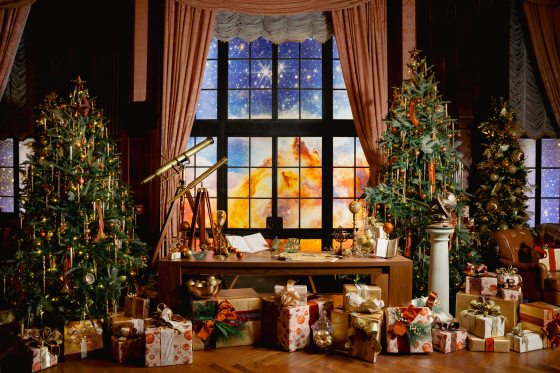
The otherworldly Music Room vista. Photo by Hank Davis.
Every image you’ll encounter in the Visitor Center and Music Room during A Longwood Christmas was carefully assembled by science visuals developers at STScI in Baltimore, Maryland, with the support of scientists as part of press releases and multimedia products. We work to reveal the subtle details of galaxies, star-forming regions, star clusters, and individual stars—every detail in every pixel. Watch videos to learn precisely how we do this for Webb and Hubble. Or explore an interactive that shows how looking longer at one region reveals more detail. There is also an in-depth article about Webb’s process.
NASA’s Nancy Grace Roman Space Telescope will soon begin expanding everything we know about the universe. Roman’s field of view is 200 times the size of Hubble’s near-infrared camera’s view. Roman launched on August 30, 2026 and is currently undergoing commissioning. It will soon return vast near-infrared images of the sky. How is it different?
In one month, Roman could survey over half the stars in our Milky Way galaxy, producing a catalog of 20 billion stars—far larger than any catalog that exists today. Roman will also help researchers locate tens of thousands of new planets that orbit other stars, known as exoplanets, adding to the list of over 6,000 known planets to date. The telescope’s ongoing monitoring will also catch spectacular cosmic displays, like tens of thousands of exploding stars that we would have otherwise missed.
Hubble and Webb will continue to excel at observing a range of locations in space. Their observations will complement and deepen what we know about objects in Roman’s surveys, both on macro and micro scales. It will be like having bird’s eye and worm’s eye views simultaneously.
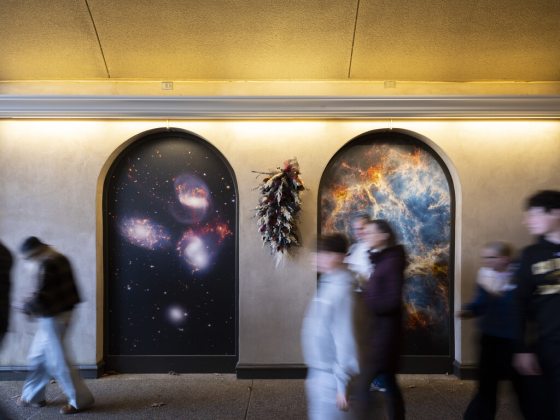
Guests enter the Gardens in front of Webb’s image of Stephan’s Quintet (left) and the Crab Nebula (right). Photo by Daniel Traub.
When it comes to tending to our cosmic “gardens”, observatories like Hubble and Webb help us witness the cosmic cycles of birth, death, and renewal in awe-inspiring detail all year. As astronomers explore the lives of stars and galaxies across billions of years, we find echoes of the same processes at work here on Earth. Gardens like Longwood remind us that we are part of an unimaginably vast universe where constant evolution is the norm.
Just as Longwood horticulturists and scientists steward the Gardens, our colleagues at STScI in Baltimore are like stewards. In support of NASA, we seek to empower astronomers around the world to make scientific discoveries that unlock the secrets of the universe. We share their discoveries with engaging press releases and multimedia products to inspire, excite, and inform the public. Hubble and Webb take new observations daily—there’s always more to learn. Read a few of Hubble’s amazing discoveries and a few of Webb’s early breakthroughs. Roman will soon radically expand our outlook with its extensive surveys. It’s an exciting time to be alive in the universe. We hope you continue to follow along all year, every year.
For now, we’re happy to share more information about all the images on display during A Longwood Christmas.