This article first appeared in issue 289 of Longwood Chimes, from Summer 2014.
Our history with growing and displaying Nymphaea dates back to 1957 with Patrick Nutt as a major influence in the development of our outdoor water gardens. Nutt has spent half a century making Longwood Gardens one of the most respected names in the botanical world with his research on hybridizing waterlilies. He is also a founding member of the International Waterlily and Water Gardening Society.

Tim Jennings, an understudy and friend of Nutt’s, is now curator of the collection and is responsible for its care. Nationally recognized as an expert in the field, Jennings is known for his teachings on Nymphaea as well as his contributions to industry publications like The American Garden Guides: Water Gardening.


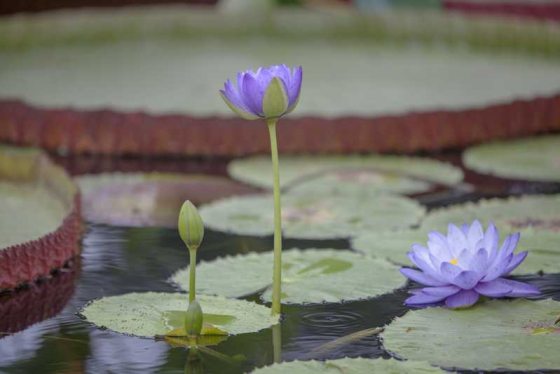
The Nymphaea collection is one of our core collections, receiving special focus on its development, management, and display in the Gardens. More than 18,000 square feet of display pools are used to grow Nymphaea between the months of April through November. The collection holds over 1,200 individual plants with nearly 100 different taxa and joined the ranks of the North American Plant Collections Consortium (NAPCC) collection in October 2012. NAPCC accreditation elevates this collection, which will now focus on preserving historic waterlily varieties and serve as a reference for plant identification. The records of this collection are maintained in a database, BG-BASE, and in original archival paper records. They are also partially accessible through Longwood's online public access plant information database, Plant Explorer.
We make every effort to grow only the highest quality Nymphaea and strive to keep improving through research. The current objective is to determine the effect of various physical and chemical properties of the growing medium on leaf and flower production of Nymphaea. While research is critical to this collection’s viability, Jennings’ real objective as curator ofthe collection is quite simple. “It’s about getting as many people interested and intrigued by these natural wonders as we can. The sheer beauty and intense complexity of these plants makes me smile every day.”