Right now is the height of summer in the Idea Garden’s Annual Corridor, an ever-changing showcase of tropical, hardy, and annual flowering plants. Bursting with color, texture, and inspiration, this vibrant display offers a chance to experience the beauty and impact of summer annuals in full bloom. Join me for a tour of this spectacular garden space and, if you haven’t visited recently, be sure to see it in person soon, while it’s at its most stunning.
As you enter the Annual Corridor, you’ll find yourself surrounded by a hedge of Hydrangea paniculata ‘Limelight’ (Panicle Hydrangea). Currently covered in blooms, these hydrangeas really put on a show during the height of the summer months. This year, they have tripled in size and are now getting close to 5 feet tall!
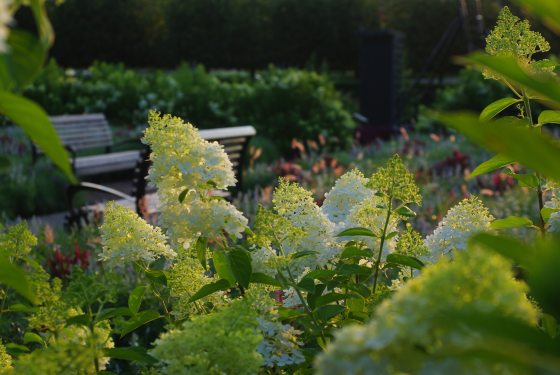
Hydrangea paniculata ‘Limelight’ (Panicle Hydrangea) frame the Annual Corridor entrance. Photo by Patrick Greenwald.
It’s also the year of Melinis nerviglumis ‘Savannah’ (Ruby Grass) with more than 1,000 plants throughout the Annual Corridor. A beautiful annual grass, it is just now beginning to send up fluffy, ruby-colored inflorescence, and will continue to bloom until the first fall frost.
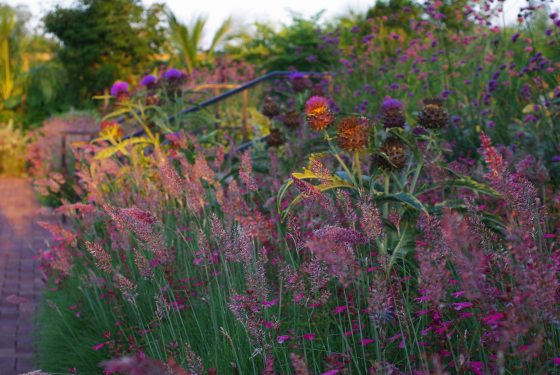
Melinis nerviglumis ‘Savannah’ (Ruby Grass) has really come alive as we approach August. Photo by Patrick Greenwald.
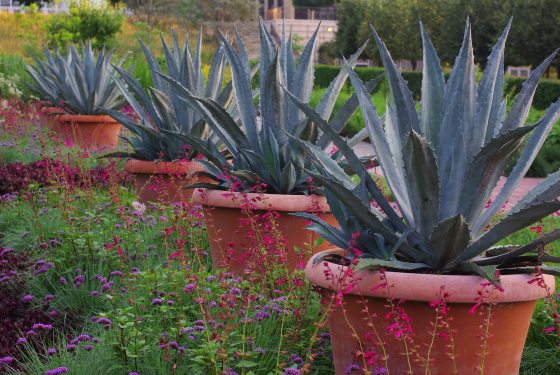
It’s hard not to notice the six stately Agave americana (Century Plant) proudly standing tall in the terra cotta containers that line the entrance. Photo by Patrick Greenwald.
Other plants to notice in the space’s meadow-like patchwork include the hummingbird-favorite Salvia ‘Wendy’s Wish’ (Sage), Celosia argentea (Plumosa Group), ‘Kelos Atomic Neon Pink’, Salvia farinacea ‘Victoria White’ (Mealycup Sage), and Salvia farinacea ‘Sallyfun™ Sky Blue’ (Mealycup Sage) abuzz with activity of bumblebees visiting the nectar-rich flowers.
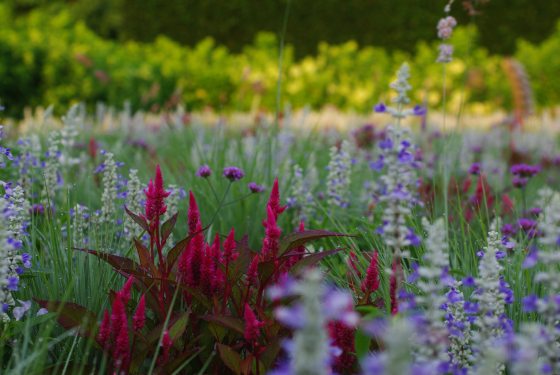
Celosia argentea (Plumosa Group) ‘Kelos Atomic Neon Pink’ adds deep color to the display. Photo by Patrick Greenwald.
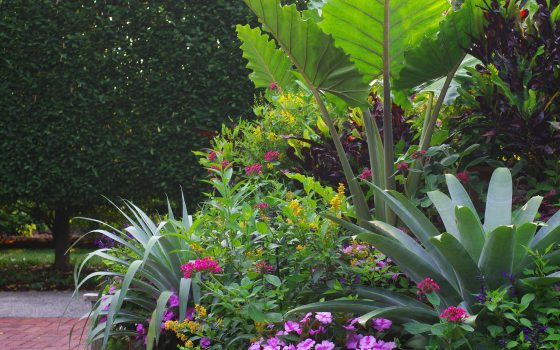
The garden’s 12+-foot-tall Carpinus betulus (European Hornbeam) hedge envelopes our tropical container garden display, punctuated by five giant upright Alocasia ‘Portodora’ (Elephant’s-ear plant), which have already doubled in size since planted. If all goes to plan, they should grow anywhere from 6 to 8 feet tall by the end of summer!
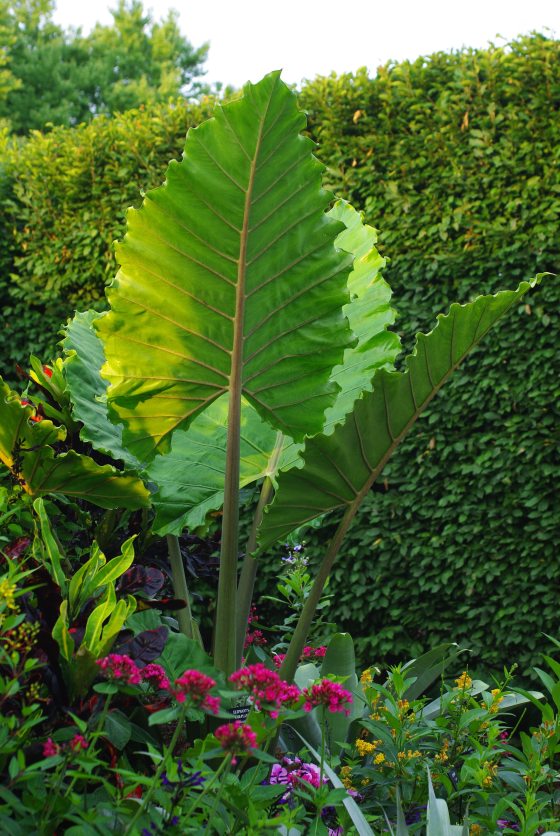
Alocasia ‘Portodora’ (Elephant’s-ear plant) stands tall amid the Carpinus betulus (European Hornbeam) hedge. Photo by Patrick Greenwald.
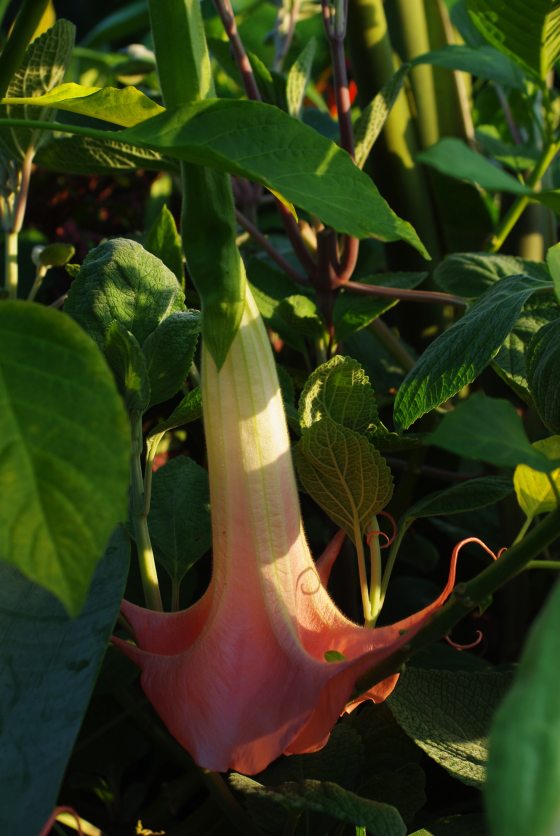
Look closely and you’ll be treated to the sight of the long, salmon pink, trumpet-shaped flowers of Brugmansia versicolor ‘Ecuador Pink’ (Apricot Angel’s-trumpet) in the center of the display. While sitting on one of the four benches in this garden space, you may notice the air filled with fragrance from this Brugmansia, which is strongest in the evening hours. Photo by Patrick Greenwald.
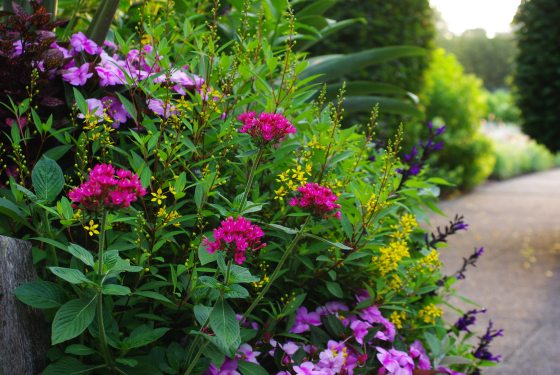
Other favorites include Pentas lanceolata ‘Nova’ (Egyptian Star-cluster), a tall variety with magenta purple flowers on plants that grow up to 4 feet tall. Photo by Patrick Greenwald.
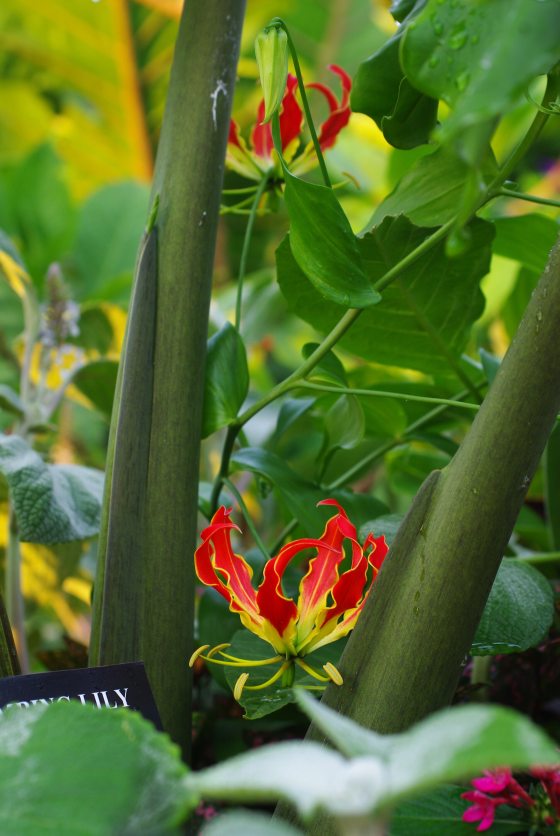
Look for Gloriosa superba ‘Rothschildiana’ (Climbing-lily) trailing up one of the Alocasia; though not a true lily, this trailing vine boasts striking lily-like blooms. Photo by Patrick Greenwald.
Purple, pink, yellow, silver, and magenta flowers fill the lush, tropical green display that surrounds each bench. Salvia discolor (Andean Sage), Galphimia glauca (Golden Thryallis), Salvia × guaranitica BODACIOUS® ‘Hummingbird Falls’ (Anise-Scented Sage), Cestrum ‘Orange Peel’, and Impatiens (SunPatiens Group) SunPatiens® make a soothing space in which to rest. This container display will continue to evolve over the course of the summer, and in late August to early September, the glorious purple panicles of the velvety leafed Tibouchina grandiflora (Large-leaved Glory Bush) should begin to bloom.
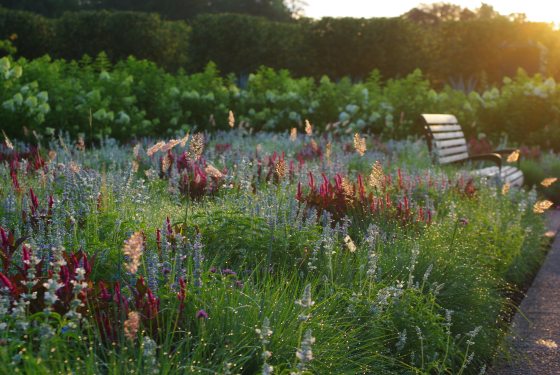
Sit and stay a while, surrounded by beauty. Photo by Patrick Greenwald.
As you venture further west, you’ll find a seaside escape-inspired palette of flowers and tropical shrubs surrounded by a border of Melinis nerviglumis ‘Savannah’ (Ruby Grass), Salvia ‘Skyscraper Pink’ (Skyscraper Pink Hybrid Sage), Oxypetalum coeruleum ‘Heavenly Blue’ (Blue Milkweed), Conocarpus erectus var. sericeus (Silver Buttonwood), Cynara cardunculus ‘Porto Spineless’ (Cardoon), and Helianthus debilis subsp. vestitus (‘Italian White’ Sunflower).
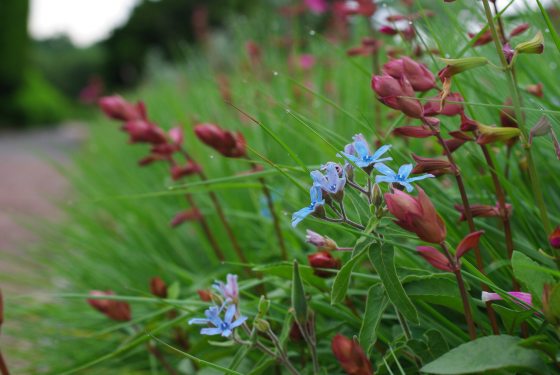
Oxypetalum coeruleum ‘Heavenly Blue’ (Blue Milkweed) adds unique sky-blue flowers to the space. Photo by Patrick Greenwald.
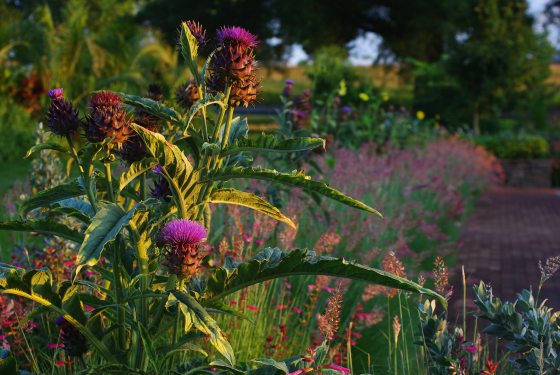
Cynara cardunculus ‘Porto Spineless’ (Cardoon) has been of particular interest to guests; related to an artichoke, it’s also an edible plant. Unlike the artichoke, its young leaf stalks are typically harvested. Photo by Patrick Greenwald.
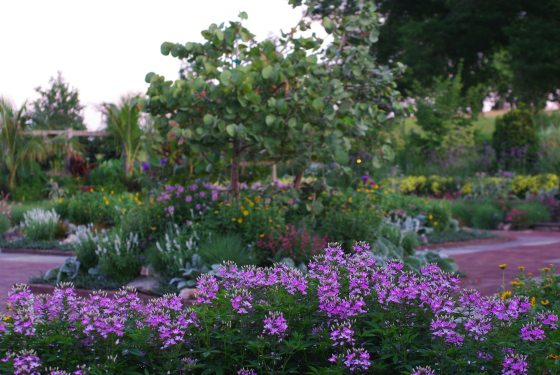
In the center of the seaside-inspired display are 10-foot-tall Coccoloba uvifera (Sea-grape), native to Florida. Photo by Patrick Greenwald.
Another native of the beaches of Florida, Helianthus debilis ssp. vestitus (Beach Sunflower) can be seen throughout the display. Measuring less than 2 feet tall, these shorter sunflowers easily grow 5 feet wide, boasting lush green foliage and cheery small sunflowers.
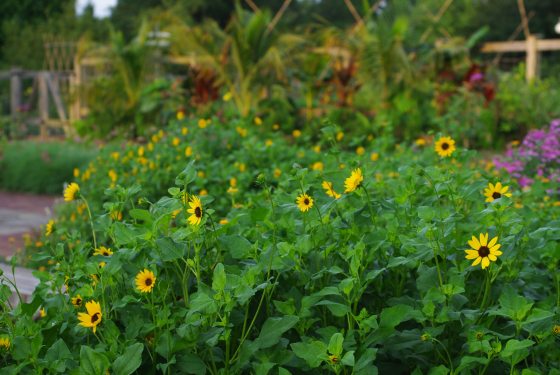
With its low-growing and free-flowering habit, Helianthus debilis ssp. vestitus (Beach Sunflower) is one of my favorites this season. Photo by Patrick Greenwald.
Don’t miss this season’s seemingly most-asked-about plant, the border of Evolvulus glomeratus ‘Beach Bum Blue’ (Brazilian Dwarf Morning-glory). Apparently loving the 100-degree stretch of weather in July, this low-growing, trailing plant is known for its true-blue flowers. Right now, the plants are maybe 4 inches tall, and we’ll see if they will make it to 10 inches by the end of summer. If planting Dwarf Morning-glory at home, it is best grown in well-drained soil; be careful with too much moisture early in the summer season when the plants are young and the temperatures are cooler.
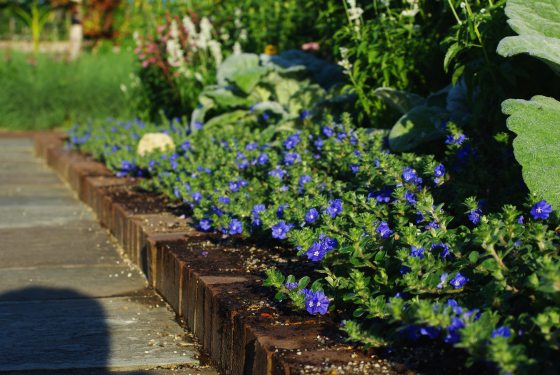
Evolvulus glomeratus ‘Beach Bum Blue’ (Brazilian Dwarf Morning-glory). Photo by Patrick Greenwald.
When planning an annual display, I try to design for pollinators and use plants that enjoy similar soil, light, and moisture conditions. I typically first choose base plants that I know from experience will do well throughout summer, such as Ruby Grass and Dwarf Morning-glory. My creative side likes to push the limits and try new or interesting plants such as the BeachSunflowers and Silver Buttonwood to add horticultural interest and lend to more of a habitat feel versus a conventional annual display.
As we come to the end of our summertime Annual Corridor tour, I do hope it leaves you inspired when it comes to your own garden at home—and to see all of these beautiful plants, blooming at their very best right now. Here’s a tip: If you find yourself here for an evening fountain performance, prior to sunset head over to the Idea Garden to catch this display in all of its golden-rays-of-sunset glory.