Every year, as part of Longwood’s Professional Horticulture Program—a two-year, tuition-free program that trains and prepares future horticulturists for successful careers—students travel abroad to a location that exemplifies outstanding horticulture with the intention of broadening our gardening perspective. After two years’ worth of enriching local field trips, as well as organizing and holding three plant sales to help fund our trip, last month we embarked on the ultimate international trip to Singapore! A global leader in horticulture, Singapore is known for its botanic gardens, award-winning green urban infrastructure, and preserved natural lands with a stunning tropical plant palette. We structured our itinerary with these pillars in mind and, here, share all we learned during this unique opportunity in the renowned “City in a Garden”.
Upon our arrival, stepping out of Changi Airport (which we would tour later) and driving to our hotel, we could immediately tell we were entering a new landscape. The streets were lined with Rain Trees (Samanea saman), providing a gentle canopy over the road. There were plantings of Plumeria, palm trees, and tropical flowers all along the roads. The temperature was also an indicator of entering a new realm, as we felt the wave of heat and humidity that makes the year-long growth of these tropical plants possible.
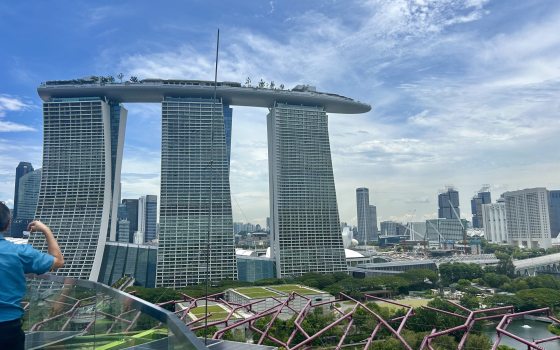
The first stop on our journey was Gardens by the Bay, and what a way to start the trip. Established in 2005 and opened to the public in 2012, Gardens by the Bay features the iconic Supertree Grove, Flower Dome, and Cloud Forest, just to name a few. The supertrees support epiphytic plants such as ferns, orchids, and other climbers. Some of the trees also provide energy by collecting sunlight through solar panels, and rainwater which helps in providing cooling for the nearby conservatories. The trees also come alive at night during shows that incorporate lights and music. We were able to go to the top of the observatory deck of one of the trees and walk the skyway that connects the trees. It was a surreal experience and provided spectacular view of both the gardens and the city.
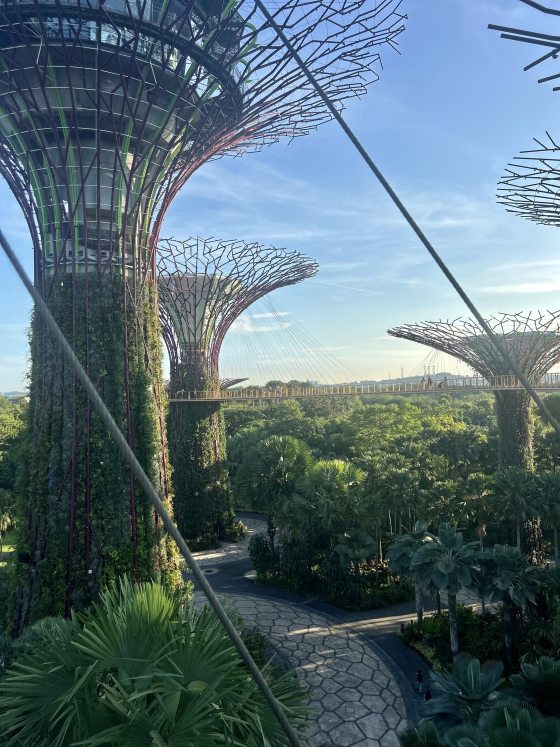
The Supertree Grove at Gardens by the Bay. Photo by Lauryn McMiller.
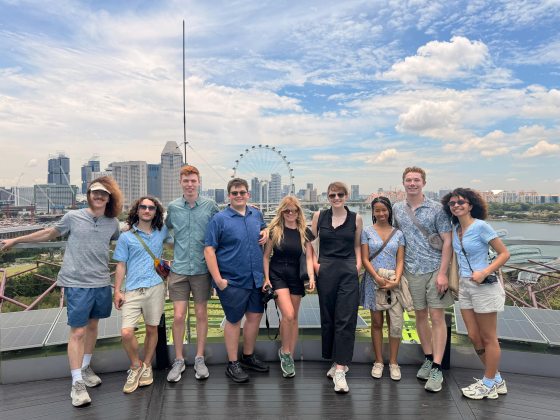
From left, Professional Horticulture Program class of 2026 students Logan Kline, Joshua Ferris, Travix Cox, Matthew Fleischhacker, Rachael Adams, Ellie Schlehr, Lauryn McMiller, Micah High, and Melanie De La Cruz at the Supertree Observatory at Gardens by the Bay. Photo provided by Lauryn McMiller.
The Cloud Forest is a conservatory housing an artificial mountain that’s covered in lush, rainforest vegetation. The mountain is shrouded in mist and features a cascading waterfall, both of which contribute to the atmosphere of a tropical cloud forest. Cloud forests are unique ecosystems as they have ideal conditions for certain tropical vegetation such as high elevation and humidity, creating a cool and wet microclimate.
Next up was the Flower Dome, which features a Mediterranean-style planting. The palette is reminiscent of the newly opened West Conservatory at Longwood, so it was great to see firsthand Gardens by the Bay’s take on this style of garden. There were plants from South Africa, Australia, and California, which included baobabs (Adansonia digitata), olive trees (Olea europaea), and succulents. During our visit, the conservatory was in the middle of their seasonal Sakura Blossom display. Uniquely, this conservatory is a reverse glasshouse, meaning it keeps the glasshouse cooler than the ambient temperatures outside, as opposed to heated and warmer.
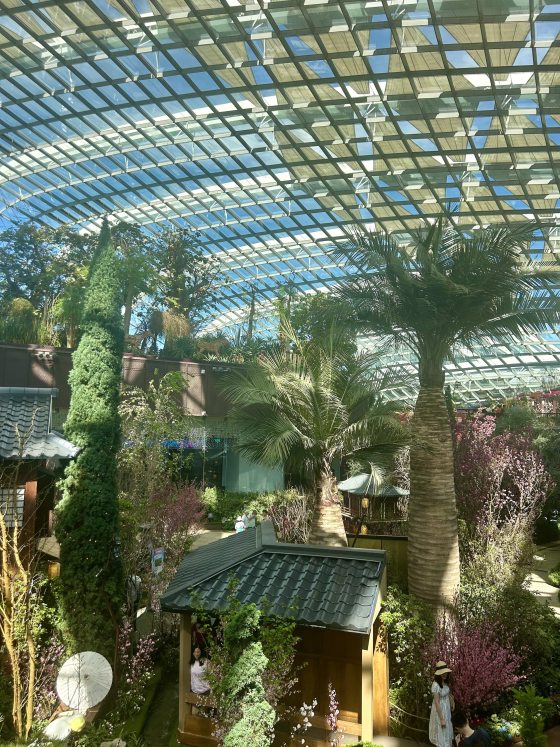
The Flower Dome. Photo by Lauryn McMiller.
Our next botanical destination was Singapore Botanic Gardens, which spans more than 200 acres of tropical landscape. It has been designated as a UNESCO World Heritage Site because of its global historic significance and its conservation contributions.
The National Orchid Garden is one of the most recognizable parts of the garden and features thousands of orchid species and hybrids. Orchids are an important part of Singapore’s horticultural identity, as their national flower is the Vanda ‘Miss Joaquim’. The sheer versatility and variety of orchids was outstanding to witness. All the different colors, shapes, and whether they were ground-bound or epiphytic, was fascinating to see. Our guide informed us that many of the cultivars are named after notable people, some of whom have visited the gardens. This includes world leaders, celebrities, and cultural figures. Vanda ‘Class of 2026’ anyone?
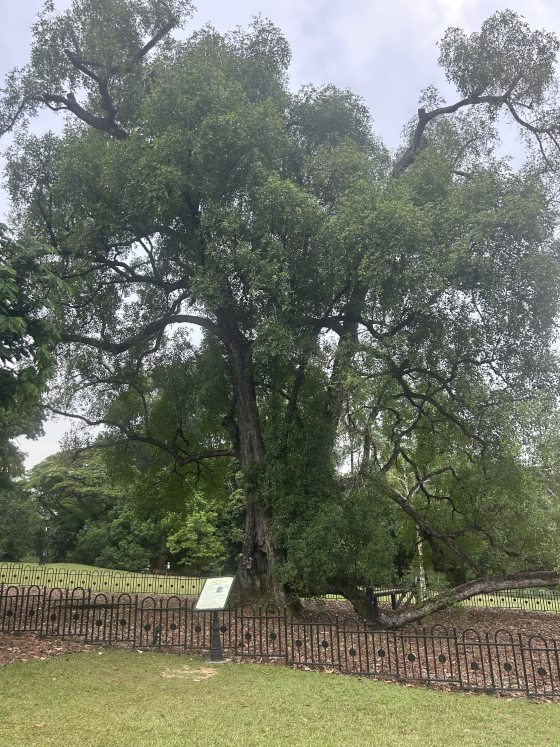
One standout moment from this visit was seeing the Tembusu tree (Fagraea fragrans). Estimated to be more than 150 years old, it has a distinctive silhouette and is featured on the back of the Singapore five-dollar note. The tree is fenced off for protection, and it felt very grounding to experience such a long-standing symbol of the city-state. Photo by Lauryn McMiller.
I was stunned at the garden’s herbarium, which holds about 800,000 plant and fungal specimens, some dating back to the 1800s. It was incredibly extensive, along with their library. There was even a conveyor belt of dried specimens being filed away for future reference. Specimens are used for things like taxonomy, tracking biodiversity changes, and conservation research. The library holds more than120,000 items, including books, journals, maps, and notes. We were shown some of the most well-preserved and rare field notes, and I was amazed at how detailed the illustrations of their findings were.
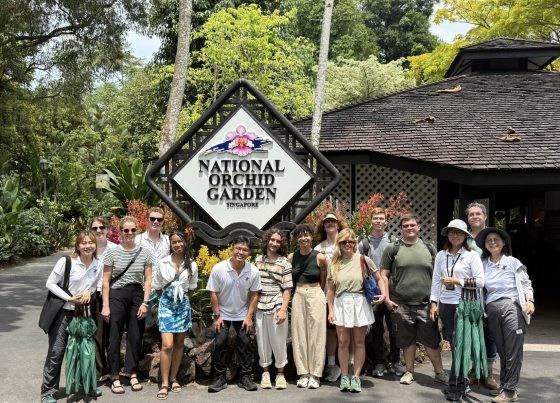
The Professional Horticulture Program class at the National Orchid Garden at Singapore Botanic Gardens. From left: Singapore Botanic Gardens Manager, Living Collections Jolene Sim; Professional Horticulture Students Ellie Schlehr; Longwood Domestic & International Studies Manager Lauren Hill; Professional Horticulture Students Michah High and Lauryn McMiller; National Orchid Garden Singapore Manager Jeremy Yeo; Professional Horticulture Students Joshua Ferris, Melanie De La Cruz, Logan Kline, Rachael Adams, Travis Cox, and Matthew Fleishhacker; Singapore Botanic Gardens Deputy Director Rebecca Tan; Longwood Associate Vice President of Conservatories Chad Davis; and National Orchid Garden Singapore Curator Whang Lay Keng.
Next, we visited Jurong Lake Gardens, which was designed as a people’s garden and is situated in the residential part of the city. Jurong is built around a freshwater lake and includes a traditional Chinese and Japanese Garden, and a Lakeside Garden. Within the Chinese Garden was a robust bonsai collection, which was special to us because we were able to create our own chrysanthemum bonsai at Longwood as part of the program. The Japanese Garden featured a waterlily pond and a stunning wooden viewing deck. It was incredibly serene, and pictures really don’t capture how stunning this area really was. It was hard to get our class to leave this section.
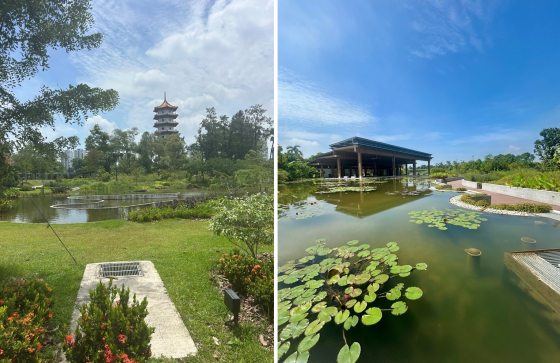
Left, the Chinese Garden at Jurong Lake Gardens. Right, the Japanese Waterlily Court at Jurong Lake Gardens. Photos by Lauryn McMiller.
I was impressed with how the caretakers of this garden were able to curate such a different feel than Gardens by the Bay and Singapore Botanic; it truly did feel like a residential garden intended for locals. Perhaps it was the extensive open lawn space for communal gathering or the walking trails. Perhaps it was the fact that it was built around Jurong Lake, a lake that historically provided fishing grounds and space for plantations for natives of the region. Whatever it was, it felt like a true peek into Singaporean culture to walk these grounds
Singapore is serious about its incorporation of gardens into everyday city life. They often incorporate biophilic design in their architecture; a design approach that blends nature into the built environment for the purpose of improving human well-being. PARKROYAL COLLECTION Pickering is an upscale hotel in downtown Singapore. It integrates around 15,000 square meters of greenery, which is significant because it essentially replaces the footprint of the lost ground level for construction with vertical greenery. The façade of the building mimics the winding shapes of rice terraces (a cultivated landscape originating in Southeast Asia) and is filled with plantings of palms and other herbaceous tropicals. These areas are accessible for walking, and we were given an impromptu tour by request.
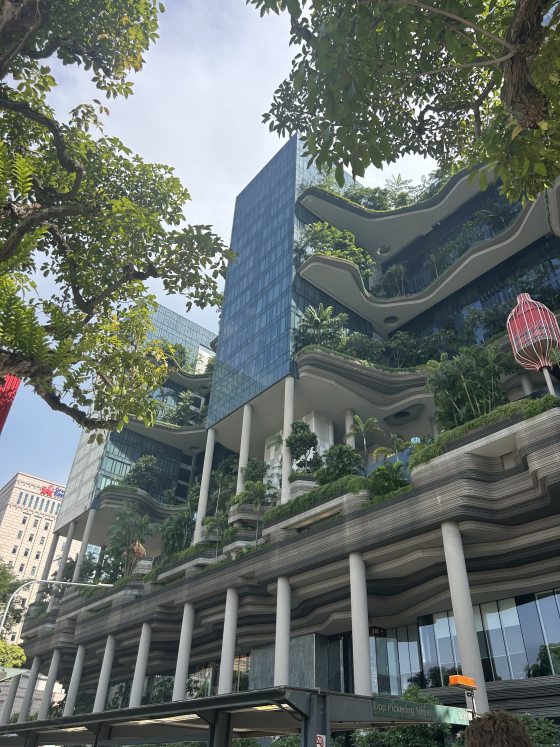
PARKROYAL Pickering Hotel façade. Photo by Lauryn McMiller.
One of my personal favorite visits was to CapitaSpring, which is a mixed-use building and one of the tallest in all of Singapore. It features a stunning multi-level open-air garden that appears to be digitally altered, even though you are looking at it with your eyes. There are five floors of these gardens, and they feature seating areas, a gym, and overlook areas.
Atop CapitaSpring is a rooftop edible garden with a breathtaking view of the city. The garden contains herbs, fruits, vegetables, and edible flowers, some of which are used in the dining venues within the building. Winding paths provided a 360-degree view of the city, and ample seating areas provided spaces to truly immerse oneself in this sky garden.
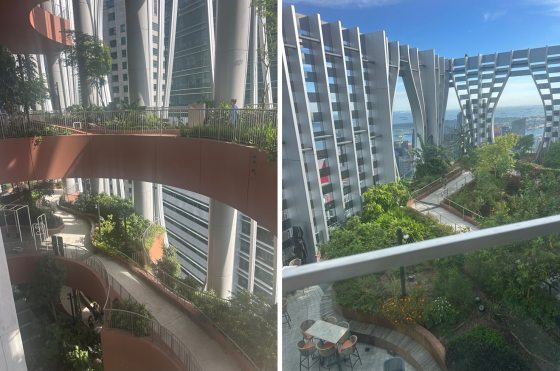
Left, the CapitaSpring open-air garden. Right, the CapitaSpring edible sky garden. Photos by Lauryn McMiller.
One of the most well-known sites in Singapore is accessible the moment you step foot into the city-state. For many, airports can be a place of anxiety, discomfort, and hurriedness. Changi Airport challenges this notion with features that inspire, calm, and lift the spirit. The airport is divided into sections, but the main attractions lie in the ‘Jewel’ section. This is where the highly photographed Rain Vortex—the world’s tallest indoor waterfall—is located. Apart from being visually hypnotic, it increases humidity and cools the surrounding air, where several floors of plantings can benefit. The Jewel also houses a number of other gardens, including floral displays and garden trails.
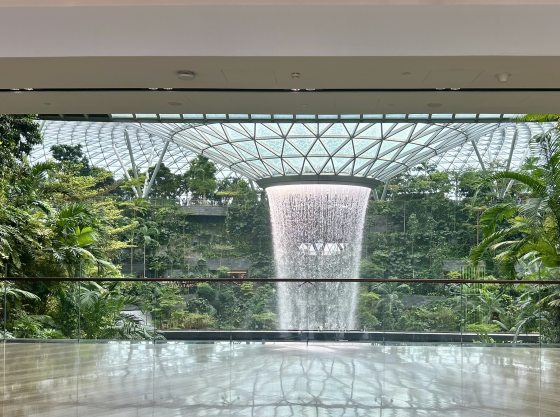
The Changi Airport Rain Vortex. Photo by Lauryn McMiller.
One of the best things about this trip was that we were able to experience so many different locations. Sure, Singapore has its futuristic locations, but it also contains unique natural landscapes that have remained largely untouched. Pulau Ubin is a small island off the northeastern coast of Singapore with unpaved roads, village homes, and pristine wetlands and forests. We travelled via ferry to the island and rented bikes to make our way around the island.
This day felt the most like a true journey as we rode together, stopping to hike to the top of overlooks and to purchase fresh coconuts from native vendors along the way. The island contains hundreds of native plant species and we were able to trek through some of Singapore’s largest remaining mangrove systems. We encountered thick roots above ground stabilizing trees in the shifty mud, noticed the smell of sulfur in the air due to nutrient cycling, and watched the tide flow in and out. These mangroves protect the coastlines as they capture sediment and create habitat for fish crab and shrimp, all of which we saw from our bridge vantage point.

The Professional Horticulture Program class of 2026, along with Longwood Associate Vice President of Conservatories Chad Davis (far left) and Longwood Domestic & International Studies Manager Lauren Hill (far right) take the ferry to Pulau Ubin. Photo provided by Lauryn McMiller.
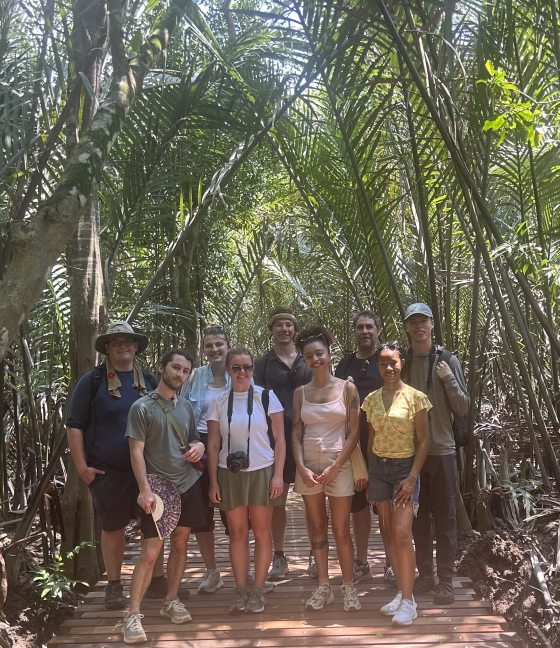
Mangrove forest at Pulau Ubin. Photo provided by Lauryn McMiller.
Our trip to Singapore was everything we imagined, plus more we couldn’t have expected. We are grateful to Longwood Associate Vice President of Conservatories Chad Davis and Domestic & International Studies Manager Lauren Hill who served as our guides, along with the plethora of Singaporean leaders who gave us a world-class experience in what it means to be a “City in a Garden”. Traveling to Singapore was a true honor, and one that we won’t soon forget. Taking our experiences into our future careers and life trajectory is what this program is all about, and who knows, maybe we’ll find ourselves back in this garden city, exploring what grows next.