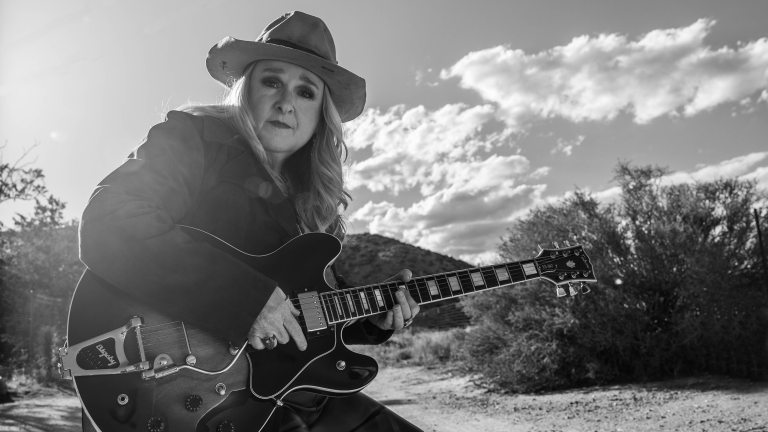
Join Grammy and Academy Award-winning rock icon Melissa Etheridge for an unforgettable evening as the legendary singer-songwriter performs and shares songs from her new studio album, Rise.
“I chose to survive,” Etheridge sings on Being Alive, the powerful, exuberant opening song of her 17th studio album, Rise. She then takes a pause, the flurry of her guitar and her bandmates’ boisterous sounds fading out, before she practically shouts, with unbridled joy: “God I love being alive!” The words say so much. But in that pause—just a few seconds long—it’s as if she’s looking at everything that has happened in her life in the time since she last released an album of new material, 2019’s The Medicine Show, and with it everything that is to come on this remarkable, emotional mosaic of songs. And it’s a lot.
Co-produced by Etheridge and Shooter Jennings (whose production credits include Brandi Carlisle, Tanya Tucker, Charlie Crockett and, of course, his father Waylon Jennings) and featuring her sharp band of guitarist and keyboard player Max Hart, drummer Eric Gardner, and bassist Erik Kertes, Rise soars as an intimate and richly realized collection.
At turns it’s celebratory and playful, as in the explosive Don’t You Want a Woman (picked as the official rally song of the Kansas City Current professional women’s soccer team) and Tomboy (reclaiming the term as a badge of pride), both punctuated by Etheridge’s hearty laugh. There’s Matches, a frisky ode to the guitars that sparked her musical passion as a kid, steeped in the spirit of childhood hero Johnny Cash. There’s the lusty honky-tonker Davina, its singalong chorus sounding as if it could have been recorded in a raucous saloon. And there’s If You Ever Leave Me, which starts with Etheridge cruising down Melrose in the 80s after first arriving in L.A., but goes on to glory in her marriage with Linda Wallem. “If you ever leave me, I’m coming too,” she sings, with another burst of laughter.
At others it’s contemplative, most profoundly and movingly in Call You, her deeply affecting account of living in the wake of the opioid death of her son, Beckett, in 2021. In it she looks deep in her soul and cherishes the strengthening embrace of family, friends, and community. This also filters through The Other Side of Blue, a light-in-the-darkness anthem co-written and co-sung with Chris Stapleton. And at the end of the album, she shines in the warmth of More Love, written for and sung at her daughter Bailey’s wedding last fall. Ultimately, it’s an album of acceptance and resilience.
The time between albums brought about a lot of personal exploration. Unable to tour during the pandemic, she turned to streaming with more than 200 episodes on Etheridge TV, featuring songs (a lot of cool covers), stories, and answers to fan questions. That all took on extra dimensions after Beckett’s death. She channeled her grief into her memoir Talking to My Angels. And she triumphed on Broadway with her one-woman show Melissa Etheridge: My Window, which The New York Times praised for its “striking intimacy, as if Etheridge had shrunk an arena to fit in the palm of her hand.”
She also founded the Etheridge Foundation to explore and promote plant-based treatments for illness, a long-standing passion since her own experience with breast cancer—and addiction. She dialogued with and performed a concert for women incarcerated at the Topeka Correctional Facility, resulting in the 2024 Paramount+ two-part docuseries I’m Not Broken. And when she returned to the road she went all out, with tours in North America and Europe, including a long-awaited co-headlining trek with the Indigo Girls. And through it all, she focused on her family.
The one thing she did not do for much of that time was write new songs. That changed in late 2024. “I just started gathering things,” she says. “I was thinking about losing my son. What was that like. Finding my own strength, being in a solid marriage relationship and with my family. Just feeling solid and wanting to sing about that experience, wanting to sing about being okay, and being okay with being okay, and showing that everything changes. And you survive. You go on. And this is life.”
Melissa Etheridge will donate two dollars ($2.00) from each ticket sold to benefit her nonprofit charitable organization, the Etheridge Foundation. Etheridge Foundation is on a mission to end the opioid crisis by funding new research on transformative plant medicines and innovative therapies that address the root causes of opioid use disorder. We work to advance groundbreaking treatments that both treat opioid dependence and help heal the underlying wounds that lead to addiction. To learn more about the Etheridge Foundation, visit etheridgefoundation.org