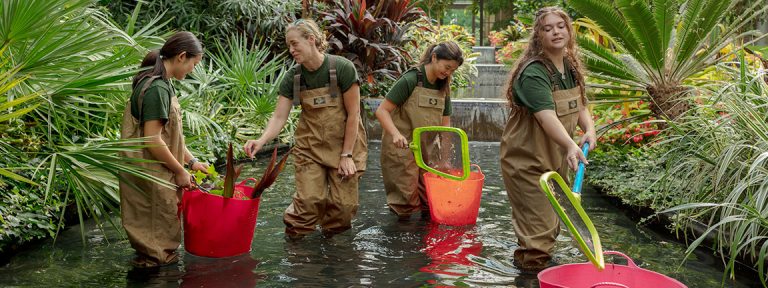
Learning by doing is an important tenet in our program. Students spend hands-on time every week in the Gardens with our expert horticulture staff, applying concepts learned in the classroom and experiencing the unique challenges of each season. In fact, time spent working hands-on in the Gardens represents about half of the total program requirements.
Students engage in informative, comprehensive courses taught by Longwood staff and regional faculty, as well as participate in learning activities, including field trips to regional gardens, conferences, and symposia; lectures; and/or self-guided study. Classes are taught at the collegiate level and articulate to regional colleges and universities. Program alumni interested in continuing their education after completing the Professional Horticulture Program can apply their program learning towards a degree at select outside institutions.
Learn More About Each Component
-
Professional Horticulture Program coursework includes:
- Current Issues in Horticulture
- Entomology
- Fruit and Vegetable Culture
- Fundamentals of Soil Science
- Fundamentals of Landscape Design
- Growing in Controlled Environments
- History and Theory of Landscape Design
- Introduction to Trees
- Landscape Design and Construction
- Plant Ecology & Sustainable Practices
- Plant Pathology
- Plant Propagation
- Principles of Horticulture
- Turfgrass Management
PH students will spend at least 9 months in coursework over the course of their two years. These courses are intended to be a combination of traditional academic classes with practical hands-on experiences, as well as include experiential learning.
Foundations of Horticulture A course designed to teach the science of horticulture in relation to plant taxonomy, nomenclature and plant records, plant anatomy, reproduction, and plant physiology. This background in science will be applied to the study of plants in unique bioregions in the Mid-Atlantic area to understand the adaptations of plants to their environment and how this relates to gardening practices. Students will better understand the growth, development, reproduction, and environmental adaptations that plants have and use this knowledge in horticultural practices. Soil Science & Water Management The course offers practical knowledge of soil science, plant nutrition, and integrated water management, including how to interpret soil tests. Growing in Controlled Environments Introduces students to the management of a greenhouse and the manipulation of its environment to support plant growth. In addition, students will learn introductory crop management practices such as container selection, root media selection, watering techniques, fertilization practices, and seed propagation. Students will solve problems and make decisions with respect to the production and sale of high-quality cut and potted crops. Fruit & Vegetable Culture Covers cultural requirements of a variety of fruit and vegetable crops with an emphasis on residential and landscape use and culture. This course is a combination of classroom and in-field instruction designed to support the success of a practical hands-on growing experience. History & Theory of Design Students will recognize and identify the key factors that influence how we understand the history of designed landscapes, as well as learn about key styles that have influenced the great gardens of the world. Fundamentals of Design Students will study the use of plant materials in landscape composition. The course combines spatial definition of various gardens with plant selection. This course places a heavy emphasis on landscape uses and four-season appearance of a group of ornamentally useful herbaceous and woody plants. Students will also design and budget their display gardens. The course teaches both hand drawing and design technology such as VectorWorks. Landscape Design & Construction Students will develop a basic framework for observing, analyzing, and creatively combining basic elements of garden design. Students learn basic construction skills needed in landscape designs by designing and constructing a seasonal garden installation in the Gardens. Students also will complete construction documentation, plant procurement, and interpretive material for their display gardens. Plant Propagation Students will study and practice the propagation of ornamental plants by asexual and sexual methods, including seed, cuttings, grafting, and micro-propagation. Entomology & Plant Pathology (Plant Health) Students will study the basic components of an integrated pest management (IPM) program. The biology of pest/beneficial insects and mites is presented. The biology of diseases is presented. The identification of biological control agents, abiotic/biotic diseases, and associated damage/symptoms/signs is taught. The identification of biological control agents, insect/mite pests in greenhouses and urban landscapes, and associated damage/symptoms/signs is taught. Control recommendations for common pests and diseases are discussed. Plant Ecology & Sustainable Practices Students will study major conceptual issues and areas of current research in plant ecology, environmental analysis, and sustainable design with a focus on the preparation of ecologically based designs for individuals and communities. Topics include distribution and abundance of plant species, hydrology, habitats, ecotypes, animal/plant relationships, management techniques, and current ecological research on environmental issues such as climate change and invasive species. Current Issues in Horticulture Seminar Seminar course discussing the impacts of climate change, including extreme weather events, water scarcity, and changing growing seasons, alongside concerns about sustainable practices, pest management, soil health, access to quality plant materials, and the need to develop new crop varieties better suited to changing environmental conditions.
-
Plant identification classes occur throughout the program. Classes may include:
- Tropical Plants
- Woody Plants
- Broad Leaf Evergreens
- Flowering Trees
- Conifers
- Deciduous Trees
- Summer Flowering Trees
- Herbaceous Plants
- Spring Annuals and Perennials
- Summer Annuals and Perennials
- Fall Annuals and Perennials
- Turfgrass
- Vines
- Grasses
- Invasive Weeds
- Aquatics
- Natives
-
In addition to their horticulture rotations and coursework, students have opportunities to apply what they have been learning through several signature elements that are distinctively Longwood:
Garden Practicum: Students will collect, plant, and care for ornamental plants while creating and maintaining a landscape design in an assigned plot. The practicum allows students an opportunity to grow a wide variety of plants, learn valuable horticultural skills, and showcase their creative talents. In addition to the garden plot, each student will be provided with a container and will plant the container seasonally. Students are required to label all plant material in their plots and maintain their plots and containers using good horticultural practices for two years.
Student Plant Sales: The plants that students grow as part of their opportunity that provides students with hands-on growing experience in which they work together as a team, sell the plants that they grow, and educate the public about their work and program. In addition to practical hands-on growing experience, Student Plant Sales also provide students with entrepreneurial, business acumen, and guest engagement skills.
Student Exhibition Gardens: provides students with an authentic, project-based learning experience of design through installation and maintenance of a seasonal display garden within the Gardens on view to the public in the IDEA Garden. Students will work in teams to maintain their own ornamental display gardens throughout the growing season and communicate through interpretative material. This interdisciplinary experience provides students experience with horticultural management, teamwork and leadership, procurement, design, maintenance, budgeting, and interpretation at a public garden.
Red Lion Row Farm: Red Lion Row Farm is a project associated with the Fruit and Vegetable Culture course that provides hands-on experience for students to grow their own vegetable garden, harvest on a regular weekly schedule, and sell their produce to be used by chefs in 1906. In addition to practical hands-on experience, Red Lion Row Farm also provides students with entrepreneurial and business acumen skills.
-
PH students will spend 9 months in hands-on horticulture rotations working alongside Longwood Gardens horticulture staff. Students will work four days per week embedded within three horticulture teams, working with each for three months. Additionally, students learn garden operations by participating in weekend duty and snow operations. As a member of each horticulture team, students will have the opportunity to attend staff meetings, planning and design meetings, as well as be mentored and taught by horticulture staff. Students will also obtain a Pennsylvania Pesticide License, as well as be trained on a variety of equipment and tools.
Outdoor Landscapes Students maintain herbaceous and woody plants in several sections of the Gardens. Duties include planting, weeding, mulching, watering, pruning, staking, and fertilizing. Students may work with woody plants, herbs, bulbs, ground covers, roses, vegetables, and fruits in some of Longwood’s most intensively cultivated areas. In addition, students may prepare trees and shrubs for transporting from the nursery to the display area by hand digging, ball-and-burlapping, or using a tree spade. Conservatory Display Students work on seasonally changing displays, including annuals, perennials, tropical plants, and bulbs. Students may work with palms, aquatics, orchids, bananas, roses, ferns, succulents, bonsai, espaliered fruit, and Mediterranean flora. Duties include grooming, planting, and maintaining plant displays. Greenhouse Production Students gain greenhouse experience in propagation, pruning, and general care of ornamental plants for use in the Longood Gardens displays. Assignments include potting and transplanting seedlings, cuttings, bulbs, and mature plants as well as pinching, tying, and preparing plants for display.
-
Students participate in one of three tracks with opportunities for further specialization within each track. Students engage in a capstone project and presentation tied to their specialization at the end of the experience.
Specializations include: outdoor gardens, under glass, conservation and stewardship, or you can create your own.
-
To best prepare Pro Hort students when they graduate, students will build their professional network and skills over the two years by:
- Build soft skills to be a confident professional, such as public speaking, budgeting basics, software tools, career readiness, written communications, public garden management, and more
- Having a dedicated mentor to help them in their journey while at Longwood and beyond
- Attending conferences and symposia, like the Today’s Horticulture Symposium, the Woody Plant Conference, and the Perennial Plant Conference
- Monthly field trips to regional gardens and meeting the professionals who care for them
- Meet and engage with Pro Hort alumni